

pro $24.99 per month
- access to all Manning books, MEAPs, liveVideos, liveProjects, and audiobooks!
- choose one free eBook per month to keep
- exclusive 50% discount on all purchases
- renews monthly, pause or cancel renewal anytime
lite $19.99 per month
- access to all Manning books, including MEAPs!
team
5, 10 or 20 seats+ for your team - learn more
Look inside
"Rigorous, curious, quietly funny, and extraordinarily generous with hard-won insight."
—Scott Hanselman, Microsoft
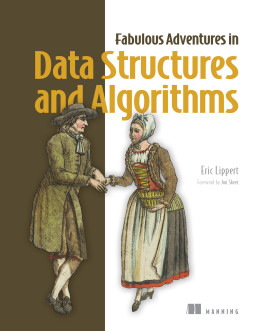
Fabulous Adventures in Data Structures and Algorithms invites you to step off the beaten path and explore interesting, unfamiliar, and even exotic algorithms that will challenge your perspective and elevate your code. Legendary language designer Eric Lippert guides you with a refreshing, conversational approach, providing beautifully practical examples that highlight the recurring patterns behind stubborn coding problems.
You’ll begin with a fresh look at foundational, thread-safe, and persistent immutable data structures. Lippert demystifies stacks, queues, and finger-tree deques, illustrating how to manage memory efficiently through persistence. For developers working in highly concurrent, cloud native environments, these patterns will help you eliminate hard-to-spot race conditions and state-mutation bugs.
Your fabulous adventure then turns to structural search, compiler design, and the integration of functional programming within mainstream object-oriented languages. You’ll dive into Directed Acyclic Word Graphs (DAWGs), greedy pretty printers, and the complexities of tree unification. This section bridges theory and real-world tools, teaching you how to design highly modular compilers or robust static analysis engines and to write declarative, composable, and expressive APIs.
In the final leg of your journey, you’ll model randomness, statistical reasoning, and continuous probability—core concepts for AI and predictive analytics. Lippert introduces advanced Bayesian and monadic techniques, teaching you how to construct joint distributions and sample them using the powerful Metropolis algorithm. This statistical toolkit aligns perfectly with modern data-driven systems that need to make consistent, sound decisions under real-world uncertainty.
In the age of AI coding, implementation is becoming cheaper. AI can write code, but it cannot relieve developers of responsibility for understanding what the code means, why a given solution was chosen, how it will scale, and whether the problem has been framed correctly. This book develops exactly that judgment. It teaches the part that is becoming more valuable: recognizing, selecting, questioning, and evaluating the ideas behind implementations. It is an apprenticeship in computational taste, taught through unusual and memorable examples.
—Scott Hanselman, Microsoft
Fabulous Adventures in Data Structures and Algorithms invites you to step off the beaten path and explore interesting, unfamiliar, and even exotic algorithms that will challenge your perspective and elevate your code. Legendary language designer Eric Lippert guides you with a refreshing, conversational approach, providing beautifully practical examples that highlight the recurring patterns behind stubborn coding problems.
You’ll begin with a fresh look at foundational, thread-safe, and persistent immutable data structures. Lippert demystifies stacks, queues, and finger-tree deques, illustrating how to manage memory efficiently through persistence. For developers working in highly concurrent, cloud native environments, these patterns will help you eliminate hard-to-spot race conditions and state-mutation bugs.
Your fabulous adventure then turns to structural search, compiler design, and the integration of functional programming within mainstream object-oriented languages. You’ll dive into Directed Acyclic Word Graphs (DAWGs), greedy pretty printers, and the complexities of tree unification. This section bridges theory and real-world tools, teaching you how to design highly modular compilers or robust static analysis engines and to write declarative, composable, and expressive APIs.
In the final leg of your journey, you’ll model randomness, statistical reasoning, and continuous probability—core concepts for AI and predictive analytics. Lippert introduces advanced Bayesian and monadic techniques, teaching you how to construct joint distributions and sample them using the powerful Metropolis algorithm. This statistical toolkit aligns perfectly with modern data-driven systems that need to make consistent, sound decisions under real-world uncertainty.
In the age of AI coding, implementation is becoming cheaper. AI can write code, but it cannot relieve developers of responsibility for understanding what the code means, why a given solution was chosen, how it will scale, and whether the problem has been framed correctly. This book develops exactly that judgment. It teaches the part that is becoming more valuable: recognizing, selecting, questioning, and evaluating the ideas behind implementations. It is an apprenticeship in computational taste, taught through unusual and memorable examples.
what's inside
- Build highly efficient, thread-safe concurrent systems using immutable parts
- Compress massive data representation sizes using memoized quadtrees and DAWGs
- Solve complex compiler optimizations using unification and backtracking search
- Automate precise, mathematically sound decisions under real-world uncertainty
about the author
Eric Lippert has designed programming languages, compilers, and developer tools for Microsoft, Coverity, and Facebook. He was a key member of the C# language design team and writes at ericlippert.com.concepts explained in this book
- Performance is a measure of how effectively a person, process, model, or system achieves its objectives, including qualities such as output quality, speed, and resource efficiency.
- Amortized analysis bounds the total cost of a sequence of operations by distributing occasional expensive operations across the sequence.
- Recursion is a computational technique in which a definition or procedure refers to or invokes itself, directly or indirectly.
- A deque is a double-ended queue data structure that supports insertion and removal at both its front and back.
- Worst-case performance is the maximum resource usage or computational cost an algorithm or system can incur over inputs or conditions of a specified size or scope.
- A posterior probability or distribution represents the probability of an event, hypothesis, or unknown quantity conditional on observed evidence and prior information.
- Memoization is an optimization technique that stores results of computations with their inputs so later evaluations with equivalent inputs can reuse them without recomputation.
- A likelihood is the probability of observed data under a model, viewed as a function of the model’s parameters or candidate hypotheses.
Filled with real-life examples and unique experiences drawn from the author’s career journey. A true gem.
Goes well beyond the typical text on data structures and algorithms.
Succeeds in making advanced topics accessible without oversimplifying them.
Balances beautifully practical examples with theoretical knowledge in a way I have rarely seen.
A bit of knowledge explained by someone who understands it well and sees the practical side of it.
This book should be on every programmer’s bookshelf!
It’s informative, the writing is a breath of fresh air, and the author truly does take you on a fabulous adventure.
related titles
related titles






choose your plan
pro
monthly
annual
$24.99
$249.99
only $20.83 per month
- access to all Manning books, MEAPs, liveVideos, liveProjects, and audiobooks!
- choose another free product every time you renew
- choose twelve free products per year
- exclusive 50% discount on all purchases
- renews monthly, pause or cancel renewal anytime
- renews annually, pause or cancel renewal anytime
-
![Fabulous Adventures in Data Structures and Algorithms]() Fabulous Adventures in Data Structures and Algorithms ebook for free
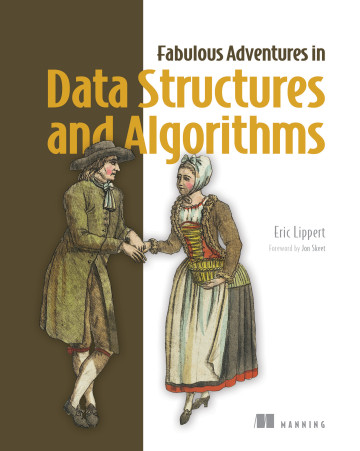 Fabulous Adventures in Data Structures and Algorithms ebook for free
team
monthly
annual
$49.99
$499.99
only $41.67 per month
- five seats for your team
- access to all Manning books, MEAPs, liveVideos, liveProjects, and audiobooks!
- choose another free product every time you renew
- choose twelve free products per year
- exclusive 50% discount on all purchases
- renews monthly, pause or cancel renewal anytime
- renews annually, pause or cancel renewal anytime
-
![Fabulous Adventures in Data Structures and Algorithms]() Fabulous Adventures in Data Structures and Algorithms ebook for free
choose your plan
pro
monthly
annual
$24.99
$249.99
only $20.83 per month
- access to all Manning books, MEAPs, liveVideos, liveProjects, and audiobooks!
- choose another free product every time you renew
- choose twelve free products per year
- exclusive 50% discount on all purchases
- renews monthly, pause or cancel renewal anytime
- renews annually, pause or cancel renewal anytime
-
![Fabulous Adventures in Data Structures and Algorithms]() Fabulous Adventures in Data Structures and Algorithms ebook for free
team
monthly
annual
$49.99
$499.99
only $41.67 per month
- five seats for your team
- access to all Manning books, MEAPs, liveVideos, liveProjects, and audiobooks!
- choose another free product every time you renew
- choose twelve free products per year
- exclusive 50% discount on all purchases
- renews monthly, pause or cancel renewal anytime
- renews annually, pause or cancel renewal anytime
-
![Fabulous Adventures in Data Structures and Algorithms]() Fabulous Adventures in Data Structures and Algorithms ebook for free
choose your plan
pro
monthly
annual
$24.99
$249.99
only $20.83 per month
- access to all Manning books, MEAPs, liveVideos, liveProjects, and audiobooks!
- choose another free product every time you renew
- choose twelve free products per year
- exclusive 50% discount on all purchases
- renews monthly, pause or cancel renewal anytime
- renews annually, pause or cancel renewal anytime
-
![Fabulous Adventures in Data Structures and Algorithms]() Fabulous Adventures in Data Structures and Algorithms ebook for free
team
monthly
annual
$49.99
$499.99
only $41.67 per month
- five seats for your team
- access to all Manning books, MEAPs, liveVideos, liveProjects, and audiobooks!
- choose another free product every time you renew
- choose twelve free products per year
- exclusive 50% discount on all purchases
- renews monthly, pause or cancel renewal anytime
- renews annually, pause or cancel renewal anytime
-
![Fabulous Adventures in Data Structures and Algorithms]() Fabulous Adventures in Data Structures and Algorithms ebook for free
