pro $24.99 per month
- access to all Manning books, MEAPs, liveVideos, liveProjects, and audiobooks!
- choose one free eBook per month to keep
- exclusive 50% discount on all purchases
- renews monthly, pause or cancel renewal anytime
lite $19.99 per month
- access to all Manning books, including MEAPs!
team
5, 10 or 20 seats+ for your team - learn more
Look inside
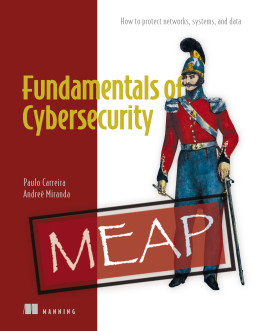
Whether you work in finance, HR, operations, or law, you need to understand the vocabulary, mental models, and practical judgments of cybersecurity. Fundamentals of Cybersecurity introduces cybersecurity fundamentals in plain English, with practical examples, clear illustrations, and real-world scenarios. Based on their experience teaching over 25,000 students, authors Paulo Carreira and Andreé Miranda Louraço align cybersecurity concepts with practical skills like recognizing a phishing attempt, knowing what to do when a staff member leaves, and understanding why a firewall rule matters.
You’ll start with the fundamentals: assets, threats, vulnerabilities, and how risk is identified, assessed, and treated. From there, you’ll work through security controls and defense in-depth, discover governance frameworks, and learn the full incident response lifecycle, business impact analysis, and disaster recovery. You’ll also dive into access control and understand networking from the ground up, and even understand the attacker’s playbook: malware, phishing, social engineering, on-path attacks, DoS, insider threats, and more.
The final chapters cover the security operations that hold everything together, from cryptography, to system hardening, to the awareness programs that turn employees into a first line of defense. Each chapter builds on the last, moving from core security principles, through risk and governance, into the operational disciplines that keep real organizations safe.
Best of all, the book follows the six knowledge domains of the ISC2 Certified in Cybersecurity (CC) exam, making it an ideal starting point for anyone pursuing their first credential. As an added bonus, full practice exams ensure that you’re ready to tackle the ISC2 and get fully certified in cybersecurity!
You’ll start with the fundamentals: assets, threats, vulnerabilities, and how risk is identified, assessed, and treated. From there, you’ll work through security controls and defense in-depth, discover governance frameworks, and learn the full incident response lifecycle, business impact analysis, and disaster recovery. You’ll also dive into access control and understand networking from the ground up, and even understand the attacker’s playbook: malware, phishing, social engineering, on-path attacks, DoS, insider threats, and more.
The final chapters cover the security operations that hold everything together, from cryptography, to system hardening, to the awareness programs that turn employees into a first line of defense. Each chapter builds on the last, moving from core security principles, through risk and governance, into the operational disciplines that keep real organizations safe.
Best of all, the book follows the six knowledge domains of the ISC2 Certified in Cybersecurity (CC) exam, making it an ideal starting point for anyone pursuing their first credential. As an added bonus, full practice exams ensure that you’re ready to tackle the ISC2 and get fully certified in cybersecurity!
what's inside
- The CIA triad, risk assessment, and governance frameworks
- Identity, authentication, authorization, and physical access controls
- Networking fundamentals, common attacks, and layered defensive controls
- The full incident response, business continuity, and disaster recovery lifecycle
- Two complete ISC2 CC practice exams
about the reader
For HR, finance, legal, operations, and IT professionals who need to understand cybersecurity to do their jobs well—and for anyone considering cybersecurity as a career.about the authors
Paulo Carreira, PhD, is Associate Professor of Information Systems at Instituto Superior Técnico, University of Lisbon, and holds the CISSP, ISO 27001, ISO 27701, and IAPP Fellow of Information Privacy certifications.Andreé Miranda Louraço, MSc, is a Cybersecurity Manager who leads the global security awareness program for one of the world’s largest energy drink brands, spanning more than 180 countries. He holds the CISSP and multiple information privacy management certifications.
related titles
related titles




choose your plan
pro
monthly
annual
$24.99
$249.99
only $20.83 per month
- access to all Manning books, MEAPs, liveVideos, liveProjects, and audiobooks!
- choose another free product every time you renew
- choose twelve free products per year
- exclusive 50% discount on all purchases
- renews monthly, pause or cancel renewal anytime
- renews annually, pause or cancel renewal anytime
-
![]() Fundamentals of Cybersecurity ebook for free
Fundamentals of Cybersecurity ebook for free
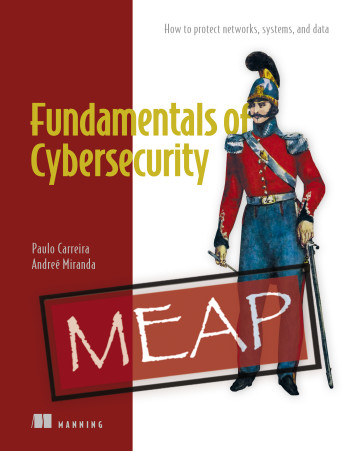 Fundamentals of Cybersecurity ebook for free
team
monthly
annual
$49.99
$499.99
only $41.67 per month
- five seats for your team
- access to all Manning books, MEAPs, liveVideos, liveProjects, and audiobooks!
- choose another free product every time you renew
- choose twelve free products per year
- exclusive 50% discount on all purchases
- renews monthly, pause or cancel renewal anytime
- renews annually, pause or cancel renewal anytime
-
![]() Fundamentals of Cybersecurity ebook for free
Fundamentals of Cybersecurity ebook for free
choose your plan
pro
monthly
annual
$24.99
$249.99
only $20.83 per month
- access to all Manning books, MEAPs, liveVideos, liveProjects, and audiobooks!
- choose another free product every time you renew
- choose twelve free products per year
- exclusive 50% discount on all purchases
- renews monthly, pause or cancel renewal anytime
- renews annually, pause or cancel renewal anytime
-
![]() Fundamentals of Cybersecurity ebook for free
Fundamentals of Cybersecurity ebook for free
team
monthly
annual
$49.99
$499.99
only $41.67 per month
- five seats for your team
- access to all Manning books, MEAPs, liveVideos, liveProjects, and audiobooks!
- choose another free product every time you renew
- choose twelve free products per year
- exclusive 50% discount on all purchases
- renews monthly, pause or cancel renewal anytime
- renews annually, pause or cancel renewal anytime
-
![]() Fundamentals of Cybersecurity ebook for free
Fundamentals of Cybersecurity ebook for free