pro $24.99 per month
- access to all Manning books, MEAPs, liveVideos, liveProjects, and audiobooks!
- choose one free eBook per month to keep
- exclusive 50% discount on all purchases
- renews monthly, pause or cancel renewal anytime
lite $19.99 per month
- access to all Manning books, including MEAPs!
team
5, 10 or 20 seats+ for your team - learn more
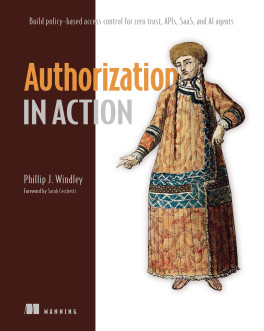
Look inside
"Covers every aspect of building dynamic authorization systems. No AI architect should be without it.”
—Drummond Reed, Co-author of Self-Sovereign Identity
Underlying all software security is access control: deciding who can get into a system and what they can do once they enter. Authorization in Action shows you how to streamline and automate access control by replacing static manually assigned permissions with a dynamic, Policy-Based Access Control (PBAC) model. Author and identity expert Phillip Windley frames authorization as a first-class citizen in your architecture and shows you how to use the intuitive Cedar policy language to integrate modern access control efficiently into both new and legacy applications.
Rather than relying on abstract theory, this practical guide uses the journey of a fictional corporation to demonstrate how policy-based access models succeed at scales where static models inevitably fail. You will watch the corporate systems transition from basic Access Control Lists (ACLs) to sophisticated, multi-tenant SaaS environments that include zero trust architectures, secure APIs, verifiable credentials, and AI agents. This single, continuous case study is grounded in famous real-world security collapses, such as the infamous Target data breach that illustrates the catastrophic consequences of weak authorization boundaries.
At the core of the book is the Cedar policy language, which makes it much easier to unify Role-Based (RBAC), Attribute-Based (ABAC), and Relationship-Based (ReBAC) access control into PBAC. The book describes typed schemas and how to write policies that are safe by construction, eliminating the common security risks of hard-coded runtime conditionals. As reviewer Michael Schleichardt of eHealth Experts GmbH points out, “By decoupling authorization logic from application code, you gain the ability to reduce operational overhead and adapt seamlessly to shifting regulatory compliance.”
Windley tackles cutting-edge security, including decentralized identity and AI. You’ll explore how to integrate cryptographically signed verifiable credentials using a “Trust Diamond” framework. Crucially, the book addresses agentic AI systems, introducing patterns like authorization before retrieval for Retrieval-Augmented Generation (RAG). Professor Yang Luo of Peking University notes, “This book provides excellent integration of real-world context, which makes dynamic decisions actually dynamic,” and ensures that LLMs operate strictly on authorized data.
Spanning 19 comprehensive chapters, Authorization in Action provides a complete roadmap from foundational access concepts to enterprise-level policy governance. The hands-on learning experience is deeply enhanced by practical appendices, including an end-to-end tutorial using Amazon Verified Permissions and live, executable agent demonstrations using the OpenClaw runtime. When you’ve finished, you’ll have mastered a battle-tested toolkit of reusable patterns ready to secure access dynamically to your APIs, microservices, and distributed cloud systems.
—Drummond Reed, Co-author of Self-Sovereign Identity
Underlying all software security is access control: deciding who can get into a system and what they can do once they enter. Authorization in Action shows you how to streamline and automate access control by replacing static manually assigned permissions with a dynamic, Policy-Based Access Control (PBAC) model. Author and identity expert Phillip Windley frames authorization as a first-class citizen in your architecture and shows you how to use the intuitive Cedar policy language to integrate modern access control efficiently into both new and legacy applications.
Rather than relying on abstract theory, this practical guide uses the journey of a fictional corporation to demonstrate how policy-based access models succeed at scales where static models inevitably fail. You will watch the corporate systems transition from basic Access Control Lists (ACLs) to sophisticated, multi-tenant SaaS environments that include zero trust architectures, secure APIs, verifiable credentials, and AI agents. This single, continuous case study is grounded in famous real-world security collapses, such as the infamous Target data breach that illustrates the catastrophic consequences of weak authorization boundaries.
At the core of the book is the Cedar policy language, which makes it much easier to unify Role-Based (RBAC), Attribute-Based (ABAC), and Relationship-Based (ReBAC) access control into PBAC. The book describes typed schemas and how to write policies that are safe by construction, eliminating the common security risks of hard-coded runtime conditionals. As reviewer Michael Schleichardt of eHealth Experts GmbH points out, “By decoupling authorization logic from application code, you gain the ability to reduce operational overhead and adapt seamlessly to shifting regulatory compliance.”
Windley tackles cutting-edge security, including decentralized identity and AI. You’ll explore how to integrate cryptographically signed verifiable credentials using a “Trust Diamond” framework. Crucially, the book addresses agentic AI systems, introducing patterns like authorization before retrieval for Retrieval-Augmented Generation (RAG). Professor Yang Luo of Peking University notes, “This book provides excellent integration of real-world context, which makes dynamic decisions actually dynamic,” and ensures that LLMs operate strictly on authorized data.
Spanning 19 comprehensive chapters, Authorization in Action provides a complete roadmap from foundational access concepts to enterprise-level policy governance. The hands-on learning experience is deeply enhanced by practical appendices, including an end-to-end tutorial using Amazon Verified Permissions and live, executable agent demonstrations using the OpenClaw runtime. When you’ve finished, you’ll have mastered a battle-tested toolkit of reusable patterns ready to secure access dynamically to your APIs, microservices, and distributed cloud systems.
what's inside
- Unify RBAC, ABAC, and ReBAC into a single PBAC framework
- Write secure, statically validated policies using the Cedar language
- Implement robust zero trust security controls across distributed microservices
- Authorize autonomous AI agents and protect sensitive RAG workflows
about the reader
For IT professionals, software architects, security engineers, and product managers who want to build secure, scalable systems.A comprehensive guide on the critical area of authorization.
Authorization is an old problem, but this book makes a solid case for revisiting it with fresh eyes.
Crisp, comprehensive, and practical—the guide practitioners need.
A tour de force on authorization, covering its history, evolution, relationship to other IAM systems as well as implementation recommendations.
A timely and useful book for anyone trying to build authorization that can keep pace with increasingly complex and autonomous systems.
Access control and authorization have never been more important than they are today. This book is a great reference to get started.
related titles
related titles


choose your plan
pro
monthly
annual
$24.99
$249.99
only $20.83 per month
- access to all Manning books, MEAPs, liveVideos, liveProjects, and audiobooks!
- choose another free product every time you renew
- choose twelve free products per year
- exclusive 50% discount on all purchases
- renews monthly, pause or cancel renewal anytime
- renews annually, pause or cancel renewal anytime
-
![]() Authorization in Action ebook for free
Authorization in Action ebook for free
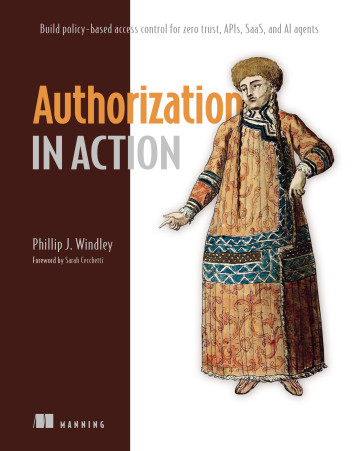 Authorization in Action ebook for free
team
monthly
annual
$49.99
$499.99
only $41.67 per month
- five seats for your team
- access to all Manning books, MEAPs, liveVideos, liveProjects, and audiobooks!
- choose another free product every time you renew
- choose twelve free products per year
- exclusive 50% discount on all purchases
- renews monthly, pause or cancel renewal anytime
- renews annually, pause or cancel renewal anytime
-
![]() Authorization in Action ebook for free
Authorization in Action ebook for free
choose your plan
pro
monthly
annual
$24.99
$249.99
only $20.83 per month
- access to all Manning books, MEAPs, liveVideos, liveProjects, and audiobooks!
- choose another free product every time you renew
- choose twelve free products per year
- exclusive 50% discount on all purchases
- renews monthly, pause or cancel renewal anytime
- renews annually, pause or cancel renewal anytime
-
![]() Authorization in Action ebook for free
Authorization in Action ebook for free
team
monthly
annual
$49.99
$499.99
only $41.67 per month
- five seats for your team
- access to all Manning books, MEAPs, liveVideos, liveProjects, and audiobooks!
- choose another free product every time you renew
- choose twelve free products per year
- exclusive 50% discount on all purchases
- renews monthly, pause or cancel renewal anytime
- renews annually, pause or cancel renewal anytime
-
![]() Authorization in Action ebook for free
Authorization in Action ebook for free