1 Introduction to Hugging Face
Hugging Face is presented as a vibrant open-source AI community that streamlines the building, training, and deployment of machine learning across natural language, vision, and audio tasks. Beyond tooling, it serves as a central hub for sharing models and datasets, accelerating the current AI wave by letting developers focus on solving real problems rather than reinventing foundational architectures. Its philosophy emphasizes openness and collaboration, enabling rapid application development and broad access to state-of-the-art capabilities.
A core pillar is the Transformers library, which provides pre-trained transformer models and a high-level pipeline API for tasks like sentiment analysis, named entity recognition, translation, summarization, and more—often in just a few lines of code. Complementing this, the Model Hub hosts a vast catalog of models that can be explored by task and architecture, many of which can be tried instantly in the browser via the Hosted Inference API or integrated directly into code with ready-made snippets. This ecosystem lowers barriers from experimentation to production, whether running in the cloud or locally.
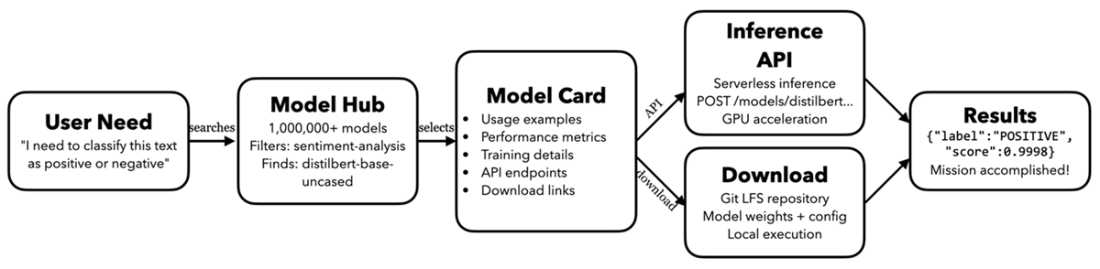
Gradio further simplifies adoption by turning models and functions into shareable, interactive web apps with minimal code, and it integrates seamlessly with Hugging Face Spaces for community-facing demos. The chapter also introduces a practical mental model for using the platform: start with a concrete need, discover a suitable model on the Hub, consult its Model Card, choose between hosted inference or local execution, and obtain results quickly. Looking ahead, the book previews advanced topics like building LLM applications with LangChain, visual prototyping with LangFlow, privacy-conscious deployments, tool-augmented agents, and connecting assistants to external data with MCP.
The result of the sentiment analysis

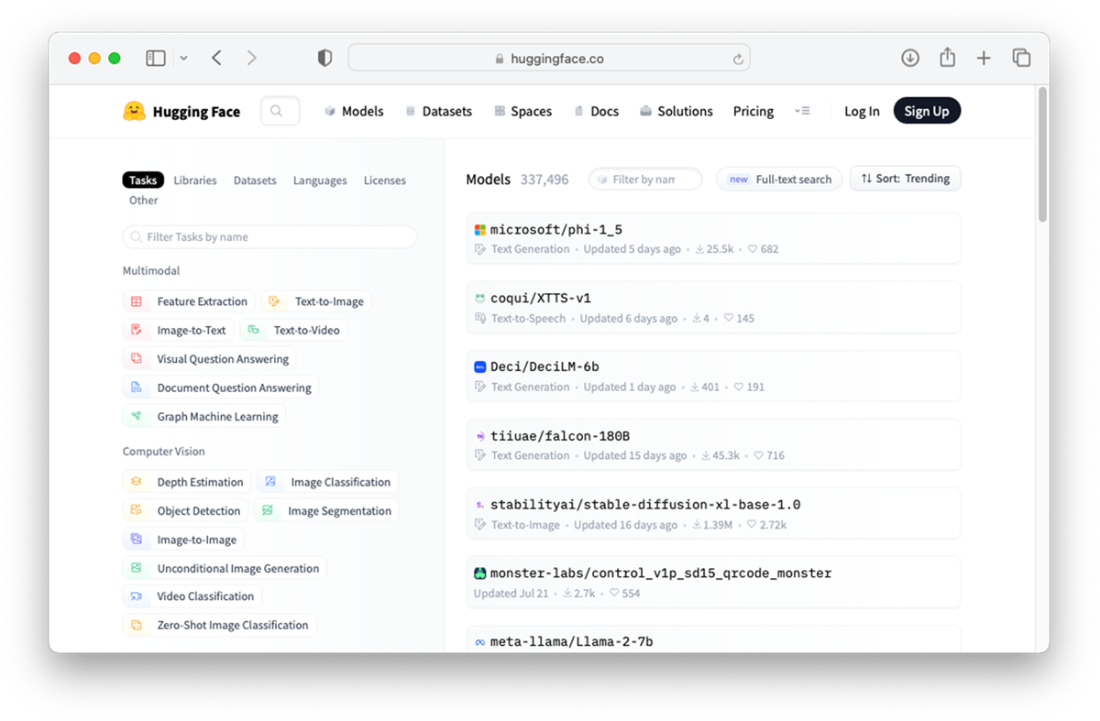
Exploring the pre-trained models hosted on Hugging Face hub
You can test the model directly on Hugging Face hub using the Hosted inference API

Performing object detection using my uploaded image

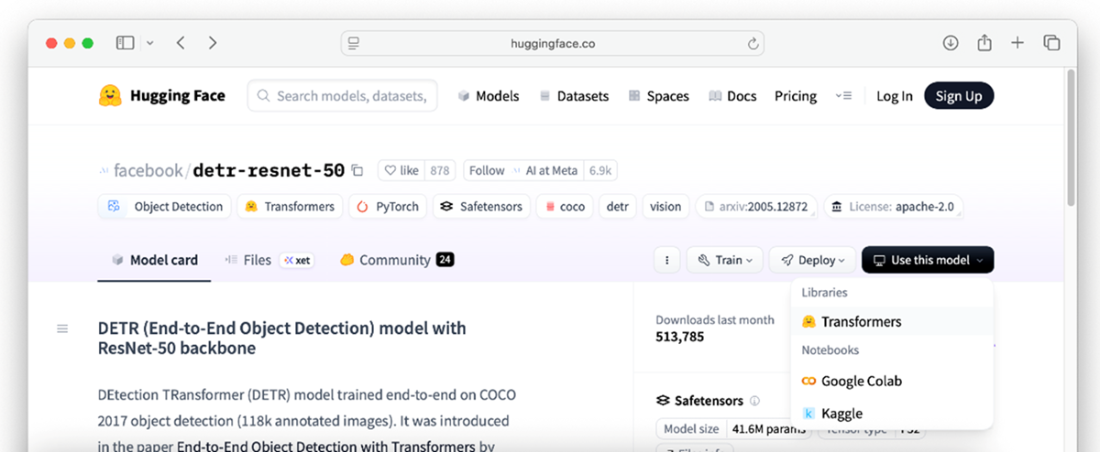
Locating the “</> Use in Transformers” button
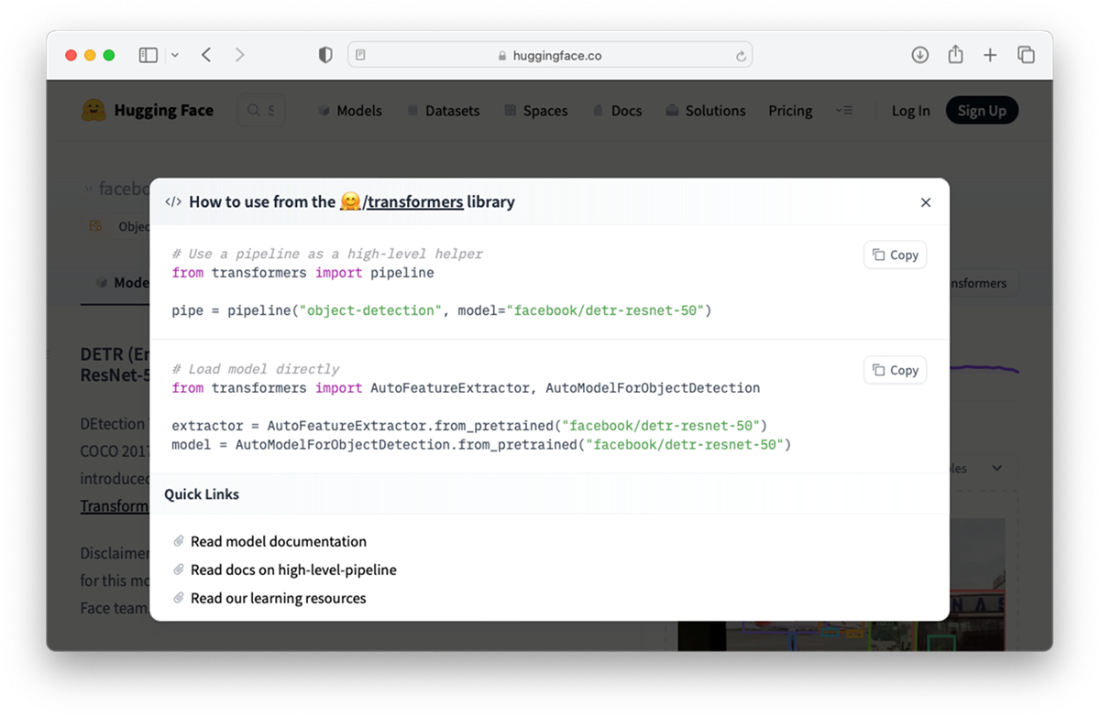
Using the model using the transformers library
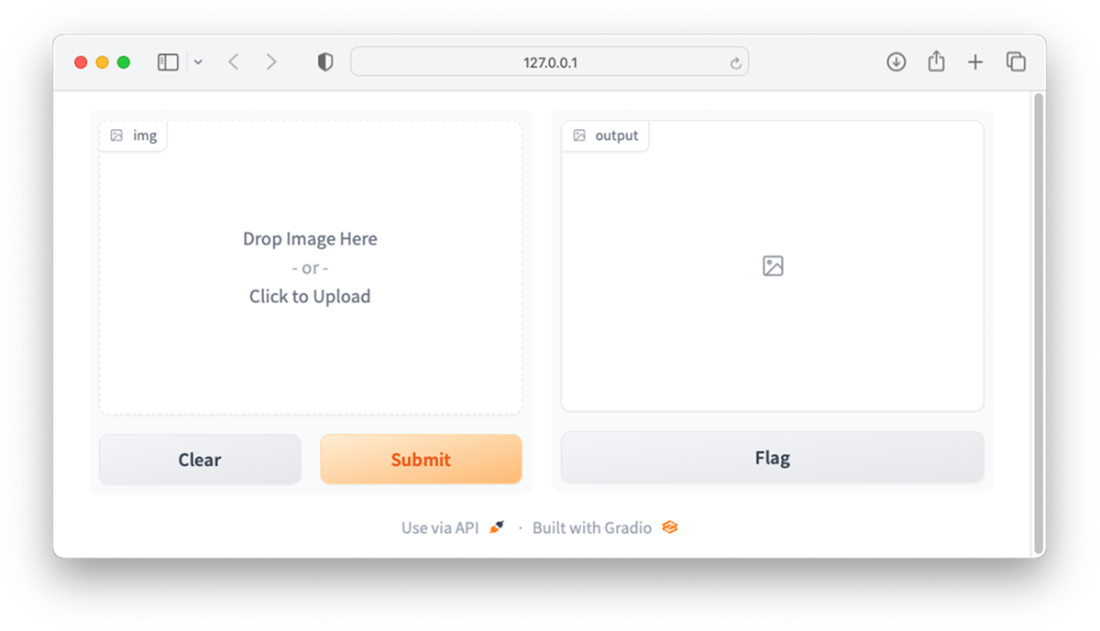
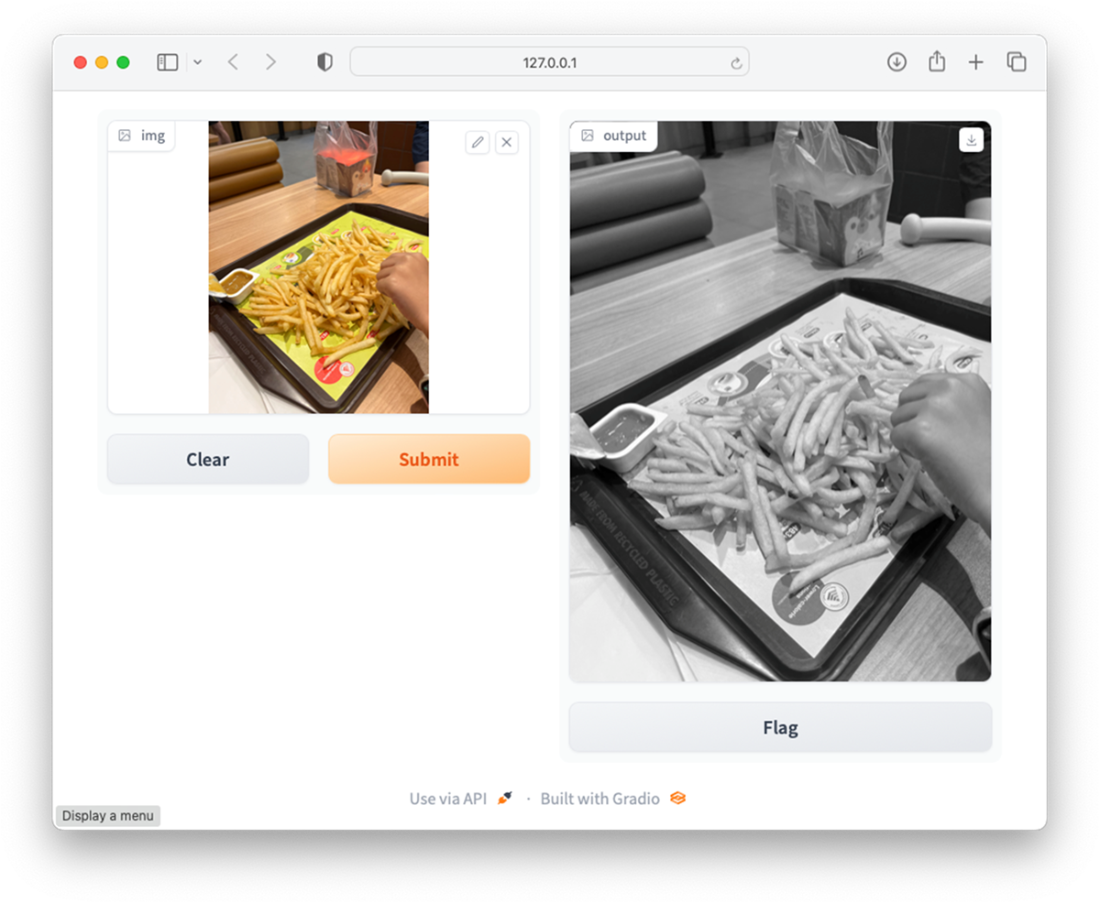
Gradio provides a customizable UI for your ML projects
Viewing the result of the converted image
A visual mental model showing Hugging Face’s core process
Summary
- The Transformers Library is a Python package that contains open-source implementation of the Transformer architecture models for text, image, and audio tasks.
- In Hugging Face's Transformers library, a pipeline is a high-level, user-friendly API that simplifies the process of building and using complex natural language processing (NLP) workflows.
- The Hugging Face Hub’s Models page hosts many pre-trained models for a wide variety of machine learning tasks.
- Gradio is a Python library that creates a Web UI that you can use to bind to your machine learning models, making it easy for you to test your models without spending time building the UI.
- Hugging Face isn’t just a model repository. It’s a complete AI problem-solving pipeline that systematically moves users from problems to solution.
FAQ
What is Hugging Face and what is it known for?
Hugging Face is an AI community and platform focused on building, training, and deploying open-source machine learning models. It’s known for the Transformers library, the Hub for sharing models and datasets, Spaces for hosting ML apps, and the Gradio library for rapid UI creation.What problems can Hugging Face models solve?
Hugging Face hosts state-of-the-art models for multiple domains, including natural language processing (e.g., sentiment analysis, translation), computer vision (e.g., object detection), and audio tasks.What is the Transformers library and why use it?
The Transformers library is a Python package with open-source implementations of Transformer-based models for text, image, and audio. It provides easy APIs and pre-trained models so developers can build applications without training models from scratch.What is a pipeline in Transformers?
A pipeline is a high-level API that streamlines common tasks—like text classification, named entity recognition, translation, and summarization—into a few lines of code, handling tokenization, model execution, and post-processing for you.How do I perform sentiment analysis with a few lines of code?
Use a text-classification pipeline with a pre-trained model, then pass your text to it, for example:from transformers import pipeline
classifier = pipeline("text-classification",
model="distilbert-base-uncased-finetuned-sst-2-english")
result = classifier("I loved the movie!")
What is the Hugging Face Model Hub and how do I find models?
The Model Hub lists over a million pre-trained models. You can search and filter by task, architecture, language, or metrics. Each model has a Model Card with usage examples, performance info, and code snippets.How can I try a computer vision model like facebook/detr-resnet-50 in the browser?
Open the model page on the Hub and use the Hosted Inference API widget to drag and drop an image. The model runs in the browser session on Hugging Face infrastructure and returns detected objects with confidence scores.What are the two main ways to run models from the Hub?
- Inference API: Send HTTP requests to Hugging Face’s hosted endpoints—no setup, auto-scaling, fast results.- Direct download: Pull model weights/configs (via Git LFS) and run locally using the Transformers library for full control.
What is Gradio and how does it help share models?
Gradio is an open-source Python library that creates web-based UIs for ML functions with minimal code. Users can upload inputs (text, images, audio) and see outputs instantly. It integrates seamlessly with Hugging Face Spaces for sharing apps.How do I wrap a Python function with a Gradio UI?
Create an Interface that binds your function to inputs and outputs, then launch it:import gradio as gr
def transform_image(img):
# return a processed image (e.g., grayscale)
...
demo = gr.Interface(fn=transform_image, inputs=gr.Image(), outputs="image")
demo.launch()

 Hugging Face in Action ebook for free