pro $24.99 per month
- access to all Manning books, MEAPs, liveVideos, liveProjects, and audiobooks!
- choose one free eBook per month to keep
- exclusive 50% discount on all purchases
- renews monthly, pause or cancel renewal anytime
lite $19.99 per month
- access to all Manning books, including MEAPs!
team
5, 10 or 20 seats+ for your team - learn more
Look inside
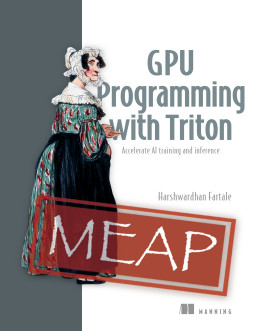
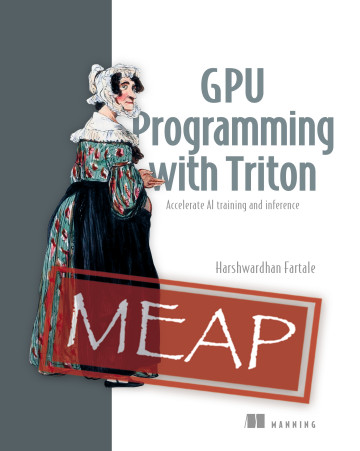
Until recently, writing GPU kernels for LLM training and inference meant learning low-level programming tools like CUDA and C++. Triton, an open source, Python-based DSL created by OpenAI, bridges the gap between high-level machine learning frameworks and low-level GPU programming. Triton is built into PyTorch 2 and backed by NVIDIA, Intel, AMD, and Red Hat.
In GPU Programming with Triton, you'll learn how to work within the Triton ecosystem, from writing your first kernel to implementing advanced LLM features like FlashAttention and Native Sparse Attention. You'll use Triton to deliver the kernel-level control, fusion power, and acceleration that frameworks like PyTorch need under the hood without dropping down to CUDA and C++.
In this practical book written for readers with no previous GPU programming experience, author Harshwardhan Fartale introduces Triton’s innovative block-level programming model that replaces the tedious manipulation of low-level threads required by CUDA. Written for the latest hardware and LLMs, this book teaches GPU programming and Triton together, in Python, by profiling real workloads, identifying bottlenecks, and understanding why each optimization (coalescing, tiling, shared memory, reductions, and fusion) actually works.
As you go, you'll build the kernels that power modern AI systems, including FlashAttention, Native Sparse Attention, sparse matrix multiplication, and on-chip fused operations. You'll learn to profile real workloads, find the bottlenecks, wrap your kernel for production, and integrate it end to end into PyTorch. Each chapter includes handpicked practice problems designed to build the fluency that makes working in Triton feel like second nature.
In GPU Programming with Triton, you'll learn how to work within the Triton ecosystem, from writing your first kernel to implementing advanced LLM features like FlashAttention and Native Sparse Attention. You'll use Triton to deliver the kernel-level control, fusion power, and acceleration that frameworks like PyTorch need under the hood without dropping down to CUDA and C++.
In this practical book written for readers with no previous GPU programming experience, author Harshwardhan Fartale introduces Triton’s innovative block-level programming model that replaces the tedious manipulation of low-level threads required by CUDA. Written for the latest hardware and LLMs, this book teaches GPU programming and Triton together, in Python, by profiling real workloads, identifying bottlenecks, and understanding why each optimization (coalescing, tiling, shared memory, reductions, and fusion) actually works.
As you go, you'll build the kernels that power modern AI systems, including FlashAttention, Native Sparse Attention, sparse matrix multiplication, and on-chip fused operations. You'll learn to profile real workloads, find the bottlenecks, wrap your kernel for production, and integrate it end to end into PyTorch. Each chapter includes handpicked practice problems designed to build the fluency that makes working in Triton feel like second nature.
what's inside
- Writing production-grade Triton kernels
- Core optimization techniques
- Building FlashAttention, Native Sparse Attention, and sparse matrix multiplication from scratch
- Profiling real workloads and integrating custom Triton kernels into PyTorch
- Reasoning about how GPUs actually execute your code
about the author
Harshwardhan Fartale is a researcher and engineer based in Bangalore, where he builds machine learning systems for scientific and defense applications. He has delivered courses in generative AI, machine learning, and MLOps to audiences ranging from university students to national research bodies.
related titles
related titles




choose your plan
pro
monthly
annual
$24.99
$249.99
only $20.83 per month
- access to all Manning books, MEAPs, liveVideos, liveProjects, and audiobooks!
- choose another free product every time you renew
- choose twelve free products per year
- exclusive 50% discount on all purchases
- renews monthly, pause or cancel renewal anytime
- renews annually, pause or cancel renewal anytime
-
![]() GPU Programming with Triton ebook for free
GPU Programming with Triton ebook for free
 GPU Programming with Triton ebook for free
team
monthly
annual
$49.99
$499.99
only $41.67 per month
- five seats for your team
- access to all Manning books, MEAPs, liveVideos, liveProjects, and audiobooks!
- choose another free product every time you renew
- choose twelve free products per year
- exclusive 50% discount on all purchases
- renews monthly, pause or cancel renewal anytime
- renews annually, pause or cancel renewal anytime
-
![]() GPU Programming with Triton ebook for free
GPU Programming with Triton ebook for free
choose your plan
pro
monthly
annual
$24.99
$249.99
only $20.83 per month
- access to all Manning books, MEAPs, liveVideos, liveProjects, and audiobooks!
- choose another free product every time you renew
- choose twelve free products per year
- exclusive 50% discount on all purchases
- renews monthly, pause or cancel renewal anytime
- renews annually, pause or cancel renewal anytime
-
![]() GPU Programming with Triton ebook for free
GPU Programming with Triton ebook for free
team
monthly
annual
$49.99
$499.99
only $41.67 per month
- five seats for your team
- access to all Manning books, MEAPs, liveVideos, liveProjects, and audiobooks!
- choose another free product every time you renew
- choose twelve free products per year
- exclusive 50% discount on all purchases
- renews monthly, pause or cancel renewal anytime
- renews annually, pause or cancel renewal anytime
-
![]() GPU Programming with Triton ebook for free
GPU Programming with Triton ebook for free
