pro $24.99 per month
- access to all Manning books, MEAPs, liveVideos, liveProjects, and audiobooks!
- choose one free eBook per month to keep
- exclusive 50% discount on all purchases
- renews monthly, pause or cancel renewal anytime
lite $19.99 per month
- access to all Manning books, including MEAPs!
team
5, 10 or 20 seats+ for your team - learn more
Look inside
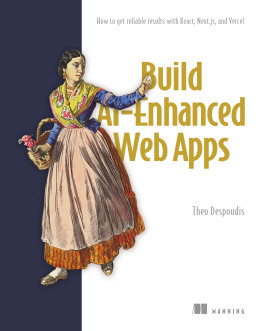
Effectively integrate AI using Large Language Models (LLMs) into your web apps and sites.
Build AI-Enhanced Web Apps shows you step-by-step and example-by-example how to build sites and applications that take advantage of large language models (LLMs) like GPT, Claude, and Llama. Written especially for web developers comfortable with React or Next.js, this book introduces the tools and techniques you need to add sophisticated AI features like Retrieval Augmented Generation (RAG), document summarization, chatbots, and more to your web-based projects.
In Build AI-Enhanced Web Apps you'll learn how to:
Build AI-Enhanced Web Apps guides you through AI development using only JavaScript and other common web dev skills–no Python or Machine Learning experience required. You’ll learn by working with full-scale AI projects that solve actual business problems. You’ll soon be delivering user-friendly, efficient interfaces that make the absolute best use of AI tech.
Build AI-Enhanced Web Apps shows you step-by-step and example-by-example how to build sites and applications that take advantage of large language models (LLMs) like GPT, Claude, and Llama. Written especially for web developers comfortable with React or Next.js, this book introduces the tools and techniques you need to add sophisticated AI features like Retrieval Augmented Generation (RAG), document summarization, chatbots, and more to your web-based projects.
In Build AI-Enhanced Web Apps you'll learn how to:
- Integrate AI models into React and Next.js applications
- Implement streaming responses and real-time AI interactions
- Manage conversation history and context in chat applications
- Implement LangChain.js for complex AI workflows and reasoning
- Build a web application for summarizing documents using LangChain.js
- Utilize Retrieval-Augmented Generation (RAG) systems for knowledge management
- Develop an AI-powered interview preparation system with voice feedback
Build AI-Enhanced Web Apps guides you through AI development using only JavaScript and other common web dev skills–no Python or Machine Learning experience required. You’ll learn by working with full-scale AI projects that solve actual business problems. You’ll soon be delivering user-friendly, efficient interfaces that make the absolute best use of AI tech.
about the technology
The users have spoken! Agents, personalized responses, and other LLM-powered features are required in modern web applications. Build AI-Enhanced Web Apps presents the end-to-end architecture of AI web apps, including UI, backend infrastructure, data processing, API integration, deployment, and scaling, with examples and language perfect for professional web developers.about the book
This accessible book shows you how to ship real AI features—not just toy demos—using a JavaScript stack you already know: React for UI, Next.js for backend integration, and the Vercel AI SDK to connect to LLMs like Gemini and GPT. In it, you’ll acquire the skills you need to complete two portfolio-ready projects: a voice-based interview assistant and a RAG-powered corporate knowledge system. You’ll also learn how to design workflows that balance latency, cost, and UX and implement responsible guardrails for security, quality control, hallucinations, and bias.what's inside
- Build AI features using a professional stack
- Ship production-ready features
- Learn from concrete projects
about the author
Theo Despoudis is a Senior Engineer at WP Engine specializing in AI-powered search and headless WordPress. He is an expert in integrating LLMs, RAG, and Vercel AI SDK into React and Next.js apps.concepts explained in this book
- Next.js is a React-based web application framework that provides features such as routing, rendering strategies, server-side capabilities, and build tooling.
- LangChain is an open-source software framework for building applications that compose language models with prompts, data sources, tools, and other components.
- Similarity search is a retrieval technique that finds or ranks items by their similarity to a query, often by comparing feature or vector representations under a similarity or distance measure.
- A pipeline is an ordered sequence of connected processing stages through which data or work flows, with each stage passing or transforming its output for subsequent stages.
- Stream processing is the incremental processing of data items as they become available, without requiring the complete dataset to be present first.
- A language model is a computational model that represents patterns in linguistic sequences to assign probabilities, predict, generate, or evaluate language.
- A rate limit is a constraint on the maximum frequency or volume of operations permitted within a defined interval or capacity.
- An embedding is a numerical vector representation of an item in a feature space, encoding selected properties or relationships for computational tasks such as comparison or retrieval.
A mind-blowing guide on building AI-powered apps.
Highly relevant for today’s advancement in the field of Generative AI.
Definitive, comprehensive, hands-on.
A thorough review of techniques and frameworks with practical examples.
Uses a clear, conversational tone while maintaining depth and rigor.
related titles
related titles





choose your plan
pro
monthly
annual
$24.99
$249.99
only $20.83 per month
- access to all Manning books, MEAPs, liveVideos, liveProjects, and audiobooks!
- choose another free product every time you renew
- choose twelve free products per year
- exclusive 50% discount on all purchases
- renews monthly, pause or cancel renewal anytime
- renews annually, pause or cancel renewal anytime
-
![Build AI-Enhanced Web Apps]() Build AI-Enhanced Web Apps ebook for free
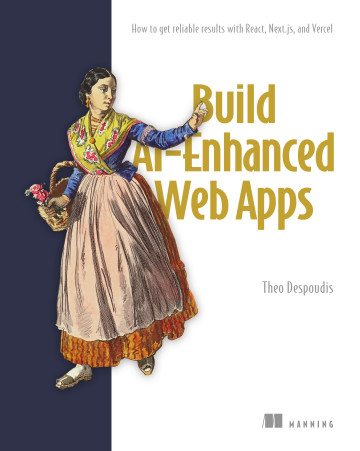 Build AI-Enhanced Web Apps ebook for free
team
monthly
annual
$49.99
$499.99
only $41.67 per month
- five seats for your team
- access to all Manning books, MEAPs, liveVideos, liveProjects, and audiobooks!
- choose another free product every time you renew
- choose twelve free products per year
- exclusive 50% discount on all purchases
- renews monthly, pause or cancel renewal anytime
- renews annually, pause or cancel renewal anytime
-
![Build AI-Enhanced Web Apps]() Build AI-Enhanced Web Apps ebook for free
choose your plan
pro
monthly
annual
$24.99
$249.99
only $20.83 per month
- access to all Manning books, MEAPs, liveVideos, liveProjects, and audiobooks!
- choose another free product every time you renew
- choose twelve free products per year
- exclusive 50% discount on all purchases
- renews monthly, pause or cancel renewal anytime
- renews annually, pause or cancel renewal anytime
-
![Build AI-Enhanced Web Apps]() Build AI-Enhanced Web Apps ebook for free
team
monthly
annual
$49.99
$499.99
only $41.67 per month
- five seats for your team
- access to all Manning books, MEAPs, liveVideos, liveProjects, and audiobooks!
- choose another free product every time you renew
- choose twelve free products per year
- exclusive 50% discount on all purchases
- renews monthly, pause or cancel renewal anytime
- renews annually, pause or cancel renewal anytime
-
![Build AI-Enhanced Web Apps]() Build AI-Enhanced Web Apps ebook for free
