Chapter 11. Streams and processes: working with infinite data
This chapter explores how to work with potentially infinite data in a dependently typed setting, contrasting ordinary batch-style functions with programs that must keep producing results over time. It explains that some useful computations are not meant to terminate in the usual sense, such as user interfaces, servers, and game loops, and that Idris distinguishes carefully between functions that terminate and functions that remain productive. The key idea is to separate data producers from data consumers so that infinite outputs can still be used safely by finite computations.
The first major topic is streams: infinite sequences that can be generated one element at a time and consumed only as far as needed. The chapter develops this idea through examples like labeling list elements with increasing numbers, building an infinite list type with delayed recursive calls, and using the Prelude’s stream type and helpers such as repeating values, taking prefixes, and iterating a function. Along the way, it clarifies why a recursive generator can still be total if it is productive, and uses that distinction to support examples like pseudo-random number streams and approximations for square roots.
The second major topic is interactive processes. The chapter shows how to model endlessly running programs as sequences of actions, first with an infinite I/O description and then with a more precise type that can also terminate cleanly. It introduces fuel to control how much of a process is executed, then refines the model with a quit constructor and later with a domain-specific command language that limits programs to console operations only. By the end, the chapter demonstrates that types can precisely describe whether a program is finite, infinite, or conditionally terminating, while still allowing readable do-notation and total definitions for realistic interactive applications.
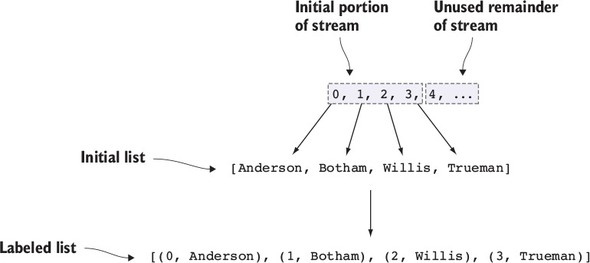
Figure 11.1. Labeling the elements of a List by taking elements from an infinite stream of numbers. The stream contains an infinite number of elements, but you only take as many as you need to label the elements in the finite list.

Summary
- You can generate infinite data using Inf to state which parts of a structure are potentially infinite.
- A total function either terminates with a well-typed input or produces a prefix of a well-typed infinite result in finite time.
- You can process infinite structures by using finite data to determine how much of the infinite structure to use.
- The Prelude defines a Stream data type for constructing infinite lists.
- You can define processes as infinite sequences of IO actions.
- To execute an infinite process, you define a function that takes an argument stating how long the process should run.
- The partial function forever allows processes to run indefinitely by generating an infinite amount of Fuel, using the Lazy type.
- By implementing (>>=), you can extend do notation for your own data types to make programs easier to read and write.
- You can mix finite and infinite structures within the same data type to define potentially infinite processes that may also terminate.
FAQ
```htmlWhat is the main idea behind using streams in this chapter?
Streams let you represent and process potentially infinite data one element at a time. This separates producing data from consuming only as much as needed, which is useful for tasks like labeling lists, generating random inputs, and building interactive programs.Why does a function like countFrom need to be treated differently from ordinary recursive functions?
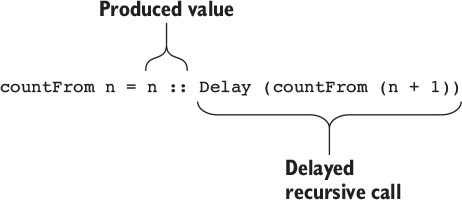
countFrom does not terminate, so it cannot be judged by ordinary termination alone. Instead, Idris checks that it is productive, meaning it always produces the next piece of output before making the recursive call.What is the difference between terminating and productive total functions?
A terminating total function always finishes and returns a result in finite time. A productive total function may run forever, but it must keep producing output in finite steps, such as an infinite stream or an infinite sequence of actions.Why does Idris use the Inf type for infinite structures?
Inf marks a value as potentially infinite, telling Idris to delay evaluation until it is explicitly forced. This allows infinite structures to be defined safely while still letting terminating functions consume only the finite portion they need.How do Delay and Force help with infinite data?
Delay postpones evaluation of a computation, and Force պահանջs the delayed value when it is actually needed. Together, they let Idris control exactly when the recursive part of an infinite structure is evaluated.What is the purpose of Stream in the Prelude?
Stream is the built-in infinite list type in Idris. It supports common operations such as repeat, take, and iterate, making it convenient for generating and consuming infinite sequences.How does labelWith separate label generation from list processing?
labelWith takes a Stream of labels and a finite List of values, pairing them element by element. This cleanly separates the creation of labels from the act of assigning them to list elements.Why is the arithmetic quiz implemented using a stream of numbers?
The quiz needs an endless supply of questions, so a stream provides a convenient infinite source of inputs. This makes it easy to generate questions on demand, whether from a simple count, a random number generator, or a bounded random stream.What is InfIO used for?
InfIO is used to describe potentially infinite interactive programs. It lets you write programs that keep producing IO actions indefinitely, such as a loop that repeatedly prints messages or asks quiz questions.Why does the chapter introduce Fuel and forever for running infinite processes?
Fuel gives a total way to limit execution so that run itself terminates. forever then provides an infinite supply of fuel, but it is marked partial, making it the only intentional source of nontermination in the design.
 Type-Driven Development with Idris ebook for free
