13 From foundations to frontier: OpenAI and the scaling laws of modern intelligence
Modern artificial intelligence is presented as the large-scale realization of ideas developed across probability, statistics, information theory, optimization, and machine learning. Rather than portraying recent AI progress as a clean break from earlier work, the chapter explains that systems such as large language models amplify long-standing principles: likelihood-based estimation, entropy and prediction, generalization, empirical learning, and distributed computation. Transformers and neural networks provide the architectures through which these ideas operate, but the major recent acceleration has come from applying them at unprecedented scale.
The chapter centers on Jared Kaplan and colleagues’ 2020 OpenAI study of scaling laws for neural language models. By training hundreds of transformer-based models while varying model parameters, training data, and training compute, the researchers found that prediction error declines according to smooth power-law relationships. This meant that performance gains were not random or purely accidental; they could be measured and partly forecast as systems grew. The chapter emphasizes that model size, data volume, and compute must be balanced: larger models need enough data and computation to use their capacity, while abundant data and compute are wasted if the model is too small. This insight helped shift modern AI toward an infrastructure-driven paradigm in which data centers, specialized processors, and large-scale training systems became central to progress.
Scaling also revealed that larger models can generalize better, use learned structure more flexibly, and develop capabilities not explicitly programmed into their training objective, such as summarization, translation, coding, question answering, and few-shot adaptation. These behaviors connect modern AI back to foundational thinkers such as Fisher, Shannon, Vapnik, Breiman, and MacKay, whose ideas about likelihood, information, generalization, ensemble behavior, and unified statistical learning remain deeply embedded in today’s systems. At the same time, the chapter warns that scaling is an empirical pattern, not an unlimited law of nature. Future progress may face constraints from compute, energy, cost, hardware, data quality, and diminishing returns, making the enduring lesson not simply that bigger systems work, but that modern AI is built from older principles expanded through massive computational scale.
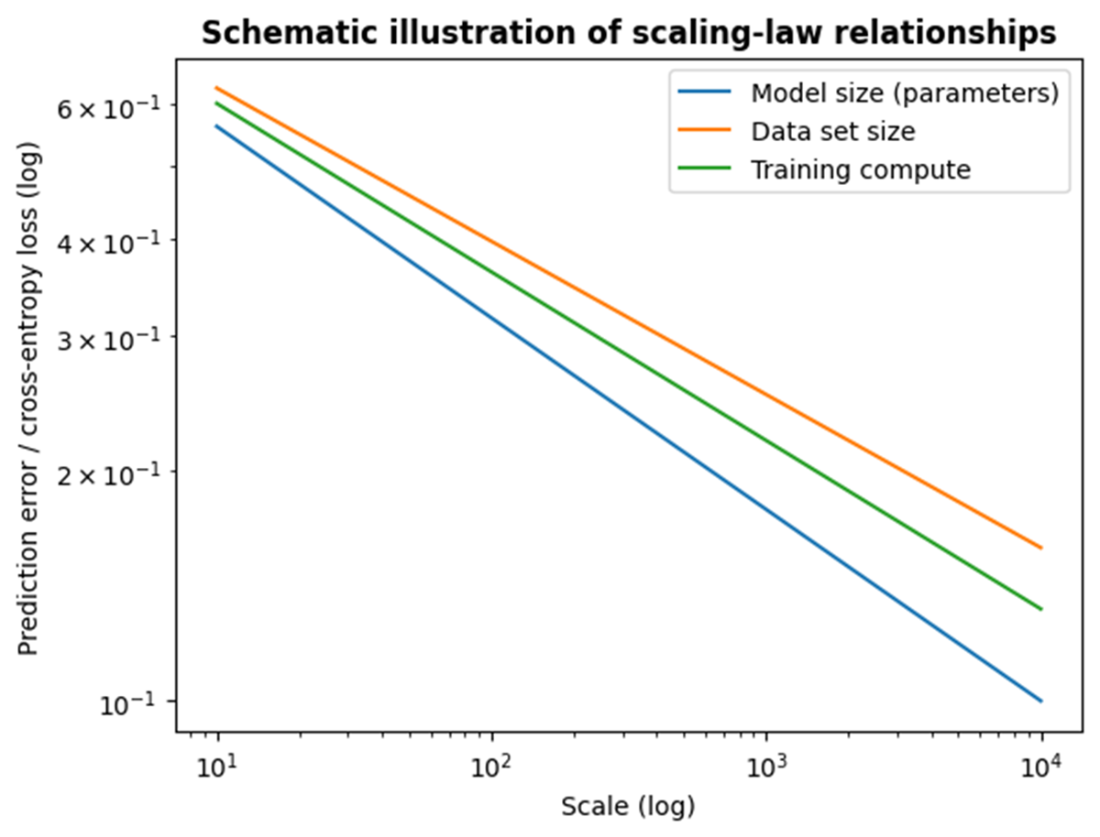
Schematic illustration of scaling-law relationships. Prediction error, measured as cross-entropy loss, decreases systematically as model size, data set size, and computational resources increase. Each curve represents a power-law relationship between performance and one of the primary scaling variables studied by Kaplan and colleagues. When plotted on logarithmic axes, these relationships appear approximately linear—a hallmark of power-law scaling behavior. The straight-line appearance on log–log axes indicates that performance changes follow stable scaling relationships across many orders of magnitude rather than irregular or rapidly saturating trends. This regularity allows researchers to estimate how predictive performance is likely to change as models, data sets, and computational resources continue to grow.
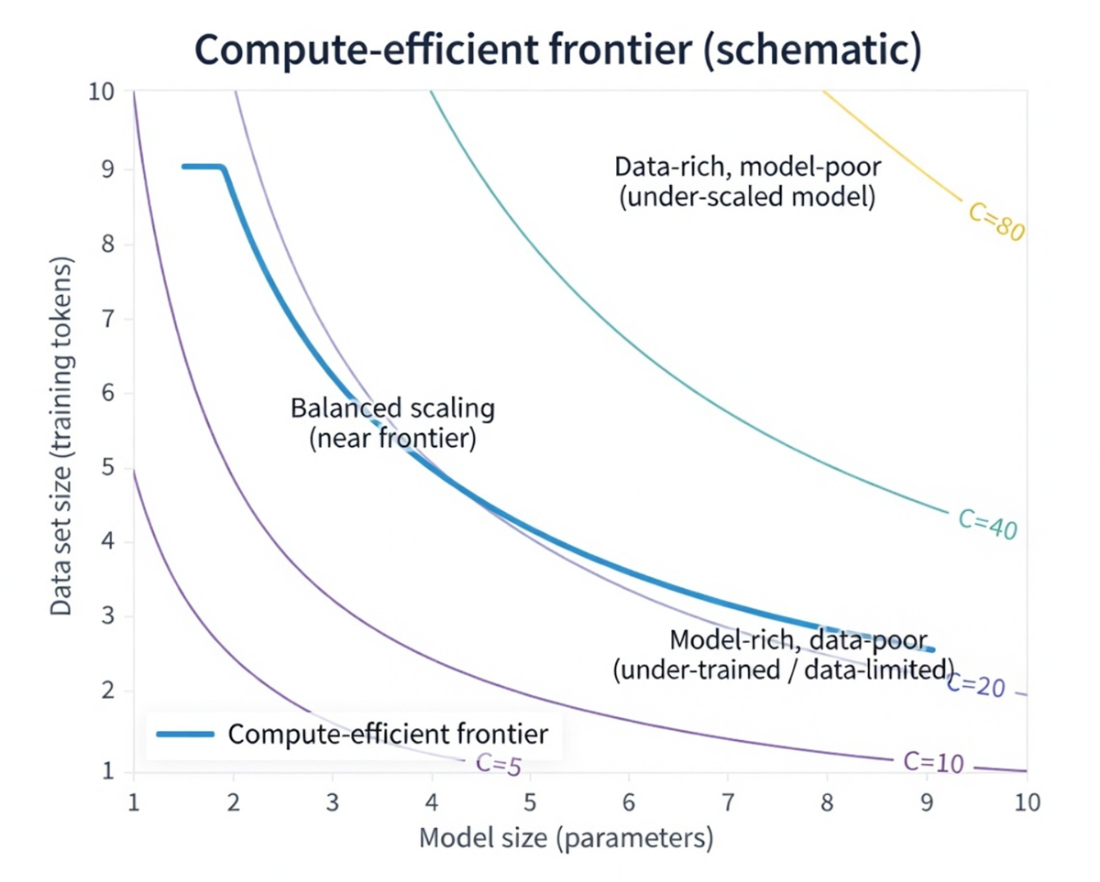
Compute-efficient frontier in large-scale language model training—how model size, data set size, and computational resources interact in large-scale neural network training. The horizontal axis represents model size (number of parameters), while the vertical axis represents the amount of training data. Curved contour lines indicate levels of total training compute required to train models at different combinations of these two variables. The bold curve marks the compute-efficient frontier, the region where model size and training data are balanced so that available computational resources are used most effectively. Points above the frontier correspond to data-rich but parameter-limited models, where additional parameters could improve performance. Points below the frontier represent parameter-rich but data-limited systems, where larger models cannot fully realize their capacity because they are trained on insufficient data. The frontier therefore identifies the combinations of model scale and data volume that maximize performance for a given computational budget.
Summary
- The OpenAI scaling experiments showed that language-model performance improves in smooth, measurable ways as three resources grow together in balanced proportions: model parameters, training data, and computational power. These relationships follow power laws, allowing reductions in prediction error to be modeled and, within limits, forecast.
- Among the three scaling variables, parameters, training data, and compute play distinct roles in determining model performance. Increasing model capacity and training data improves predictive accuracy, while compute functions as the enabling resource that allows the other two to be used effectively during training. Scale therefore depends not on any one factor alone, but on the coordinated growth of capacity, information, and optimization effort.
- Larger neural networks do not merely perform better because they contain more parameters. They often learn more efficiently, extracting more structure from each example, generalizing well despite enormous capacity, and developing capabilities that transfer beyond the narrow objective used during training.
- The scaling laws helped shift the focus of modern AI progress away from continual algorithmic invention and toward the expansion of existing learning systems. Once sufficiently expressive architectures were in place, improvement increasingly came from scaling them rather than replacing them.
- Modern artificial intelligence therefore represents less a break from earlier statistical thinking than its large-scale realization. The principles developed by Fisher, Shannon, Vapnik, Breiman, and others now operate together inside computational systems capable of learning from vast corpora of data.
- The success of scaling is substantial but may not be unlimited. Continued progress depends on the balanced expansion of data, computation, and model capacity, and may be constrained by physical infrastructure, energy demands, finite high-quality data, and the enormous financial resources required to train frontier-scale models.
- The larger lesson is that breakthroughs in intelligence often arise not from abandoning earlier ideas, but from recombining and extending them under new technological conditions. In that sense, the foundational algorithms explored throughout this work remain not only historically important, but structurally central to modern intelligence.
FAQ
What are scaling laws in modern neural language models?
Scaling laws are empirical mathematical relationships showing that language-model performance improves predictably as key resources increase. In Kaplan et al.’s 2020 OpenAI study, prediction error declined according to power-law relationships as model parameters, training data, and training compute grew. This meant that performance gains were not random or purely accidental; they followed smooth, measurable trends across many orders of magnitude.
What did Jared Kaplan and colleagues discover in Scaling Laws for Neural Language Models?
Kaplan and his colleagues trained hundreds of transformer-based language models across different sizes and resource budgets. They found that cross-entropy loss decreased in a stable, predictable way as models became larger, training data increased, and more compute was used. Their key discovery was that much of the recent progress in language modeling could be explained by scaling existing systems rather than inventing entirely new algorithms.
What are the three main variables that determine language-model scaling?
The chapter identifies three interacting scaling variables: model parameters, training data, and training compute. Model parameters determine the system’s expressive capacity; training data provides the statistical information from which the model learns; and compute enables the model to process data and update parameters effectively. The best performance gains occur when these three resources grow together in balanced proportions.
Why is model size so important in scaling laws?
Model size, measured by the number of parameters, determines how much structure a neural network can represent. Larger models can capture more complex statistical relationships in language. Kaplan and colleagues found that model size had the strongest influence among the three scaling variables, producing the largest reductions in prediction error when sufficient data and compute were available.
How does training data affect model performance?
Training data determines how much statistical structure the model can infer from examples. Larger and more diverse corpora expose the model to more topics, styles, grammatical patterns, and contextual relationships. As data set size increases, cross-entropy loss tends to decline, allowing models to generalize more effectively. However, the chapter notes that high-quality human-generated data is finite and may become a major constraint on future scaling.
What role does compute play in modern AI scaling?
Compute is the enabling resource that allows large models to process data and adjust their parameters during training. Training requires repeated matrix operations, prediction-error calculations, and gradient-based parameter updates. Without enough compute, a large model cannot fully use its parameters or training data. Specialized hardware such as GPUs, TPUs, and distributed computing systems has therefore been central to the rise of large-scale AI.
What is a power-law relationship, and why does it matter for AI?
A power law is a nonlinear relationship in which one quantity changes as a power of another. In the chapter’s simplified form, model loss can be written as L(N) = aN-b, where N may represent parameters, data, or compute. As N increases, loss declines predictably. This matters because it allows researchers to estimate how performance may improve as models and training resources grow.
What is the compute-efficient frontier?
The compute-efficient frontier describes the balanced allocation of computational resources between model size and training data. If a model is too small for the available compute, it lacks capacity and additional training yields diminishing returns. If a model is too large but trained on too little data or for too short a time, much of its capacity remains unused. The efficient frontier identifies combinations of model size and data volume that produce the best performance for a given compute budget.
How does scaling challenge classical ideas about overfitting and generalization?
Classical statistical learning often warns that increasing model complexity raises the risk of overfitting. Large neural networks complicate this intuition. Despite having billions or trillions of parameters, modern language models often generalize well when trained on sufficiently large and diverse data sets. The chapter explains this through factors such as regularization, abundant data, and optimization dynamics that tend to favor solutions capturing meaningful statistical structure rather than noise.
What are the main limits of continued AI scaling?
The chapter emphasizes that scaling laws are empirical patterns, not guarantees of indefinite progress. Future scaling may be constrained by computational infrastructure, semiconductor limits, memory bandwidth, energy consumption, environmental pressures, financial cost, and the finite supply of high-quality training data. Even if scaling eventually slows, the underlying foundations—probability, likelihood, information theory, optimization, and generalization—are likely to remain central to AI.

 Timeless Algorithms: The Seminal Papers ebook for free
