Chapter 8. Practical considerations
This chapter opens with the idea that moving an application into the cloud changes what you control and what you must trust a provider to deliver. Once an application is in production, the main challenge is not just deployment but maintaining visibility into how well it is actually running. The chapter frames cloud operations around three practical concerns: choosing a vendor wisely, understanding the guarantees offered in service-level agreements, and measuring whether the application and the provider are meeting expectations.
When evaluating a cloud provider, the text emphasizes both business and technical factors. On the business side, organizations should examine the vendor’s financial stability, operational track record, data-center assets, customer references, and audit/compliance posture. On the technical side, the most important issues are availability, performance, elasticity, security, compliance, and interoperability. The chapter explains that availability and performance should be measured from the end user’s perspective and that cloud applications must be designed to tolerate failure, recover quickly, and scale horizontally when demand spikes. It also notes that network distance, geographic location, and the broader internet can significantly affect user experience.
The chapter then compares how major providers describe and enforce their SLAs, showing that these agreements are central to holding vendors accountable. It also explains that cloud operations should be monitored through a mix of provider dashboards, APIs, and third-party tools. Provider status pages and operational dashboards give high-level visibility, while services such as cloud monitoring APIs and synthetic transaction testing provide more detailed insight into instance health and response time. The overall message is that cloud adoption requires a shift from direct control to disciplined verification: continuously measure real user experience, detect problems quickly, and use both internal monitoring and external benchmarks to confirm whether the cloud provider is delivering on its promises.


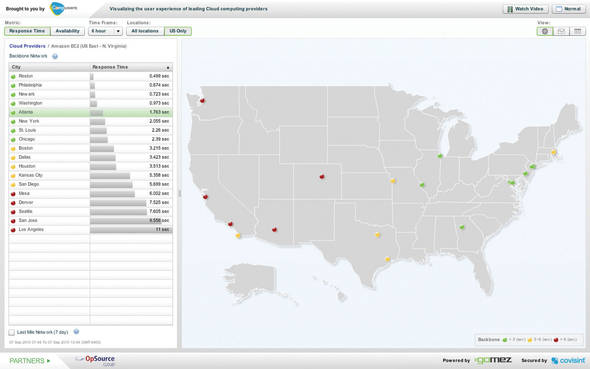
A comparison of the average time it takes to access the same web page for an application running in a sample cloud provider from 18 different cities across the U.S., as measured by Gomez
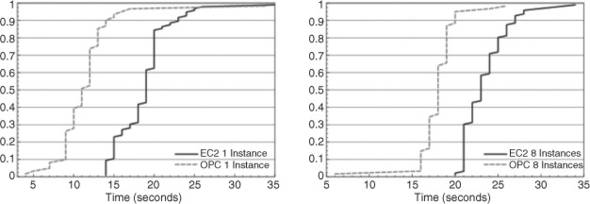
Elasticity of EC2 and a private cloud deployment based on Eucalyptus. The left graph shows the cumulative probability as a function of time for an instance to be available after the request has been made to start it. The right graph shows the cumulative probabilities of the time it takes before eight instances are available. Source: Daniel Nurmi et al, “Eucalyptus: A Technical Report on an Elastic Utility Computing Architecture Linking Your Programs to Useful Systems,” UCSB Computer Science Technical Report Number 2008–10, August 2008.

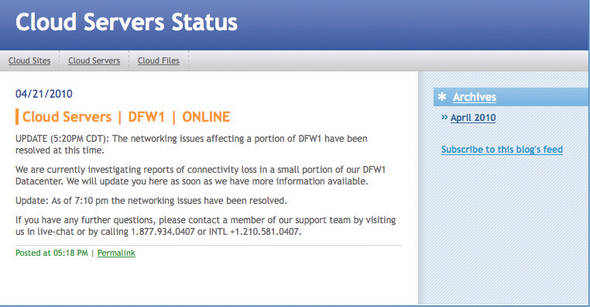
A screenshot of the Rackspace Cloud system status web page, displaying active and resolved incidents (http://status.rackspacecloud.com/cloudservers/)
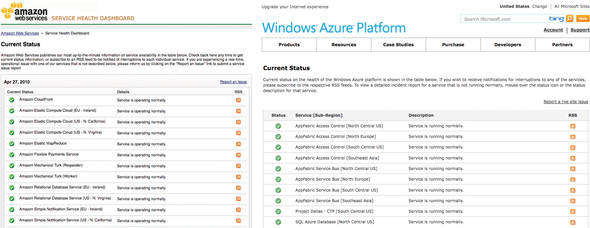
These two parallel screenshots show the real-time status dashboards for Amazon EC2 (http://status.aws.amazon.com/) and Windows Azure (www.microsoft.com/windowsazure/support/status/servicedashboard.aspx).
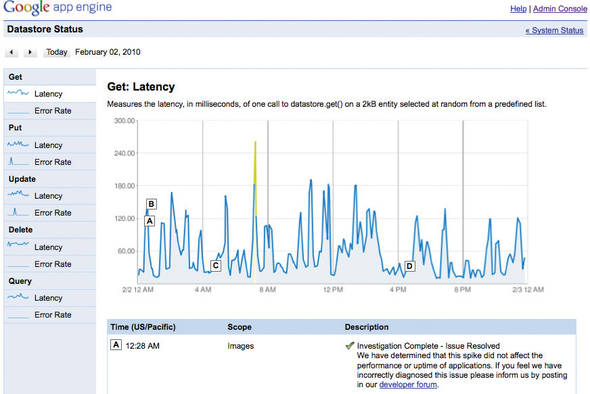
Datastore status from the Google AppEngine dashboard. Variations in performance as well as annotations describing incidents are shown in this display (http://code.google.com/status/appengine/detail/datastore/2010/02/02#ae-trust-detail-datastore-get-latency).
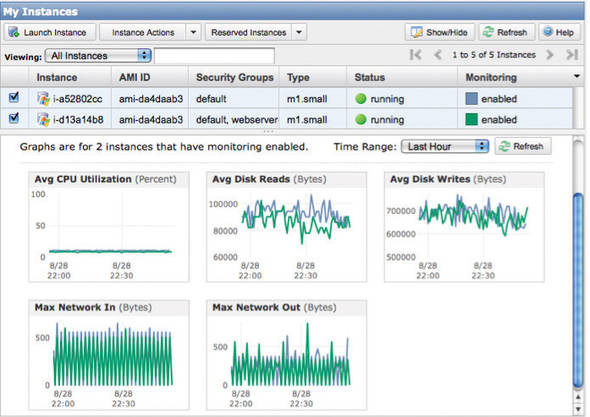
The CloudWatch feature of Amazon EC2 lets the cloud customer see metrics related to the performance of instances. Data is reported for CPU, network I/O, and disk utilization.
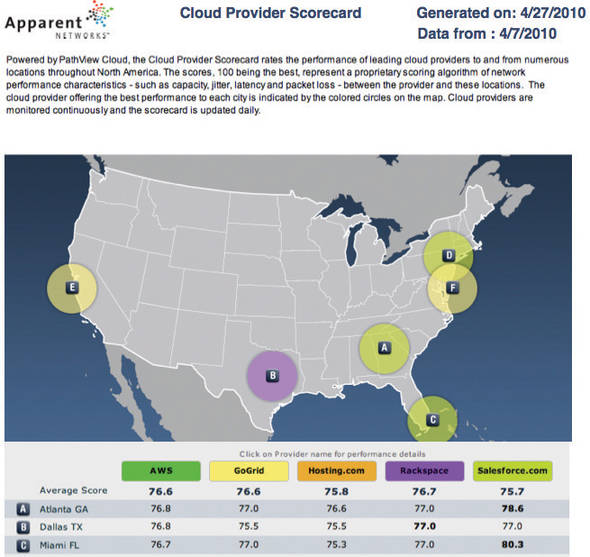
Apparent Networks provides a free service that monitors and compares the performance of various cloud providers as measured from geographical locations across the U.S. The interface includes a user-definable scorecard that can be configured with different weighting factors to rank the providers. The company also has an advisory service that documents outages of major cloud providers (www.apparentnetworks.com/CPC).
FAQ
What business factors should you evaluate before choosing a cloud provider?
You should assess the provider’s financial viability, operational viability, and contractual viability. That means checking how long the vendor has been in business, whether it is financially stable, whether it has multiple data centers and a good operating history, whether it can provide customer references, and whether its operations are audited and supported by clear SLAs.
Why is SAS 70 Type II compliance important when selecting a cloud vendor?
SAS 70 Type II compliance indicates that the provider has appropriate infrastructure and controls in place to handle customer data satisfactorily. It also signals that the vendor has undergone a substantial audit process, which suggests maturity and seriousness about operational controls.
What is the difference between availability and performance in cloud operations?
Availability refers to whether an application performs its intended function successfully, while performance refers to how fast or slow the application is. Both should be measured from the end user’s perspective, since that reflects the real experience of the service.
How should availability be measured for a cloud application?
Availability is best measured as the percentage of time a service can successfully serve users over a given period. For practical monitoring, it is often measured against key business services such as search, browse, shopping cart, or purchase rather than the application as a whole.
What does “three 9s” or “five 9s” availability mean?
“Three 9s” means 99.9% availability, while “five 9s” means 99.999% availability. Each additional 9 represents a tenfold reduction in allowed downtime, so more 9s means a much stricter reliability target.
What are the main technical operational considerations for cloud applications?
The main technical considerations are availability and performance, elasticity and scale, operational security and compliance, and interoperability and platform compatibility. These are the practical issues that affect how well a cloud application runs in production.
How can you improve cloud application availability in the face of failures?
You can design with failure in mind by using horizontal scaling and balancing across multiple instances, and you can also plan to fail fast but recover quickly by detecting failures early and switching to an alternate instance immediately.
What factors can affect cloud application performance for end users?
Performance depends on the cloud provider’s infrastructure, the quality and robustness of the application design, and network conditions between users and the cloud. Geographic distance and internet routing can also cause significant variation in response times for different users.
What are the typical ways cloud providers and third parties provide operational visibility?
Cloud providers commonly offer status pages, operational dashboards, and APIs such as monitoring services for metrics like CPU, network I/O, and disk usage. Third parties may also provide synthetic transaction monitoring, black-box testing, and global dashboards that compare multiple cloud providers.
Why are SLAs important in public cloud computing?
SLAs define measurable service commitments that the provider must meet, and they give customers a way to hold the provider accountable when those commitments are not met. If the provider violates the SLA, the customer is usually entitled to service credits or other compensation.

 The Cloud at Your Service ebook for free
