Chapter 6. Achieving high reliability at cloud scale
The chapter explains that cloud systems must be designed not only for scale, but also for reliability, because large numbers of commodity servers inevitably produce failures. It connects the cloud’s modern architecture to earlier distributed systems and service-oriented architecture, showing how multi-tier designs, loose coupling, and service interfaces help reduce single points of failure and make applications easier to build, test, replace, and extend. In this view, reliability comes from separating components cleanly and allowing each service to fail or change without bringing down the whole system.
A major theme is that loose coupling improves resilience by limiting dependency between components. The text contrasts tightly coupled systems, which are harder to modify and more fragile, with loosely coupled ones that use abstract interfaces, asynchronous messaging, self-describing data, and delayed bindings. It also describes web services and message-based communication as practical ways to build distributed applications that can continue operating even when individual services or machines are unavailable, slow, or changed unexpectedly.
The second half focuses on reliability at extreme scale, especially through redundancy and MapReduce. Redundancy across software, data, networks, and hardware helps systems survive component failures, while MapReduce provides a framework for splitting large jobs into independent map tasks, combining their results with reduce tasks, and rescheduling work when nodes fail. The chapter emphasizes that at cloud scale, reliability must be built into the software itself, since hardware failures are normal, and it illustrates how platforms like Hadoop make this approach practical for massive, real-world workloads.
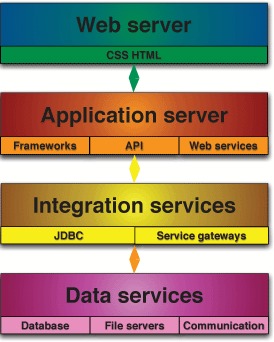
An N-tier architecture. Many variations are possible. But generally, an application server is involved. From the application server, many different logical layers can be accessed. At the application server level, you can begin to interact with the cloud. Any or all of these layers can operate in the cloud effectively.
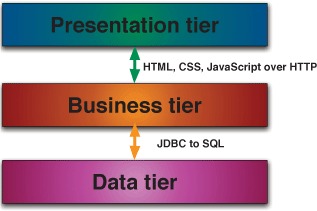
A three-tier architecture: Presentation layer + Business layer + Database layer
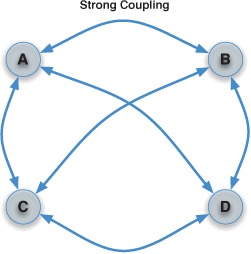
Strong coupling. Changes in A impact B, C, and D. Changes in B impact A, C, and D.
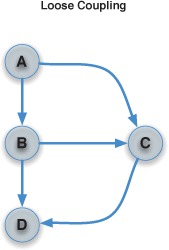
Loose coupling. Modifications in A’s behavior don’t impact B, C, or D. Modifications in B’s behavior may affect A but nothing else.
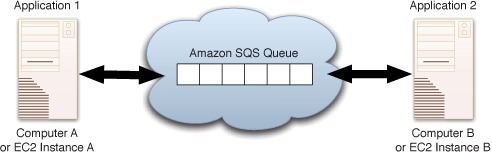
The simple structure of Amazon’s SQS interprocess communication web service
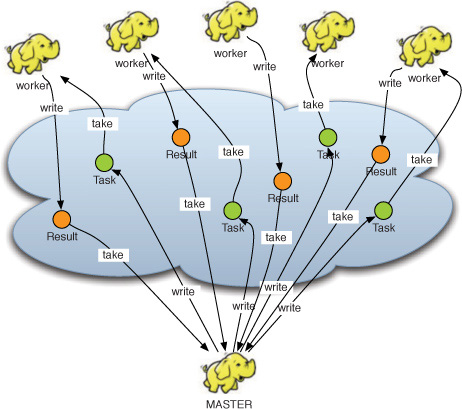
The roles of master and worker are depicted using the little elephant logo of the open source Hadoop implementation of MapReduce. The master divides the problem into tasks and assigns them to workers. Each worker performs its task and writes back a result that the master gathers into an overall result.
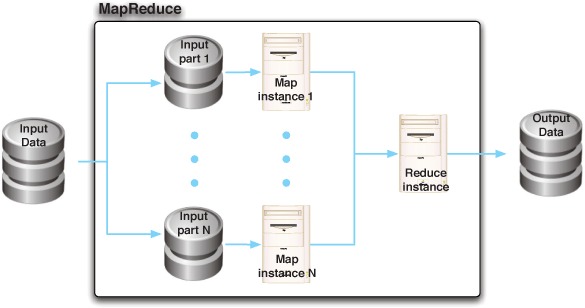
The map and reduce functions in a MapReduce model. The input data is partitioned into subparts, each of which is handed to a map function. It passes the output of all the map functions to a reduce function that prepares the final output.
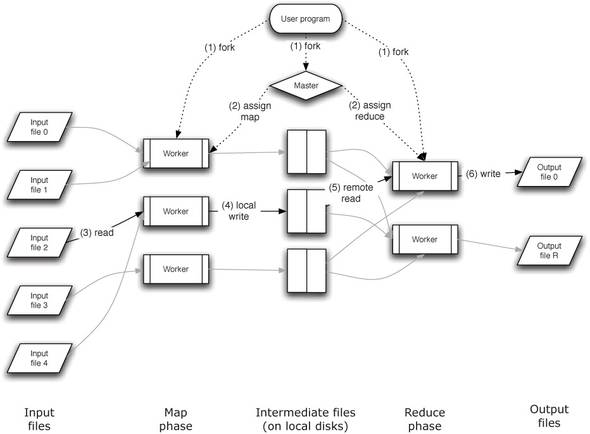
How MapReduce operates (see reference numbers in the above diagram)

 The Cloud at Your Service ebook for free
