1 The aesthetics of code
Code is presented as an artistic medium shaped by logic, syntax, and judgment, where beauty is not decorative but practical. Beautiful code raises the quality of a codebase by making software easier to understand, maintain, extend, and trust over time. The chapter argues that developers should take pride in crafting code that is robust and meaningful, especially as AI-assisted and agentic coding change how software is produced.
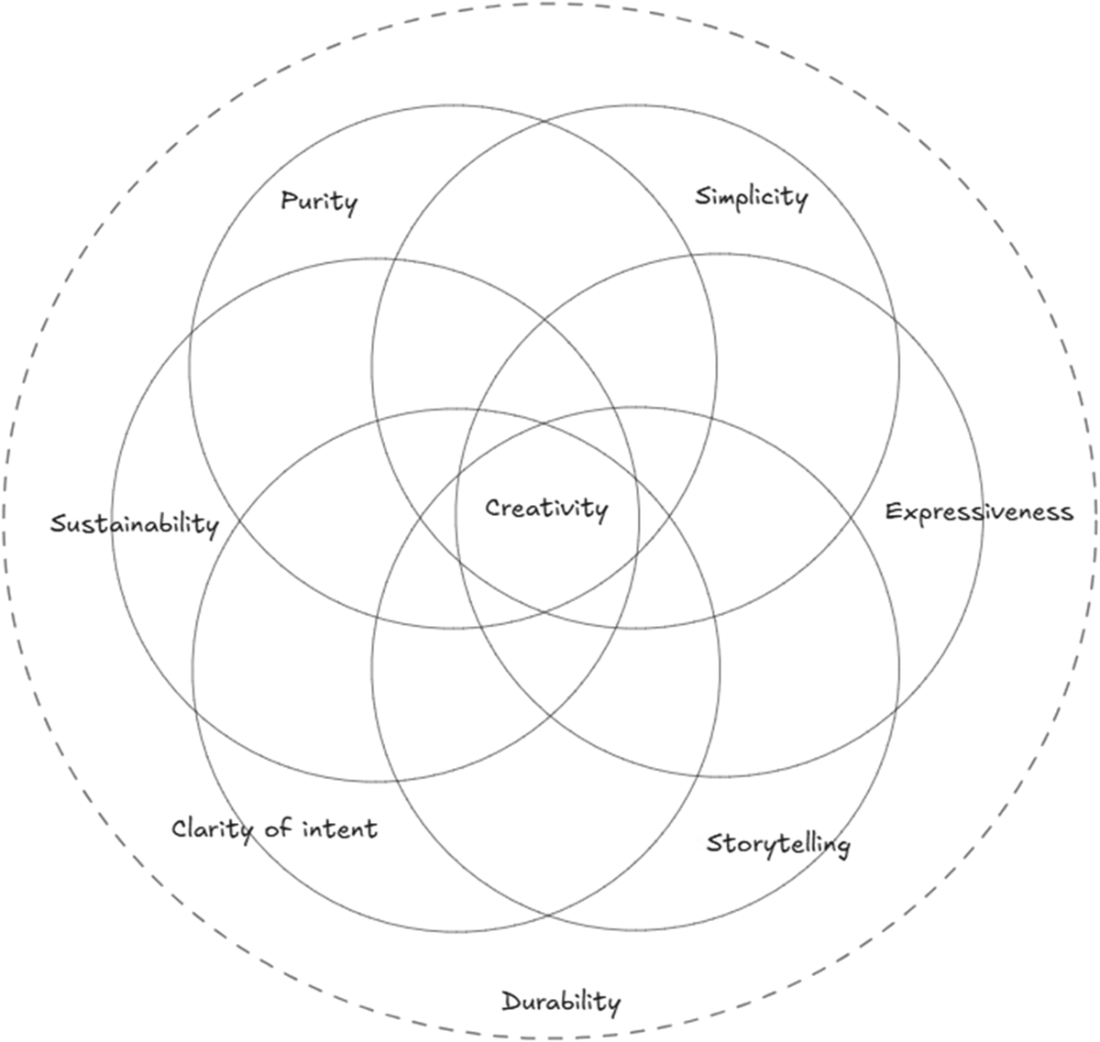
The chapter defines beautiful code through recurring qualities inspired partly by the beauty of mathematics: patterns whose ideas fit together harmoniously. It introduces eight dimensions of code quality—storytelling, simplicity, clarity of intent, expressiveness, purity, sustainability, durability, and creativity—and explains that these qualities reinforce one another rather than standing alone. The rosette model captures this interaction, with creativity bringing the dimensions together and durability forming the foundation for code that can evolve gracefully.
A concrete example shows how handling absence with raw null checks can make code verbose, fragile, and difficult to read, while approaches such as Kotlin null-safety or Java Optional can make absence explicit and safer. Used in a functional style, Optional helps shift attention from defensive plumbing to the business intent, producing code that is simpler, more expressive, clearer, and more durable. The chapter also cautions that no technique should become an absolute rule: beautiful code depends on context, human judgment, and the ability to use tools—including AI agents—without surrendering understanding or responsibility.
The rosette of beautiful code, which captures the idea that beauty in code arises from the interplay of multiple dimensions, each reinforcing the others to create a whole that is greater than the sum of its parts.
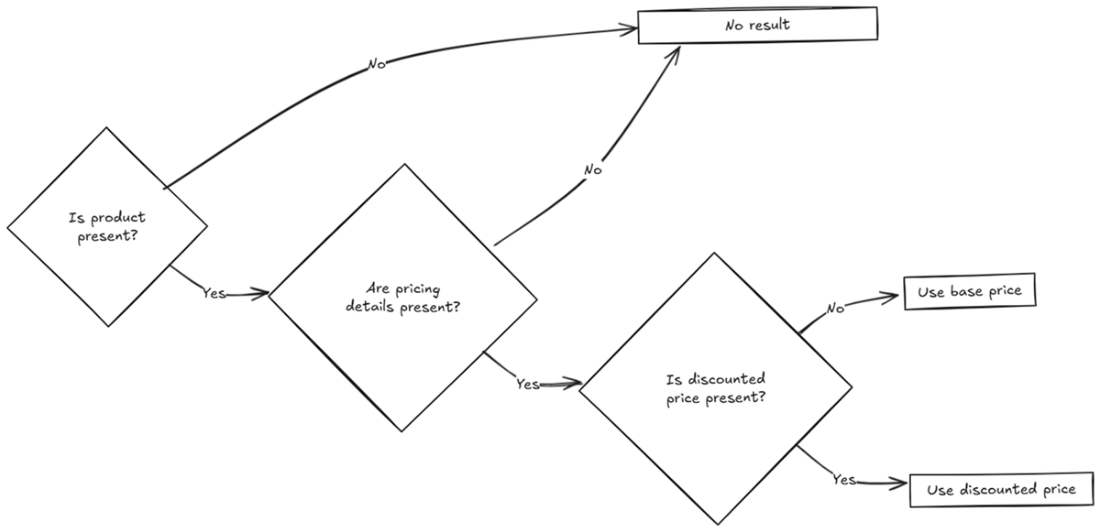
A product may be missing entirely, may lack pricing details, or may have no discounted price. When pricing details exist, the base price is always present.
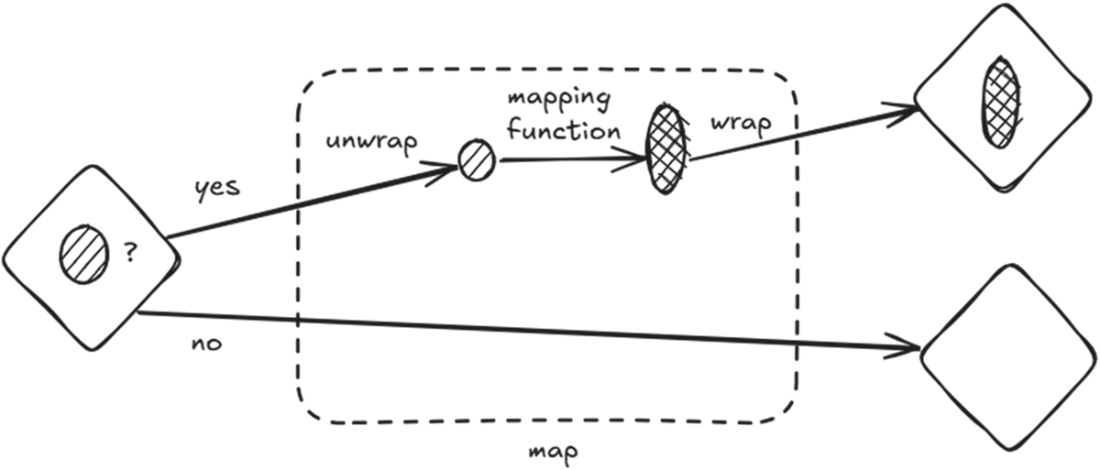
The map() method for Optional. If a value is present, map() unwraps it, applies the mapping function, and wraps the transformed result in a new Optional. If no value is present, the mapping function is not executed, and an empty Optional is returned.
Summary
- Beautiful code is not only about formatting or tool-enforced quality; it is a higher standard shaped by developer judgment and taste.
- Beautiful code brings practical benefits: it improves readability, maintainability, onboarding, reliability, and long-term durability.
- The rosette model presents eight dimensions of beautiful code: storytelling, simplicity, clarity of intent, expressiveness, purity, sustainability, durability, and creativity.
- These dimensions reinforce one another; beautiful code emerges from balancing them according to the problem, the language, and the people who will maintain the code.
- Null-heavy code hides business intent behind defensive plumbing and increases fragility. Modeling absence explicitly can make code clearer, safer, and easier to maintain.
- Agentic coding can create comprehension debt: code that works but cannot be fully explained, trusted, or safely evolved.
- Agentic coding can speed up development, but durable, high-quality code still requires human judgment, careful supervision, and clear responsibility for the final design.
FAQ
What does it mean to treat code as art?
Treating code as art means seeing the developer as someone who shapes ideas through logic and syntax. The goal is not decoration, but robust, high-quality software that is understandable, maintainable, extensible, and worth being proud of.
Why does beautiful code have practical value?
Beautiful code raises the standard of the entire codebase. It makes software easier to read, change, and maintain while reducing bugs. This is especially important when many developers work on the same system under deadlines, shifting requirements, and long-term reliability expectations.
How does the chapter define beauty in code?
Beauty in code is defined through intellectual qualities rather than visual appeal. Like mathematics, beautiful code reveals harmonious patterns of ideas. It is functional, clear, expressive, simple, safe, and satisfying to understand.
What are the eight dimensions of beautiful code?
The chapter introduces eight dimensions: storytelling, simplicity, clarity of intent, expressiveness, purity, sustainability, durability, and creativity. These dimensions work together to make code clearer, safer, more maintainable, and more meaningful to craft.
What is the rosette model?
The rosette model represents beautiful code as the interplay of multiple dimensions. No single quality is enough on its own. For example, purity becomes more beautiful when balanced with simplicity and expressiveness. Creativity sits at the center, while durability forms the foundation.
Why is null handling used as an example of code aesthetics?
Null handling is a common problem where code can quickly become noisy and fragile. Repeated defensive null checks bury the real business intent. By modeling absence more explicitly, code can become safer, clearer, and more expressive.
How does Java Optional help model absence?
Optional represents a value that may or may not be present. Instead of returning raw null, a method can return Optional<T>, forcing callers to acknowledge the possibility of absence and handle it explicitly.
Why is a functional Optional chain often clearer than nested null checks?
A functional Optional chain uses methods such as map() to transform values step by step only when they are present. This removes repetitive defensive checks and shifts attention from avoiding NullPointerException to expressing the real intent of the code.
Should Optional always replace null checks?
No. The chapter emphasizes that beautiful code is not about absolute rules. Optional can improve clarity, but overusing it or creating overly complex chains can obscure intent. The right choice depends on the problem, the language, and the people who will maintain the code.
What risks does the chapter associate with agentic coding?
AI agents can help developers write code faster, but they may reproduce the quality of the surrounding codebase. Without human judgment, they can create poor designs or comprehension debt, where code works but the team does not fully understand it. Human supervision remains essential for durable, trustworthy software.

 The Art of Code ebook for free
