16 Designing multithreaded programs
This chapter explains how to design Python programs that run multiple threads safely and predictably. It clarifies concurrency versus parallelism, noting that while modern CPUs enable true parallel execution, CPython’s global interpreter lock (GIL) generally restricts threads to concurrent execution. The key design challenge is that threads share code, data, and external resources, so correct programs must coordinate access to shared state. Using Python’s threading module, the chapter shows how to structure threaded work, when the runtime naturally switches threads (e.g., during I/O), and why explicit synchronization is required to avoid subtle timing bugs.
The chapter first tackles race conditions and critical regions, introducing mutexes (locks) to enforce mutual exclusion. A simple printing example demonstrates how unprotected shared output interleaves unpredictably, and how a Lock (especially via the with statement) serializes access and prevents deadlock-prone mistakes. It then expands to semaphores to model the classic reader–writer problem: multiple readers may access a resource simultaneously, but writers need exclusive access. The solution combines a mutex to serialize writers and block readers during writes, a semaphore to admit multiple readers, and an Event to signal that the first write has occurred, illustrating the interplay of blocking, sleeping, and busy-waiting in realistic coordination.
For tighter coordination, the chapter introduces condition objects, which bundle a lock with signaling so threads can wait for specific state changes. Using a bounded queue, it implements the producer–consumer pattern where producers wait when the queue is full, consumers wait when it’s empty, and threads notify each other precisely when the queue transitions from empty to not empty or from full to not full. Crucially, waiting releases the lock, and awakened threads must recheck conditions to handle races. The chapter closes with cautions: thread scheduling is nondeterministic, debugging race conditions and deadlocks is hard, and synchronization and context switching add overhead—so more threads don’t automatically mean faster programs. It briefly notes alternatives like asyncio for I/O-bound concurrency and multiprocessing for true parallelism.
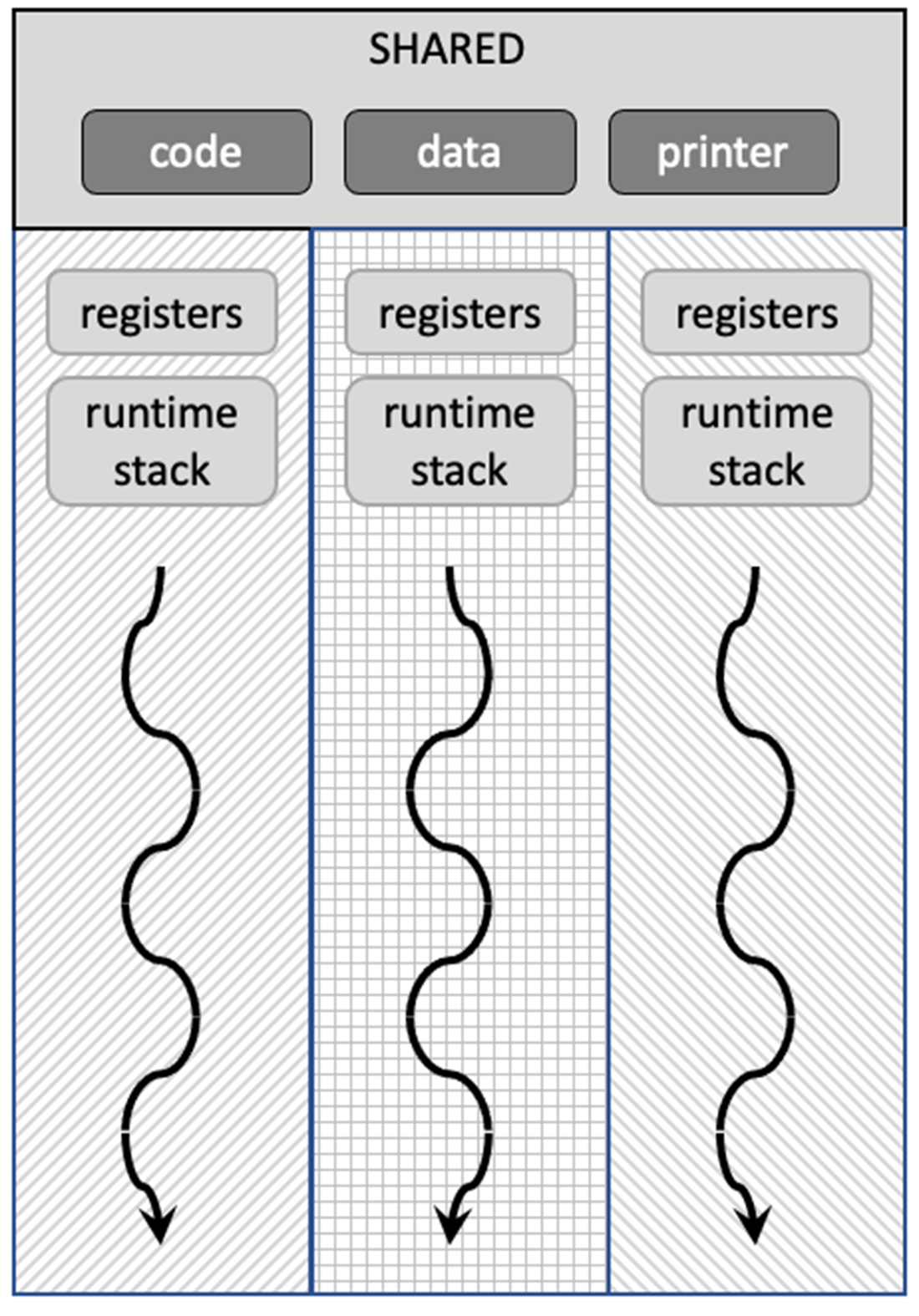
A multithreaded application with three threads. The threads share the application’s internal resources of code and data in memory and external resources such as printers and files. The runtime system gives each thread its own runtime stack and the appearance of having its own set of machine registers.

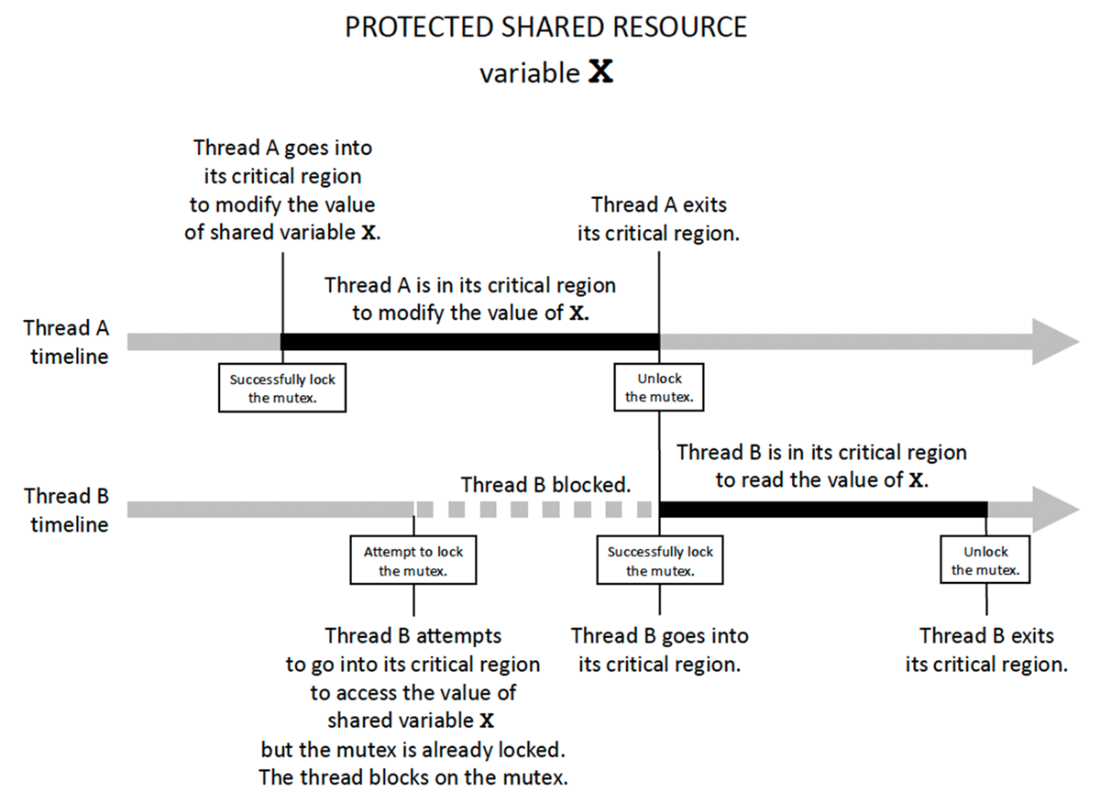
The critical regions of Thread A and Thread B modify variable X, the shared resource. A mutex object guards the critical regions to protect the shared resource. A thread that successfully locks the mutex can proceed into its critical region. Attempting to lock a mutex that’s already locked causes the thread to block. The thread that’s exiting its critical region must unlock the mutex to allow another thread to lock it.
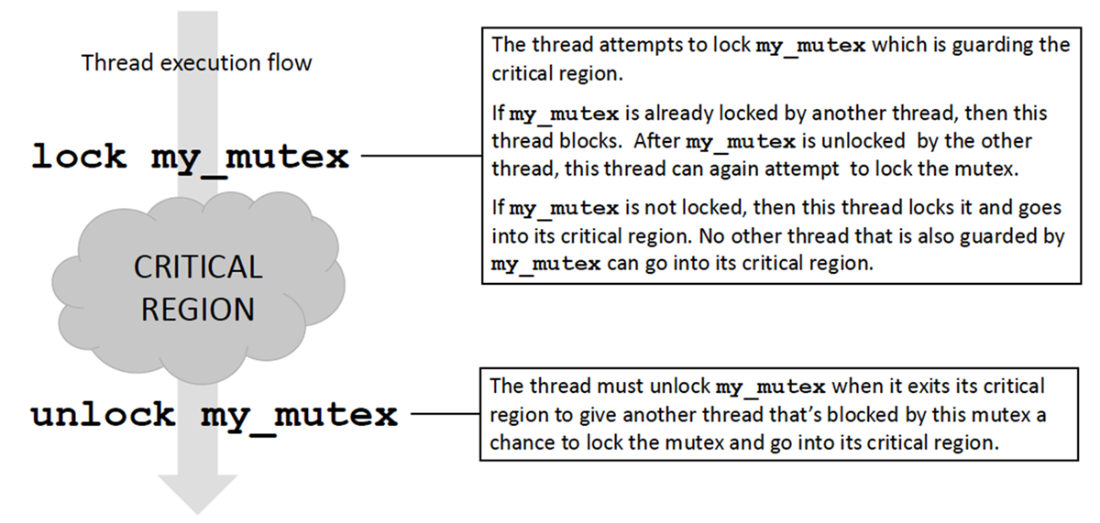
How a mutex guards a critical region. It only allows one thread at a time to be in its critical region.
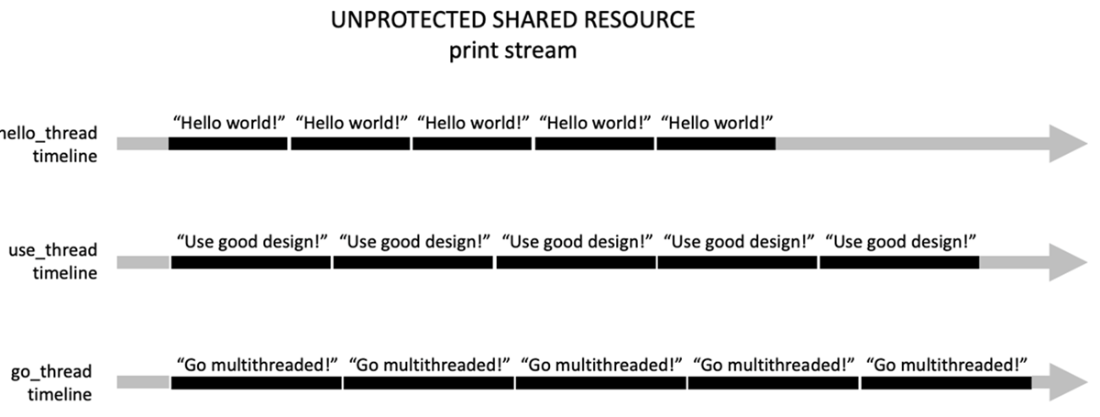
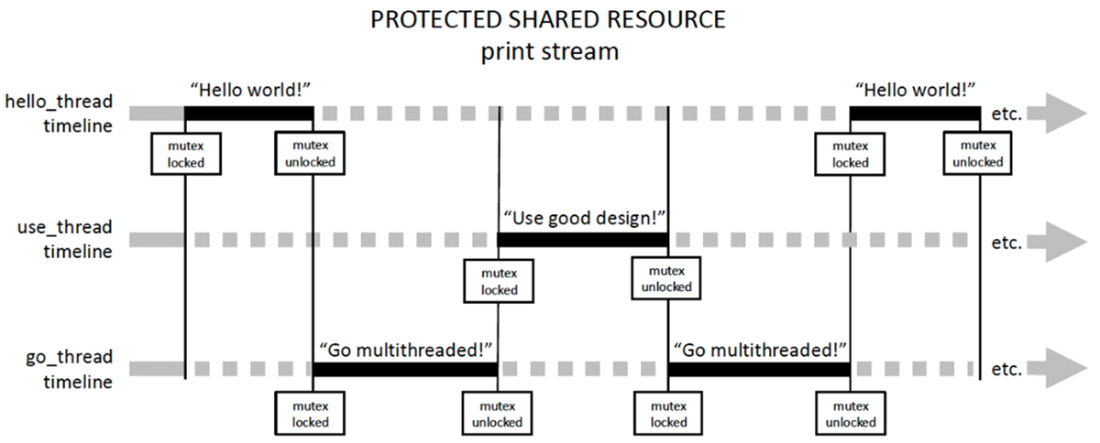
Three threads simultaneously print to the shared print stream, the unprotected shared resource.
With a mutex guarding the critical regions of the threads, only one thread at a time can print to the print stream, which is the shared resource. When a thread wants to go into its critical region, it attempts to lock the mutex. If it succeeds, it can enter its critical region and print. If it doesn’t succeed, it blocks until another thread unlocks the mutex. Then the thread can attempt to lock the mutex again. A thread must unlock the mutex before it exits its critical region. Whenever the mutex unlocks, the runtime system determines which blocked thread can lock it.
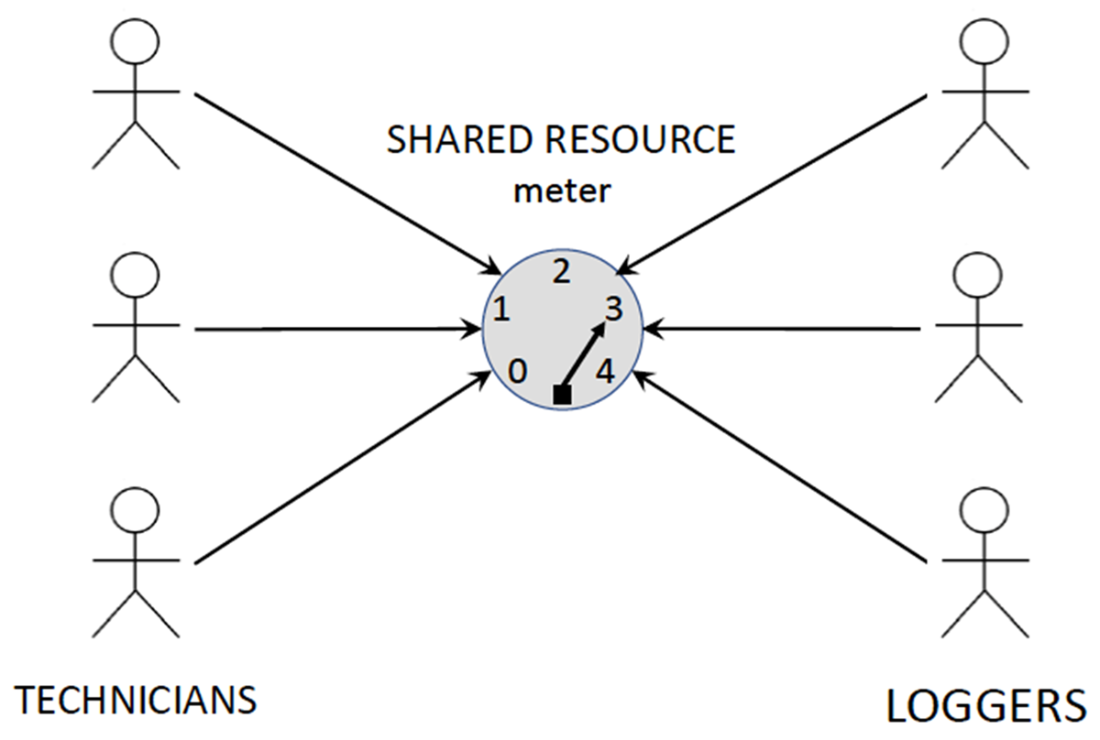
Three technicians simultaneously attempt to set the meter’s value. Meanwhile, three loggers attempt to read and log the meter’s current setting. Therefore, the meter is the shared resource. Only one technician at a time should be setting the meter, and no logger should read the meter while a technician is setting it. However, as long as no technician is setting the meter, multiple loggers can be reading it at the same time.
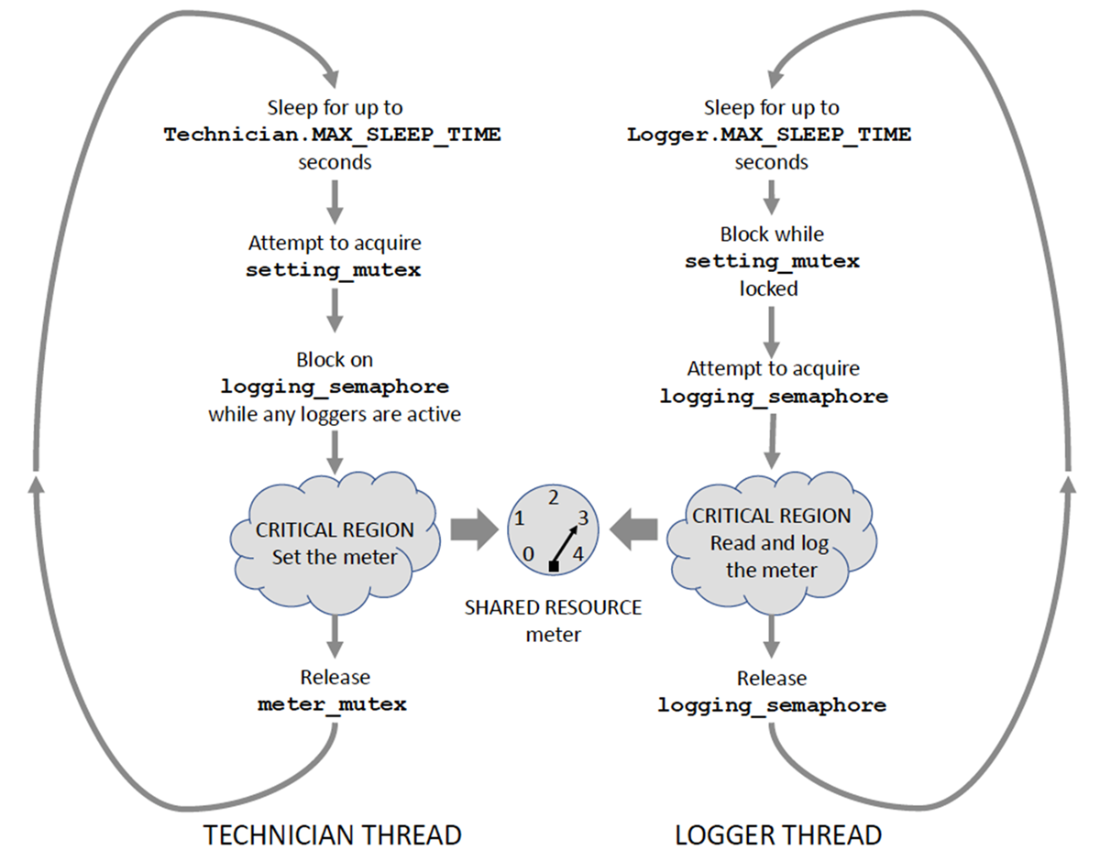
The technician threads and the logger threads each loop and attempt to go into their critical regions to access the meter, which is the shared resource. The setting_mutex prevents more than one technician thread at a time from setting the meter. The same mutex prevents a logger from reading and logging the meter’s value while a technician thread is setting the meter. The logging_semaphore allows multiple reader threads to simultaneously read the meter, and it will block technician threads from setting the meter when any reader thread is reading it.


Simultaneously, multiple producers enter values into the bounded queue and multiple consumers remove values from the queue. The queue, the shared resource, has limited capacity.
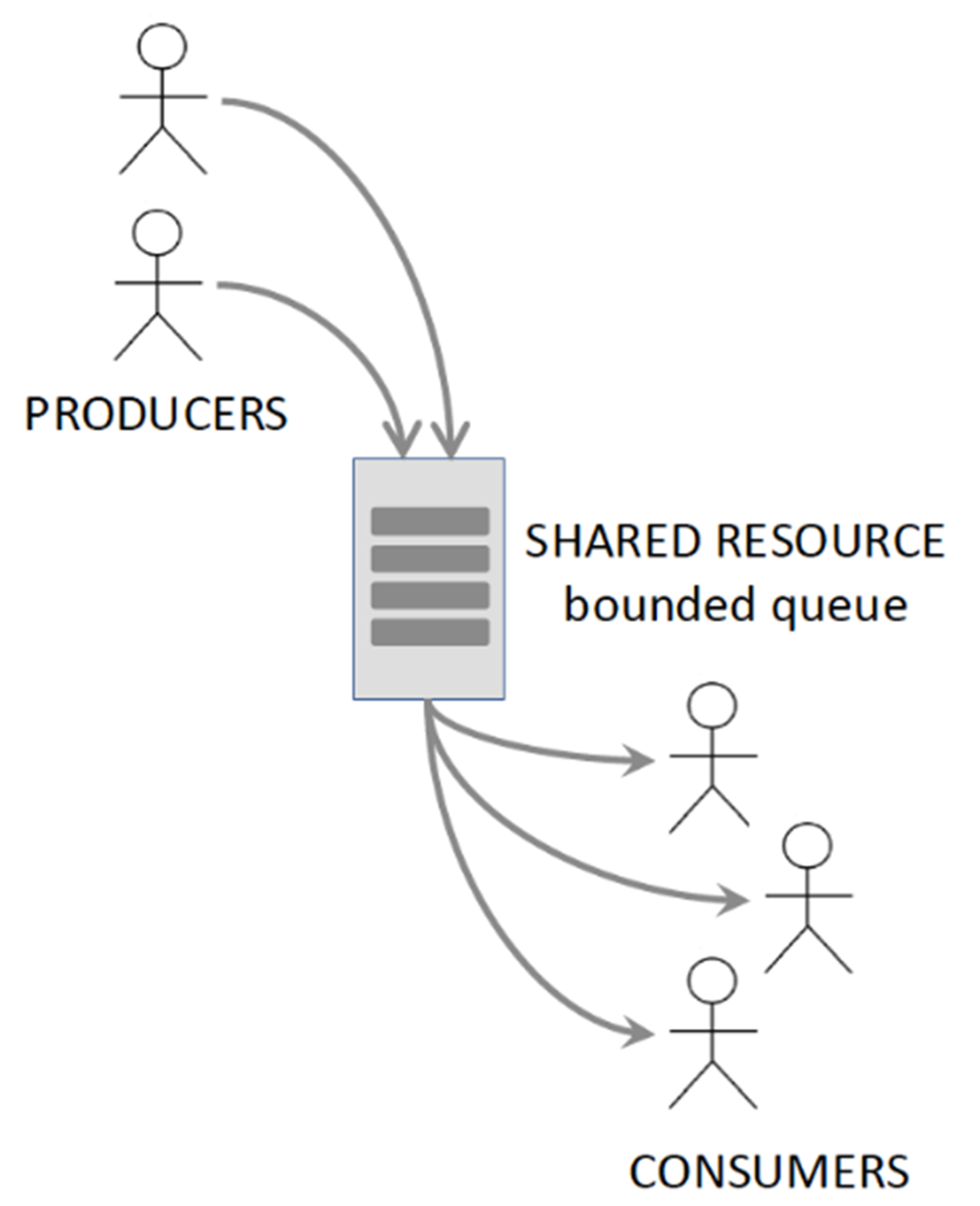
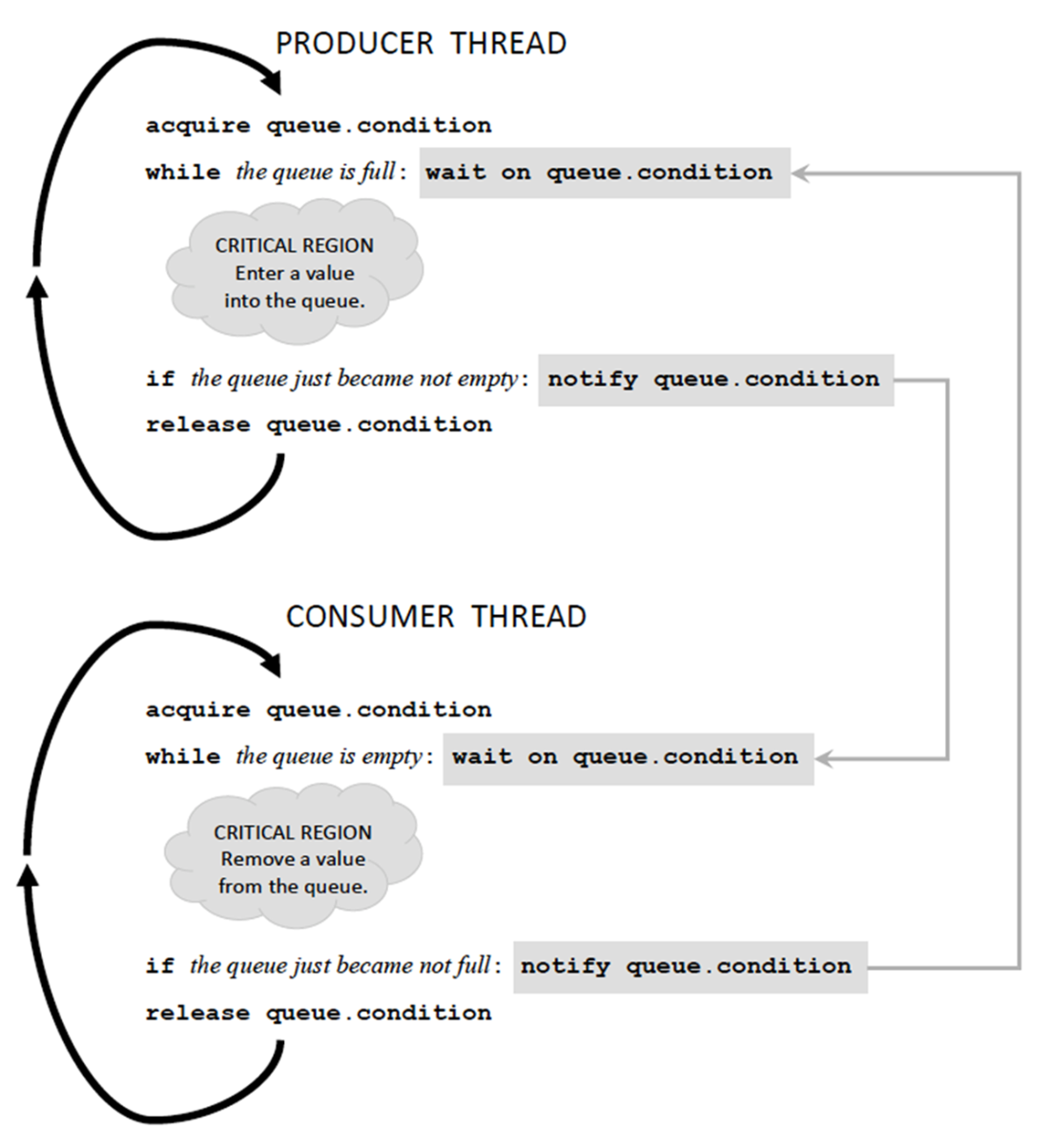
The producer and consumer threads each attempts to acquire queue.condition at the top of its loop. The condition object synchronizes the producer and consumer threads. The producer threads loop to enter values into the shared bounded queue, and the consumer threads loop to remove values from the queue. A producer thread cannot enter a value into the queue when the queue is full. A consumer thread cannot remove a value from an empty queue.
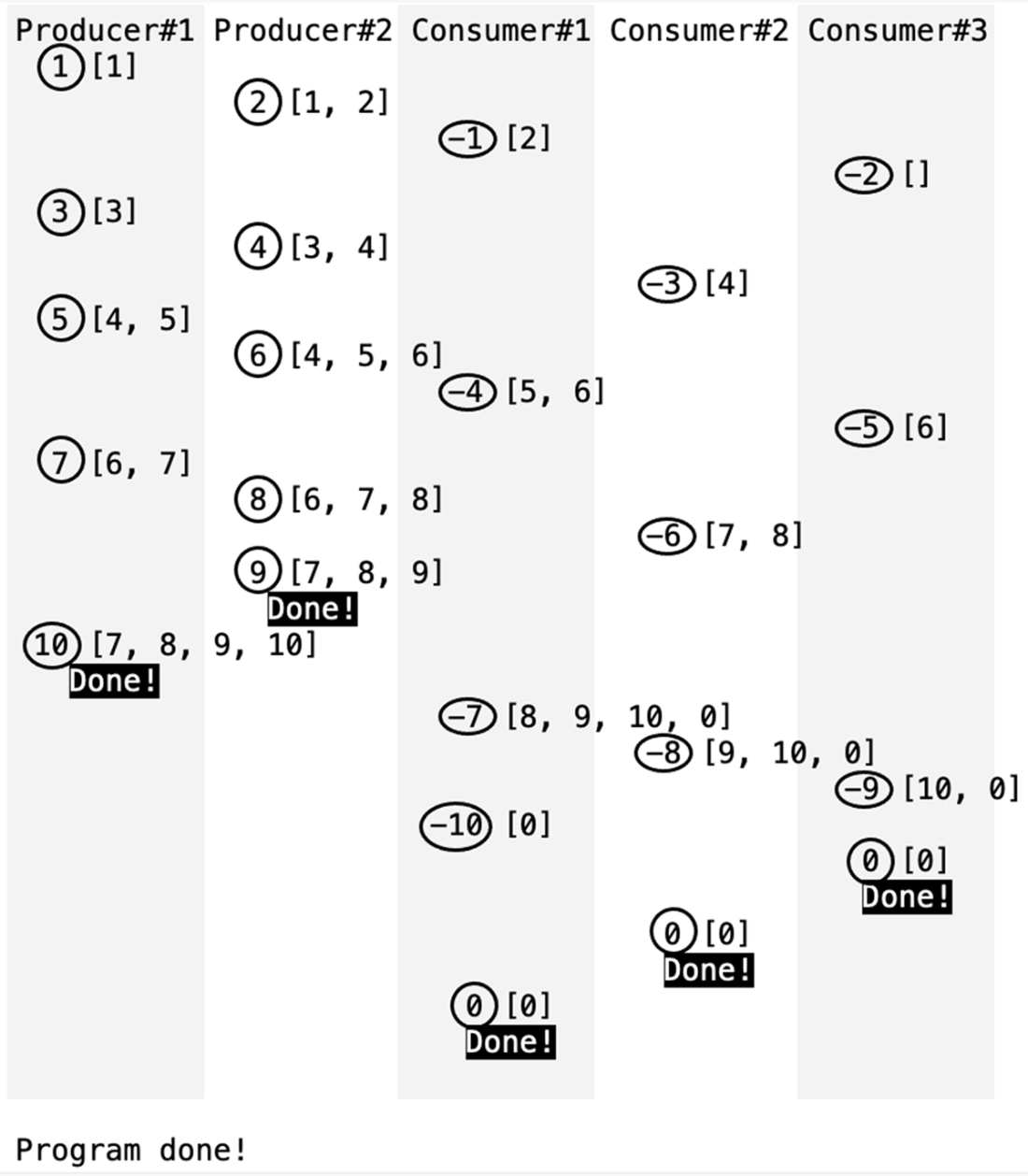
In order by time from top to bottom, each line shows the action of one of the producer or consumer threads, depending on which column the line begins in. The circled integer is the value entered into the shared bounded queue by a producer thread, or the value (shown as a negative value) removed from the queue by a consumer thread. The list in square brackets after each circled integer is the contents of the queue after the action. A zero value is the end sentinel.
Summary
- Knowing how to design multithreaded programs is important for applications that inherently have concurrent operations. Designing, developing, and debugging multithreaded applications are major challenges.
- Each thread is an execution path through the program.
- Python’s global interpreter lock (GIL) limits a program’s multiple threads to execute concurrently and not in parallel. The runtime engine switches rapidly among the threads.
- Multiple threads may attempt to access shared resources of the application simultaneously. We must protect the shared resources.
- The code in each thread that accesses the shared resource is the thread’s critical region associated with that resource.
- Use a mutex to guard each critical region with mutual exclusion.
- Python implements a mutex with a Lock object.
- A thread attempts to acquire (lock) a mutex. A mutex that’s already locked blocks the thread from proceeding into a critical region. Once the mutex is released (unlocked), the thread can try again to acquire the mutex.
- A thread that successfully acquires a mutex does not allow any other thread to acquire that mutex. Therefore, only the thread that acquires the mutex can be in the critical region.
- A Semaphore object allows multiple reader threads to simultaneously acquire the semaphore to read a shared resource without modifying it. But it also blocks writer threads from modifying the resource while reader threads are reading it.
- To allow another thread to run, a thread must release a mutex or a semaphore before it exits its critical region. Otherwise, a deadlock may occur.
- Deadlocks, race conditions, and random effects are major debugging challenges.
- An Event object enables a thread to signal another thread.
- A Condition object combines the functionalities of a mutex and an Event object to synchronize the simultaneous operation of multiple threads.
- A thread waits on a Condition object as long as an associated condition remains true. When the condition object is notified by another thread, a thread that’s waiting on the condition variable unblocks and checks if the condition is still true. If the condition is false, the thread can proceed into its critical region. Otherwise, it resumes its wait.

 Software Design for Python Programmers ebook for free
