Reinforcement learning from human feedback (RLHF) grew out of the need to train AI systems for problems that are hard to define precisely, especially when human preferences are subtle, contextual, and difficult to express as fixed rules. The chapter explains that RLHF became especially important as language models moved from academic benchmarks to widely used products, where the main challenge was no longer just producing fluent text, but making models more useful, safe, and responsive to people. Its prominence rose sharply with the success of ChatGPT and the broader shift toward post-training methods for foundation models.
The chapter presents RLHF as part of a broader post-training pipeline: first teaching a model to follow instructions, then collecting human preference data to train a reward model, and finally using reinforcement learning to improve the model’s responses. The key intuition is that instruction tuning teaches basic format and content patterns, while RLHF shapes the model’s response-level behavior, style, and preference alignment. This is why RLHF can make answers more helpful, warmer, more reliable, and better suited to real interaction, even when the underlying knowledge largely comes from pretraining.
At the same time, the chapter emphasizes that RLHF is powerful but costly and technically complex, since it relies on proxy rewards, careful optimization, and strong base models to work well. It describes how the field evolved from early open efforts and skepticism toward RLHF into more mature preference-tuning methods and newer approaches such as direct preference optimization and reinforcement learning with verifiable rewards. Overall, the book positions RLHF as a foundational technique that helped define modern post-training, while also showing how it fits into a larger and rapidly evolving landscape of methods for eliciting useful behavior from language models.
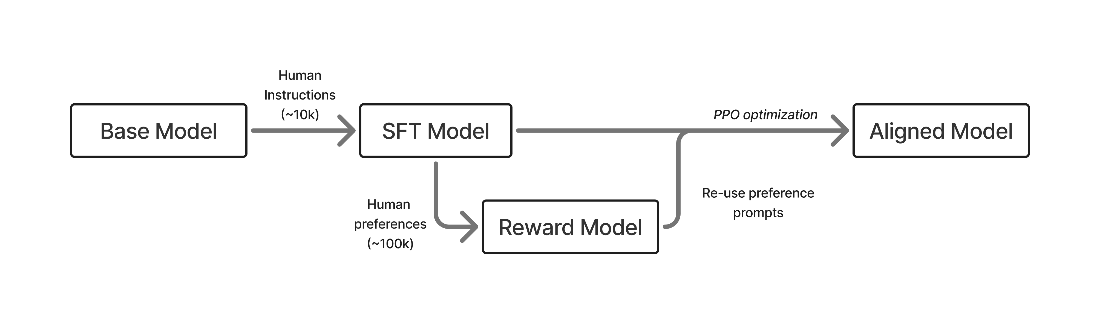
A rendition of the early, three stage RLHF process: first training via supervised fine-tuning (SFT, chapter 4), building a reward model (RM, chapter 5), and then optimizing with reinforcement learning (RL, chapter 6).
Summary
RLHF incorporates human preferences into AI systems to solve problems that are hard-to-specify programmatically, and became widely known through ChatGPT’s breakout, which made the capabilities of language models more approachable.
The basic RLHF pipeline has three steps: instruction fine-tuning to teach the model to follow the question-answering format, training a reward model on human preferences, and optimizing the model with RL against that reward.
RLHF is known to primarily change the style, tone, and format of model responses – making them more helpful, warm, and engaging. But it’s not “just style transfer”: RLHF also improves benchmark performance, though over-optimization (e.g., excessive length or chattiness) can harm capabilities in other domains.
The elicitation theory of post-training suggests that base models contain latent potential, and post-training’s job is to extract and cultivate that intelligence into useful behaviors.
RLHF is one component of modern post-training, alongside instruction fine-tuning (IFT/SFT) and reinforcement learning with verifiable rewards (RLVR), used together in an intertwined manner to craft particular training recipes.
FAQ
What is RLHF and why did it become important?RLHF, or Reinforcement Learning from Human Feedback, is a way to incorporate human preferences into AI systems. It became important because many real-world tasks are hard to specify exactly, but humans can still judge which outputs are better. RLHF helped make models more useful, helpful, and aligned with human expectations, and it became especially visible with the success of ChatGPT.What problem is RLHF trying to solve?RLHF is meant to solve hard-to-specify problems where writing an exact objective is difficult or impossible. Instead of trying to define the “right” answer in advance, it uses human preference signals to guide the model toward better behavior and responses.What are the three main steps in the basic RLHF pipeline?The classic RLHF pipeline has three stages: first, train an instruction-following model with supervised fine-tuning; second, collect human preference data to train a reward model; third, optimize the language model with reinforcement learning using the reward model as feedback.How does RLHF differ from supervised fine-tuning?Supervised fine-tuning teaches the model to imitate examples and learn the basic structure of instruction-following. RLHF goes further by ranking whole responses and nudging the model toward better ones, which helps shape style, helpfulness, and subtle preferences that are harder to capture with imitation alone.What kinds of changes does RLHF make to model behavior?RLHF often changes the model’s style, tone, and format. It can make answers more concise, warm, reliable, and engaging, rather than just technically correct. It helps transform a base text-completion model into a more conversational assistant.Why is style considered important in RLHF?Style matters because it affects how information is received by users. A model can say the same factual content in a blunt, confusing, or supportive way, and that changes the usefulness of the answer. RLHF helps align the model’s style with what people prefer in practice.What is the role of the reward model in RLHF?The reward model turns human preferences into a scalar score that can be optimized later. It learns from comparisons between responses and estimates which answers are better, so the RL stage can use that signal to improve the language model.Why is RLHF more complex than instruction tuning?RLHF is more complex because it depends on proxy reward models, noisy human preference data, and careful optimization control. It can suffer from issues like over-optimization and length bias, and it usually costs more in compute, data, and time than simple supervised fine-tuning.What does the book mean by “post-training”?Post-training refers to everything done after large-scale pretraining to make a model more useful, including instruction tuning, preference fine-tuning, RLHF, and reinforcement learning with verifiable rewards. RLHF is one major part of this broader post-training process.What is the main intuition behind post-training and RLHF?The book presents an “elicitation” view: base models already contain a lot of knowledge and capability, but post-training helps extract and shape that potential into useful behavior. In this view, pretraining builds the foundation, and post-training makes the model speak and behave in a way people can actually use.
pro $24.99 per month
access to all Manning books, MEAPs, liveVideos, liveProjects, and audiobooks!

 Reinforcement Learning from Human Feedback ebook for free
