11 Higher Kinded Types and Beyond
This chapter widens the familiar map idea from arrays and iterables to a broad family of generic “containers,” showing how the same transformation can be reused across many shapes of data while keeping branching and plumbing out of business logic. It introduces functors as the unifying concept behind these map operations and explains how higher kinded types provide the ideal type-level machinery to express them rigorously. Because TypeScript (like many mainstream languages) lacks higher kinded types, the chapter treats functors as a practical pattern rather than a checked interface, and even shows that functions themselves form functors via composition.
Through concrete examples (Option/undefined, Box, and Either), the text demonstrates how mapping decouples data storage from transformation and cleanly encapsulates error propagation. It then exposes the limitation of functors when every step in a pipeline can fail, motivating bind: whereas map expects T => U, bind expects T => H and prevents nested “boxes.” This leads to the monad pattern, pairing bind with a simple unit/return that lifts values into the context. In languages without higher kinded types, monads are again best approached as a consistent design pattern whose names (map, bind/then/flatMap, unit/return) may vary but whose behavior is uniform.
The chapter grounds monads with practical domains: Either for branchless error handling, Promise as the continuation monad (then as bind, resolve as unit), and the list monad, where bind both maps and flattens. It briefly surveys other widely used monads (state and IO) and closes by pointing beyond: learning functional programming to internalize these abstractions, understanding higher kinded types and category-theoretic roots, and exploring adjacent type system ideas such as dependent and linear types. The overall message is that these abstractions enable concise, composable pipelines that factor out control flow, error handling, and data management while remaining applicable across many contexts.
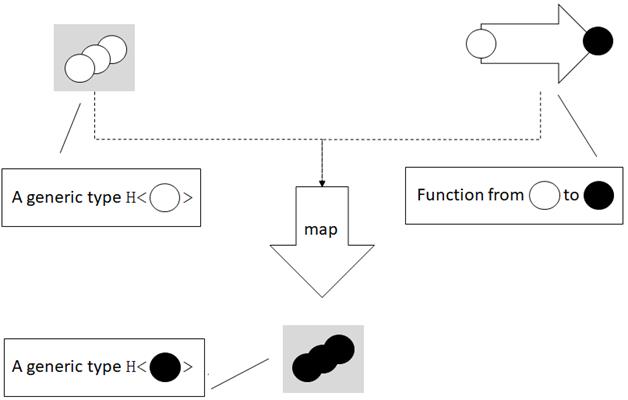
We have a generic type H which contains 0, 1, or more values of some type T, and a function from T to U. In this case T is an empty circle and U is a full circle. The map() functor unpacks the T or Ts from the H<T> instance, applies the function, then places the result back into an H<U>.
FAQ
What does “an even more general map” mean in this chapter?
It means lifting the familiar map algorithm beyond iterators/arrays so it can apply a function (T => U) to values wrapped in many generic contexts (like Optional<T>, T | undefined, Box<T>, Either<E, T>, or even functions), returning the same context with transformed values. This decouples data containers from the functions that operate on their contents.What is a functor in practical TypeScript terms?
A functor is any generic type H<T> that supports a map operation turning a function T => U into a function H<T> => H<U>. In practice we implement it either as: - a free function: map(h: H<T>, f: (t: T) => U): H<U>, or - a method on H<T>: h.map(f): H<U>.What are higher kinded types, and why do they matter here?
Higher kinded types are type constructors that take other type constructors as parameters (e.g., H<T> where H itself is generic). They let us write precise interfaces like Functor<H> with map returning H<U>. TypeScript lacks true HKT support, so we treat functors/monads as patterns rather than enforceable interfaces.How can map be defined for Optional<T>, T | undefined, and Box<T>?
- Optional<T>: If it has a value, apply f and wrap the result; otherwise return an empty Optional<U>.- T | undefined: If defined, return f(value); else return undefined.
- Box<T>: Unbox T, apply f, and rebox into Box<U>.

 Programming with Types ebook for free
