The chapter steps back to synthesize the book’s lessons: PostgreSQL succeeds across a wide range of users and use cases, but that breadth also invites diverse mistakes. Adopting a reliability and safety mindset—learning from both wins and failures—helps explain why problems happen and how to avoid them. Self-awareness about your role, constraints, and biases, paired with continuous learning and community engagement, becomes the foundation for better decisions and fewer surprises.
It outlines common user profiles—the dabbler, the cautious steward, the oblivious coder, and the freefaller—each prone to characteristic missteps such as misusing data types, resisting useful features, over-relying on ORMs, or cargo-culting fixes. The antidote is proactivity: treat small slowdowns and anomalies as early warnings; don’t wait for outages, data loss, or runaway costs to act. Review code and access patterns, monitor for anomalies, plan and test changes in staging, and use the ecosystem’s tooling and community knowledge to reduce technical debt before it accumulates.
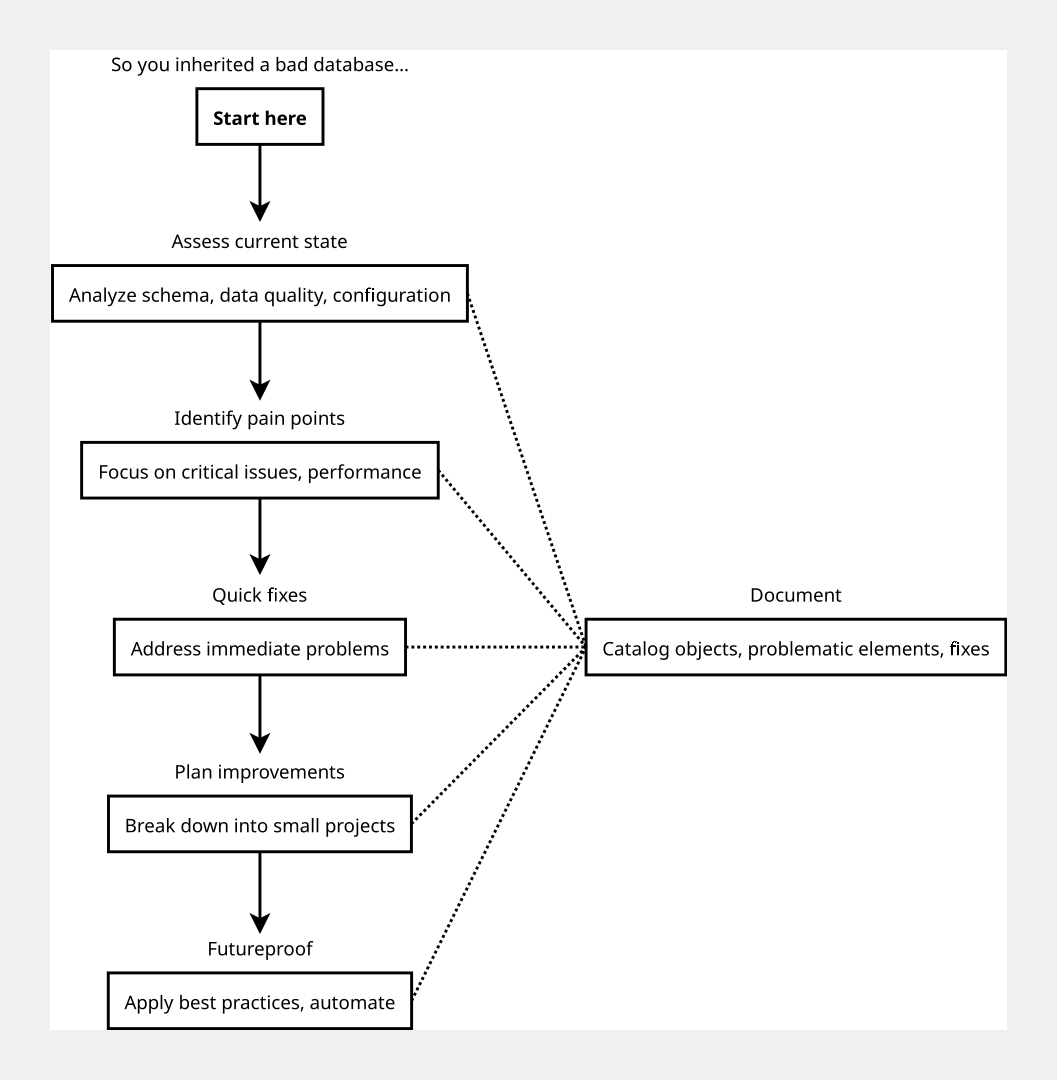
When inheriting a troubled database, acknowledge historical reasons, triage pain points, secure quick wins, and avoid the XY problem. Map the schema, inspect data quality, validate configuration, observe live workload statistics, and break remediation into manageable projects; then document, automate HA/DR and maintenance, and socialize clear guidelines. The chapter closes by advocating thoughtful stewardship: sound design and indexing, correct configuration, measurement-driven scaling, preventative maintenance (including diligent vacuuming), strong security and HA with solid backups, and judicious use of advanced features. Treat PostgreSQL as a partner—meet it halfway—and it will repay you with performance, reliability, and flexibility.
A roadmap for systematically assessing, fixing, documenting and improving an inherited database.
Summary
Misaligning your usage of PostgreSQL with your needs may stem from a lack of self-awareness and can lead to predictable mistakes. Recognizing your user profile and role-specific tendencies, biases, and limitations helps you focus on areas needing improvement to prevent mistakes and optimize your database interactions. Understanding what kind of user you are, following best practices, and seeking guidance allows for a more objective view of potential problems.
Waiting until problems escalate before intervening on performance, reliability, or scalability is an unnecessary risk. Plan for future growth and optimize from the beginning to prevent technical debt. Proactive measures like code reviews and usage pattern analysis, coupled with regular monitoring and prompt attention to inefficiencies, are crucial and can save you a lot of trouble.
Inheriting a poorly designed database means you should address major pain points as a priority before incrementally improving the system. Systematically assess the database using tools for schema inspection, data analysis, and performance monitoring. Along the way, document what you find and what you change, automate processes, share best practices, and take care to avoid the XY problem.
Failing to recognize PostgreSQL’s requirements, stemming from its versatile nature, can limit its effectiveness. Use it thoughtfully by optimizing queries, indexing effectively and through preventive maintenance to have a performant, stable and reliable system. Stay informed, and treat Postgres, its ecosystem, and its community as trusted partners on your data journey. Recognizing common mistakes and adopting best practices lets you harness PostgreSQL’s potential to build robust, reliable systems.
FAQ
What types of PostgreSQL users does the chapter describe, and why do they matter?The chapter outlines four archetypes—dabbler, cautious steward, oblivious coder, and freefaller. Each comes with strengths and blind spots that shape common mistakes, from misusing features and skipping docs (dabbler) to resisting new capabilities and upgrades (cautious steward), ignoring the database’s needs behind an ORM (oblivious coder), or applying copy‑paste fixes without context (freefaller). Recognizing your alignment helps you anticipate pitfalls and balance perspectives for better outcomes.I’m a “dabbler.” How can I explore PostgreSQL without falling into common traps?Clarify whether your use case fits relational/JSONB patterns or needs other paradigms (graphs, Parquet/Iceberg, streaming). Learn core SQL and data types to avoid shortcuts that create debt (bad SQL, wrong types). Prefer well-supported extensions and CDC tools when integrating other systems. Read docs, test in staging, and invest in understanding indexes, query plans, and autovacuum before scaling.What risks does the “cautious steward” face, and how can I stay current safely?Over-reliance on legacy habits (e.g., logical dump/restore as the only backup) and reluctance to adopt PostgreSQL-specific features can limit performance and flexibility. Balance safety with evolution: track new releases, plan regular upgrades, evaluate JSONB, partitioning, and modern index types. Replace fragile manual routines with automated, tested HA/backup processes. Keep an eye on ecosystem trends while preserving ACID guarantees and performance budgets.How can an “oblivious coder” avoid ORM and data-access pitfalls?Understand how your ORM translates queries; prevent N+1 patterns and move filtering/aggregation into SQL. Use correct data types (e.g., timestamps, numerics) instead of text and let the database enforce integrity. Size and manage connection pools; don’t demand thousands of idle connections. When using AI/vector, GIS, or other extensions, still treat Postgres as the system of record—monitor, index appropriately, and test plans.I feel like a “freefaller.” What’s the safest way to regain control of a complex setup?Pause and map the terrain before acting. Avoid cargo-culting blog snippets or blindly delegating to an LLM; verify every change. Ask for context and pain points; prioritize fixes that reduce immediate risk (security, backups, HA, runaway bloat). Use observability first—logs, pg_stat_activity, pg_stat_statements—to guide targeted, reversible changes.What are early warning signs I should act on immediately in PostgreSQL?- Queries getting slower or regressing across releases or data growth
- Rising bloat or autovacuum falling behind
- Approaching key space limits or storage exhaustion
- Spiking connection counts, replication lag, or lock contention
- Postponed upgrades needed for features/security
Don’t wait for outages: index, optimize, partition, tune autovacuum, right-size resources, and plan upgrades early.How do I build a proactive, learning-oriented database culture?Review code and query patterns regularly; share findings early. Monitor and alert on leading indicators, not just failures. Test changes in a production-like staging environment, then roll out gradually. Allocate time for training and knowledge sharing; participate in the Postgres community. Encourage foresight over firefighting to minimize technical debt.I inherited a bad database. What should I do first?Stabilize before optimizing. Identify and address burning issues (data loss risk, no backups, missing HA, disk/memory pressure). Capture the current state: pg_dump schemas, inventory configurations, and collect workload stats. Communicate with stakeholders to confirm the biggest pain points and buy time for systematic fixes.How do I systematically assess and improve an inherited PostgreSQL database?- Inspect schema with pg_dump, pgAdmin, or DBeaver; review naming, types, constraints, and indexes
- Explore data quality with targeted queries; validate assumptions and relationships
- Monitor runtime via logs, pg_stat_activity, pg_stat_statements to find hotspots
- Triage into small, measurable projects; fix easiest high-value items first
- Document decisions, automate HA/DR/maintenance, and share guidelines to futureproofWhat does “treat Postgres well and it will treat you well” mean in practice?Design clean schemas, choose correct data types, and write efficient SQL with proper indexing. Plan capacity and partitioning; monitor and maintain regularly (VACUUM/autovacuum). Enforce security, backups, redundancy, and tested failover. Stay current on features and extensions so you can pick the right tool (e.g., JSONB, specialized indexes) for each need. When you meet Postgres halfway, it delivers performance, reliability, and scalability.
pro $24.99 per month
access to all Manning books, MEAPs, liveVideos, liveProjects, and audiobooks!

 PostgreSQL Mistakes and How to Avoid Them ebook for free