1 Why model adaptation?
Enterprise teams often discover that a general-purpose LLM can sound convincing while still being wrong in ways that matter operationally. The chapter opens with a cautionary example: a policy assistant confidently invents a reimbursement clause and an escalation path, showing that fluency does not equal organizational knowledge. That gap—between what a base model can do broadly and what a business needs it to do precisely—is the central reason to adapt a model rather than use it unchanged.
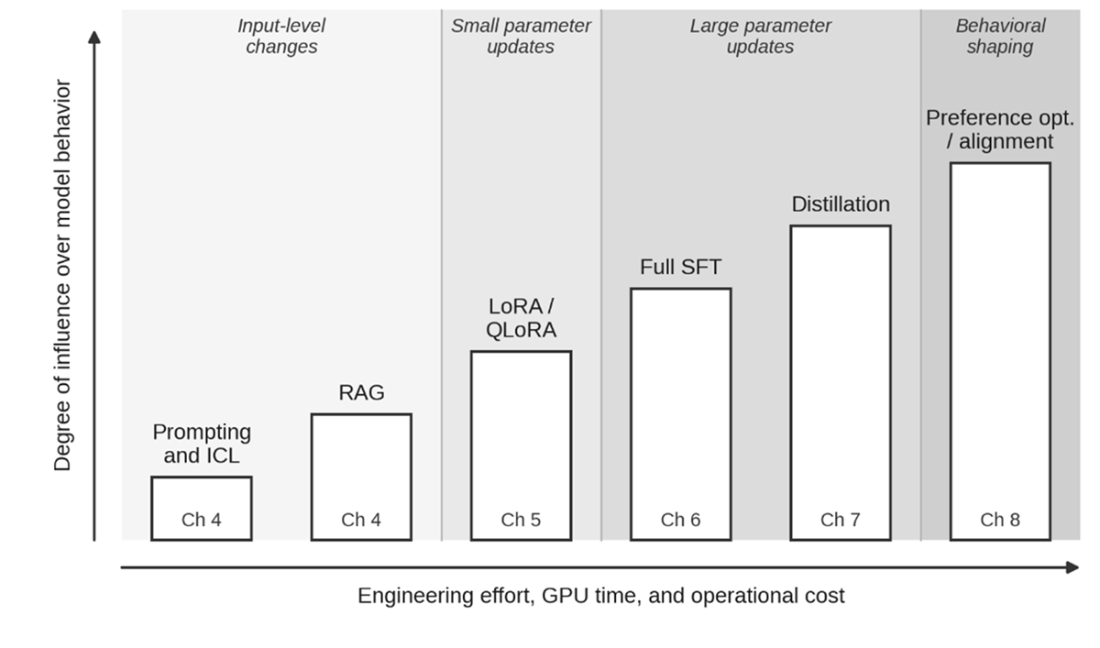
Adaptation is presented as a continuum, not a yes-or-no decision: prompting and few-shot examples, retrieval-augmented generation, parameter-efficient tuning like LoRA and QLoRA, full supervised fine-tuning, distillation, and alignment all sit on different rungs with different costs and benefits. The chapter explains when adaptation pays off, especially for industry-specific tasks, regional language and culture needs, and enterprise tone or brand voice. It also ties the decision to ROI in practical terms, emphasizing cost at scale, privacy and regulatory constraints, latency, competitive advantage, and the often-underestimated human effort needed to curate data and maintain evaluation.
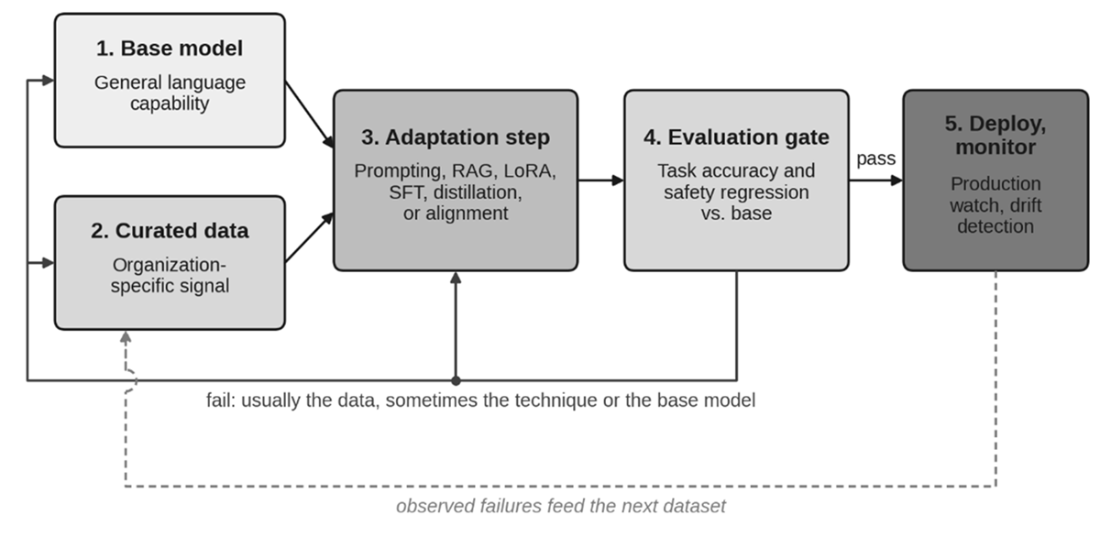
Just as important, the chapter explains when not to adapt: if a frontier model plus a good prompt already meets the requirement, if the task is still early and poorly understood, if the team lacks enough high-quality data, or if the base model is improving faster than the team can keep up. It frames adaptation as a lifecycle with a base model, curated data, an evaluation gate, and ongoing monitoring, and argues that the real work is not merely changing weights but building a disciplined process. The practical takeaway is to measure first, choose the lightest technique that solves the problem, and only move up the ladder when evidence shows the current rung is insufficient.
The model adaptation continuum as a ladder of six rungs, ordered by engineering effort and by influence over model behavior; the ordering matters more than the spacing.
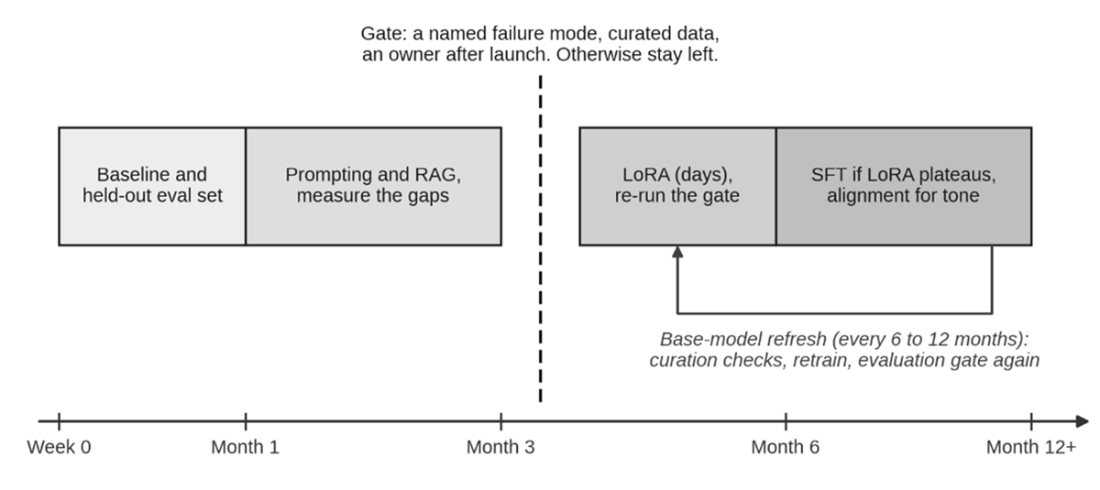
When adaptation starts, and why every base-model refresh sends the project back through the gate.
The model adaptation lifecycle
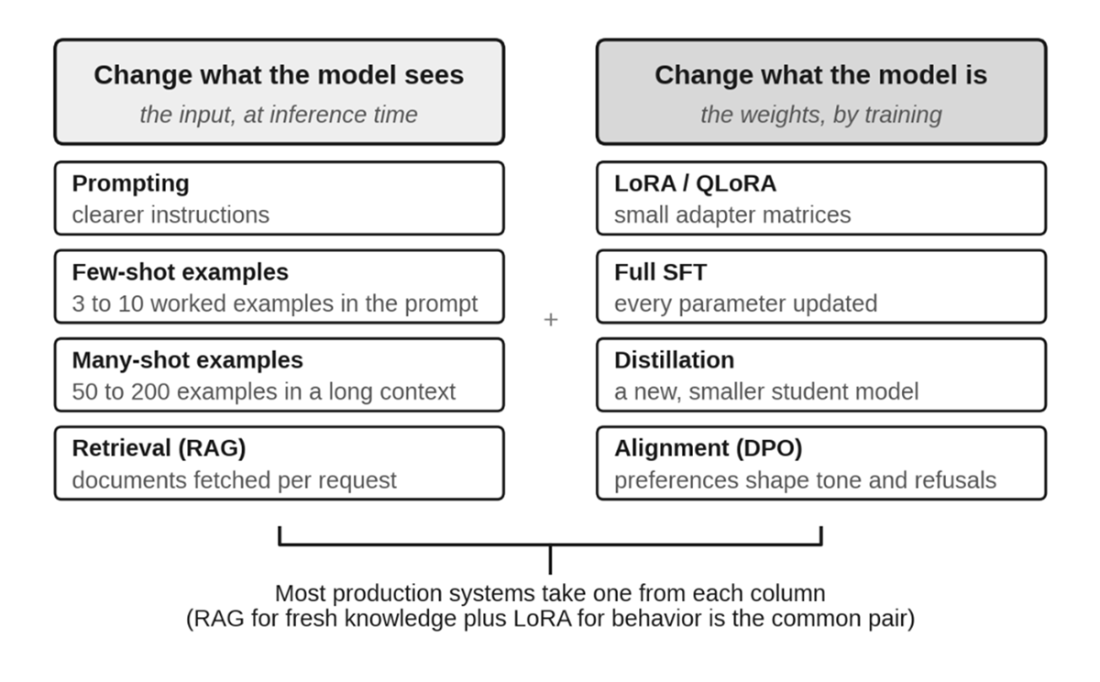
Two axes of adaptation: techniques that change what the model sees, and techniques that change what the model is.
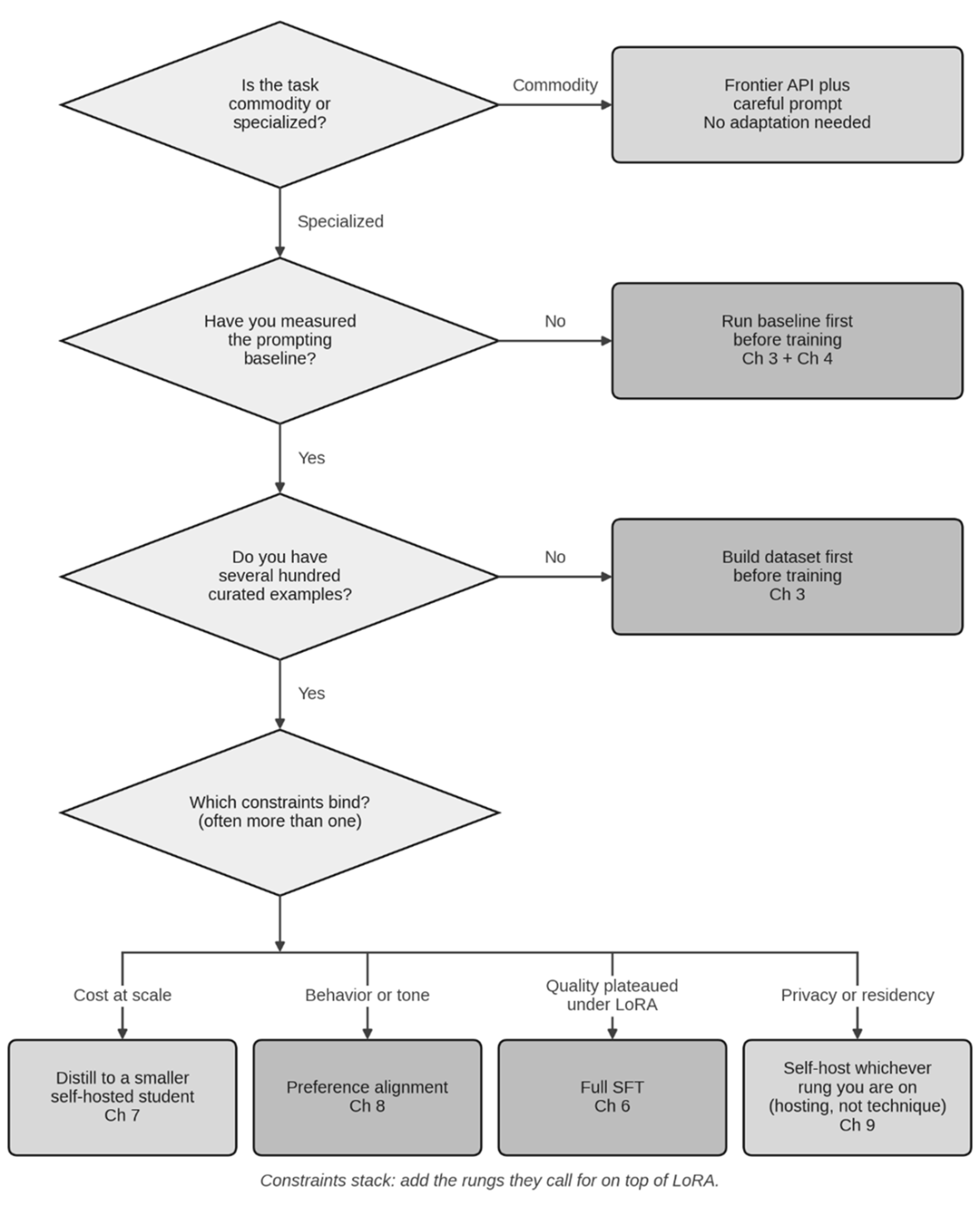
A decision flowchart for choosing your first adaptation technique.
Summary
- Off-the-shelf LLMs are generalists; enterprises need specialists. The right framing is a continuum, not “fine-tune or not.” The question is which rung of the ladder this specific problem fits.
- Four questions structure every adaptation project: do we need to fine-tune at all, how much data, open-source or frontier API, and what is the difference between fine-tuning, distillation, and alignment.
- Model adaptation is a five-stage lifecycle: base model + curated data → adaptation technique → evaluation gate → deploy and monitor → feedback to data curation. The technique is one of the five places a project can fail.
- Three scenarios drive most enterprise work: industry-specific specialization, regional and cultural adaptation, and enterprise tone and brand.
- ROI breaks down into cost (a clear saving against frontier reasoning models, a modest one against mainstream tiers at a million calls a month, and none against the fast tiers), privacy and data sovereignty, latency, competitive advantage, and the human effort that dominates all of them. Common pain points are accuracy gaps, API cost at scale, regulatory constraints, and vendor lock-in.
- Adaptation is the wrong answer for commodity use cases, early-stage projects without baselines, projects without enough high-quality data, cases where the frontier model is already good enough, and cases where the base model is improving faster than you can re-adapt.
- The continuum runs from prompting and RAG through LoRA and full SFT to distillation and alignment. A four-question decision framework points each project to its starting technique.
- Adaptation does not fix confabulation by itself. Fine-tuning on generic instruction data can make a model’s wrong answer more confident, not more correct. Closing the gap requires training data that explicitly demonstrates the desired behavior and, often, preference optimization on top.
- Adaptation can weaken model safety properties.

 LLM Customization and Fine-Tuning ebook for free
