Overview

1 Recommender systems in action

Recommender systems sit at the heart of today’s digital experiences, quietly ordering the overwhelming abundance of choices we face and concentrating attention on a tiny fraction of items. In social media, shopping, entertainment, news, and even dating, they personalize feeds to save time and surface what seems most relevant. Crucially, people and algorithms coevolve in a feedback loop: recommendations shape what we see and engage with, and our engagements train the next set of recommendations. This cycle can efficiently connect users to content—but it can also steer attention, norms, and beliefs, sometimes nudging behavior toward more extreme material through a process the chapter frames as algorithmic amplification.

The chapter explains recommender systems as ranking algorithms increasingly powered by machine learning and embedded across platform designs. Social media illustrates their rise: early chronological feeds gave way to algorithmic curation that prioritizes predicted engagement, shifting from subscription-only exposure to models that include network reshares and out-of-network content chosen by the system. The benefits are clear—less friction, tailored discovery, and scalable distribution—but so are the trade-offs: filter bubbles, cultural homogenization, addiction via intermittent rewards, creator dependence on opaque ranking shifts, and heightened risks for vulnerable users when harmful content is repeatedly reinforced. As gatekeeping erodes and virality accelerates, the societal stakes expand from individual relevance to public discourse, safety, and democratic health.

Because attention is finite, recommendation is inherently a form of amplification—deciding who and what gets seen. The chapter argues that understanding this influence requires measuring amplification, yet doing so is hard: “value” is elusive, engagement is an imperfect proxy, popularity can be self-reinforcing, and user–algorithm–society interactions evolve over time. These dynamics can normalize fringe or emotionally charged content and scale real-world consequences, all within markets dominated by a few platforms fortified by network effects and lobbying. The authors propose treating amplification transparency like nutrition labels: standardized, evolving metrics that illuminate how content is selected and ranked. Establishing shared, rigorous definitions is presented as a prerequisite for accountability, effective oversight, and healthier digital ecosystems.

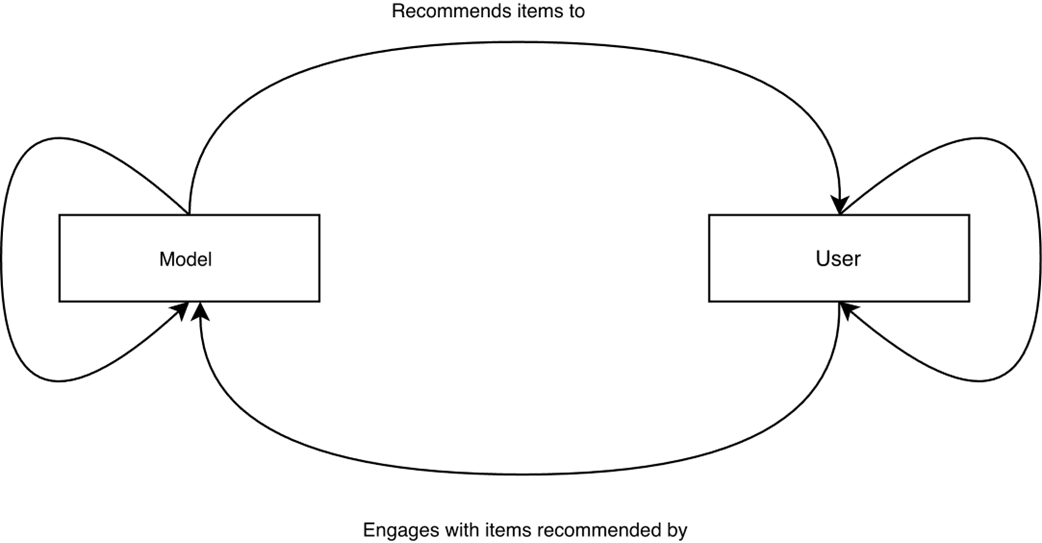
The feedback loop between user and recommender systems. Users and recommender systems are in a mutual feedback loop, with the output of one serving as the input to the other. The output of the algorithm, the recommendations, is the input for the users. The users’ output, what they engage with, is a signal for the recommender. On top of that, both the user and the recommender system update their internal state. Users change their minds and evolve their preferences over time, while algorithms learn users’ preferences and try to align more with them.
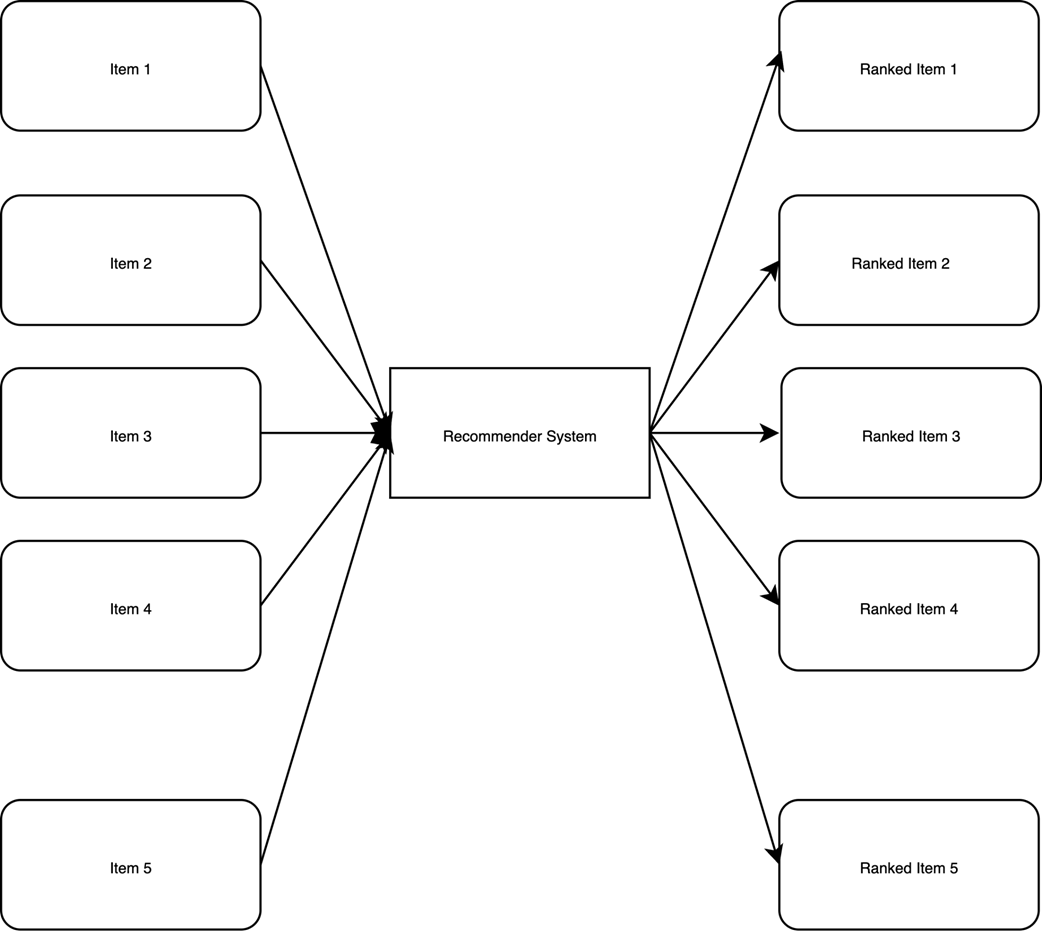
Given a list of items, this recommender system reranks them according to a predefined metric, such as value to the user.
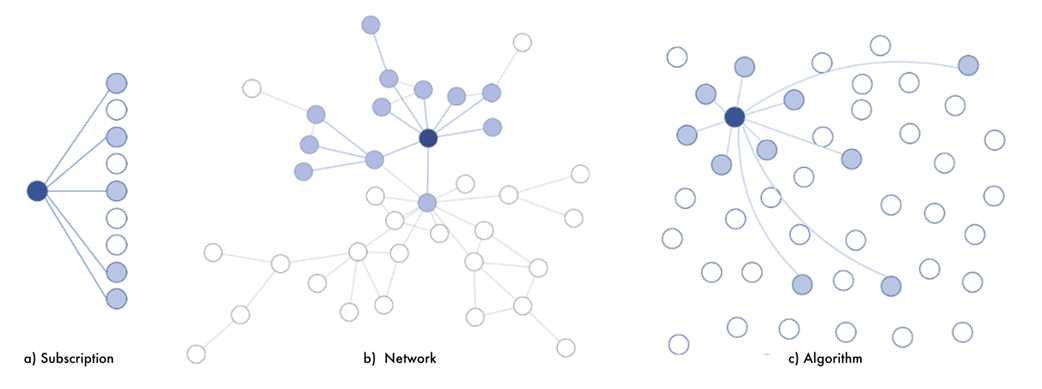
Various social media models. In the Subscription model, the content is seen only by users who explicitly follow the content producer, with no options or resharing. In the Network model, users can also reshare content from users they follow, enabling the distribution of content outside of the immediate network. Finally, in the Algorithmic model, an algorithm can add content to users’ feeds, even with no direct connection to the content itself or its author.
Summary

  • Recommender systems are a powerful tool—and often underappreciated as a tool to order vast amounts of information for us. As a technology that pervades every application we interact with, RecSys have the power to influence our preferences in numerous domains, including highly consequential ones such as news consumption, dating choices, and financial decisions.
  • Social media was created as a tool to connect people on the internet—at first free of commercial interest—and to build location-free communities around shared interests.
  • The evolution of the internet has brought about more online platforms that have been able to connect an unprecedented number of people. Given the high running costs and the investors’ demands, platforms were nudged into finding ways of monetizing such efforts.
  • Social media platforms began experimenting with recommender systems as a means to align business and customer interests. By explicitly indicating business goals and taking into account users’ behavior, platforms were able to serve more relevant content to users—which made the users be more active and spend more time on the platforms.
  • The use of such algorithms raises important questions about algorithmic amplification, such as understanding which content is amplified more and why. Different types of platform designs enable various approaches to thinking about amplification.

FAQ

What is a recommender system (RecSys)?A recommender system is a specialized algorithm that orders a set of items according to a goal (for example, user value or predicted engagement). It can be non-personalized (like reverse-chronological order) or personalized by learning from past user interactions to rank unseen items by inferred preference.
How do users and recommender systems influence each other?They form a feedback loop. The system’s output (recommendations) becomes the user’s input; the user’s output (clicks, likes, dwell time, follows) becomes the system’s input. Both the user and the algorithm update over time, which can reinforce and push content toward extremes.
Where do RecSys show up in everyday life?Practically everywhere online: e-commerce product suggestions, travel and hotel matching, news “what to read next,” social feeds and people-to-follow, streaming queues, and dating matches. Their rankings funnel attention and have real economic and cultural consequences.
What would a world without RecSys look like?Users would sift through massive catalogs and endless user-generated posts, making discovery slow and frustrating. RecSys save time by surfacing likely-relevant items and can align user and business incentives—though they also introduce downsides like filter bubbles and cultural homogenization.
How did algorithmic feeds emerge and evolve on social media?Facebook’s 2007 EdgeRank moved feeds from reverse-chronological to relevance ranking. Later, platforms like Twitter/X (2017), Instagram (2016), and LinkedIn (2017) adopted machine learning feeds, shifting optimization toward engagement. This supports “surveillance capitalism”: more time spent yields more behavioral data and ad revenue.
What are the main social media feed models?
  • Subscription: you see posts only from accounts you explicitly follow.
  • Network: you see followed accounts plus what they reshare; virality emerges.
  • Algorithmic: you also see out-of-network (OON) content added by algorithms that curate and rank beyond your explicit connections.
What is algorithmic amplification, and why measure it?Amplification is the extra exposure content gets because of the algorithm. Measuring it reveals what types of content are promoted. It’s hard in practice and involves both steps—selection (what enters the feed) and ranking (what’s shown first). A proposed approach is platform “amplification reports,” like nutrition labels.
What risks and societal impacts are linked to RecSys?
  • Radicalization via feedback loops and OON recommendations.
  • Mis/disinformation spread, and emotionally charged content traveling farther.
  • Harms to vulnerable users (for example, eating-disorder content).
  • Creator precarity when algorithm changes shift reach.
  • Addictive use patterns via intermittent rewards and dopamine hits.
  • Documented real-world harms (for example, role in the Rohingya genocide).
Why is measuring RecSys impact so difficult?There’s no agreed measure of “Value” to users; platforms use engagement as a proxy (which clickbait can game). Popularity begets popularity. Users and algorithms co-evolve, and effects are networked and time-varying (the “butterfly effect”). Even courts (for example, Gonzalez v. Google) grapple with assigning responsibility.
How do platform power and regulation shape outcomes?Network effects create dominant, hard-to-regulate platforms. Heavy lobbying slows or waters down rules; some regulations (like GDPR compliance costs) can entrench incumbents. Proposals include treating key services more like public utilities and publishing amplification metrics. Platform-level tweaks can sway public opinion with global consequences.

pro $24.99 per month

  • access to all Manning books, MEAPs, liveVideos, liveProjects, and audiobooks!
  • choose one free eBook per month to keep
  • exclusive 50% discount on all purchases
  • renews monthly, pause or cancel renewal anytime

lite $19.99 per month

  • access to all Manning books, including MEAPs!

team

5, 10 or 20 seats+ for your team - learn more


choose your plan

team

monthly
annual
$49.99
$399.99
only $33.33 per month
  • five seats for your team
  • access to all Manning books, MEAPs, liveVideos, liveProjects, and audiobooks!
  • choose another free product every time you renew
  • choose twelve free products per year
  • exclusive 50% discount on all purchases
  • renews monthly, pause or cancel renewal anytime
  • renews annually, pause or cancel renewal anytime
  • Hidden Influences ebook for free
choose your plan

team

monthly
annual
$49.99
$399.99
only $33.33 per month
  • five seats for your team
  • access to all Manning books, MEAPs, liveVideos, liveProjects, and audiobooks!
  • choose another free product every time you renew
  • choose twelve free products per year
  • exclusive 50% discount on all purchases
  • renews monthly, pause or cancel renewal anytime
  • renews annually, pause or cancel renewal anytime
  • Hidden Influences ebook for free
