6 Business Continuity Planning
Business continuity planning is about preparing an organization to keep delivering essential products and services when disruptive events occur. Since disasters, cyberattacks, outages, equipment failures, and human error can interrupt normal operations, organizations need a proactive approach that identifies critical functions and builds resilience before a crisis happens. The goal is not to prevent every disruption, but to ensure that important operations can continue at an acceptable level while recovery is underway.
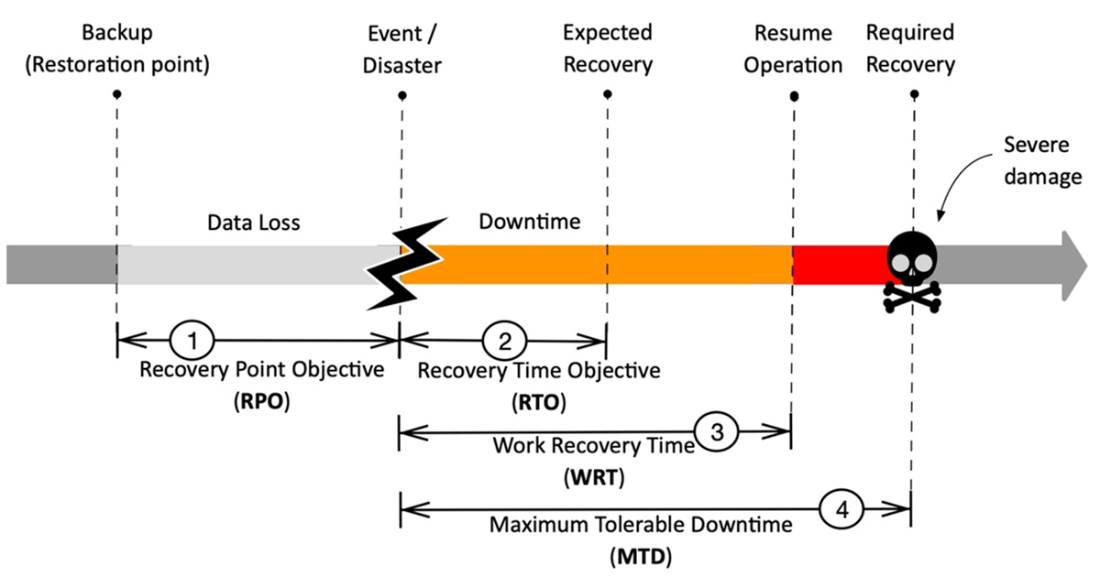
A major part of this process is the business impact analysis, which helps determine which business functions matter most and how badly they would be affected by an interruption. It uses recovery metrics such as Recovery Point Objective, Recovery Time Objective, Work Recovery Time, and Maximum Tolerable Downtime to prioritize what must be restored first and how quickly. Because business processes depend on people, technology, facilities, and external partners, the analysis often requires workshops, interviews, questionnaires, and operational review to accurately assess dependencies and recovery needs.
Once critical functions and recovery targets are identified, organizations build a business continuity plan that defines roles, procedures, activation triggers, communication paths, and contingency actions. The plan must be specific enough to guide teams during emergencies, but flexible enough to stay current as the business changes. Testing is essential to confirm the plan will work in practice, and methods range from simple walkthroughs to full-scale exercises that reveal weaknesses, improve readiness, and strengthen the organization’s ability to maintain operations under adverse conditions.
Meaning of key metrics used in business impact analysis with respect to time
Answers to Review Questions
- The correct answer is B. The primary purpose of a business continuity plan is to maintain business operations while recovering from a significant disruption. A business continuity plan outlines the procedures and instructions an organization must follow in the face of such disasters; it covers business processes, assets, human resources, business partners, and more.
- The correct answer is C. A Business Impact Analysis (BIA) is a systematic process for identifying and evaluating the potential impact of an interruption to critical business operations as part of business continuity planning. A BIA helps identify and prioritize the critical business functions affected by a disaster, facilitating recovery and maintaining business operations.
- The correct answer is D. In the team member list of a Business Continuity Plan (BCP), it is critical to have multiple methods of contact and a list of back-up members to allow for accessible communication and contingency planning in case the initially assigned members become incapacitated or unavailable during an incident.
- The correct answer is B. Careful designation of a new decision maker is the best approach in an emergency when one person is unavailable. This process ensures continuity and that critical decisions are made quickly and effectively
- The correct answer is A. Simulations are full re-enactments of business continuity procedures and can involve most, if not all, of the organization workforce. They also tend to take place on-site in the relevant business areas. Thus, they are an exceptionally effective way to test your business continuity plan. Walkthroughs verbally carry out specific recovery steps stipulated in the business Continuity plan. Discussion and reviews are static ways of testing the business continuity plan.

 Fundamentals of Cybersecurity ebook for free
