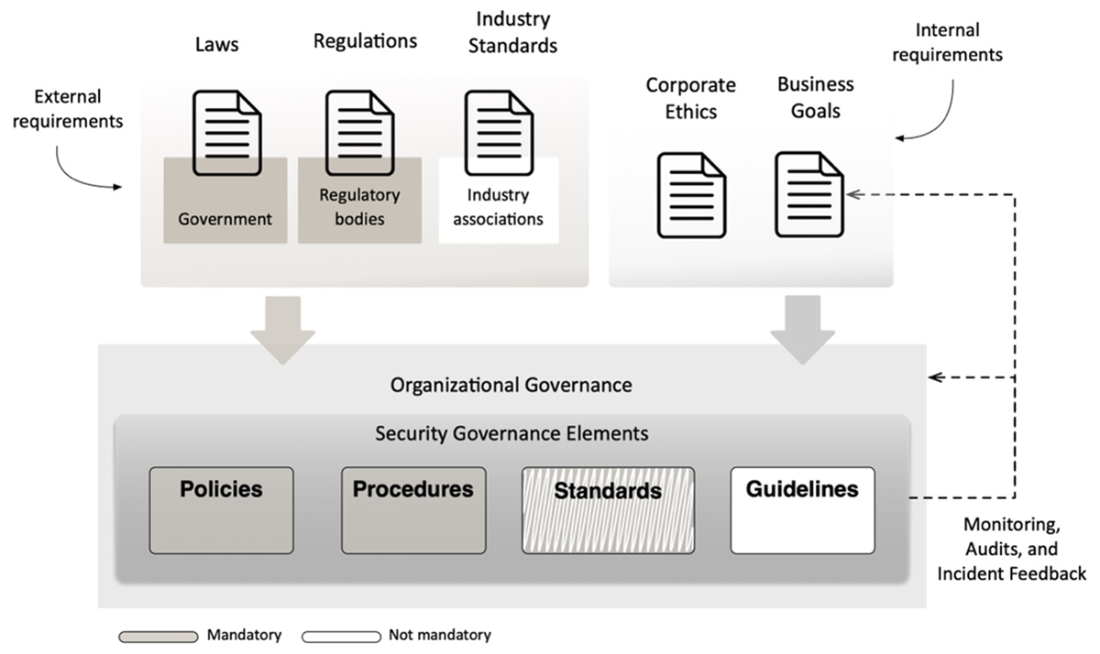
Governance in cybersecurity is the system that directs and controls how an organization makes decisions, assigns responsibility, and monitors outcomes so that security efforts support business goals. The chapter explains that governance is not a one-time activity but a cyclical process: external requirements such as laws, regulations, industry standards, and ethical expectations feed into organizational direction, while the results of security activities can reveal new risks, compliance gaps, or business impacts that require changes to policies, controls, and priorities.
The main governance building blocks are laws, regulations, standards, policies, procedures, and guidelines, each serving a different role and level of enforceability. Laws and regulations are mandatory and legally binding, while standards offer structured best-practice guidance that may become mandatory once adopted or required by contract or regulation. Policies translate external requirements and business goals into internal rules, procedures turn those rules into step-by-step actions, and guidelines provide flexible recommendations that help organizations adapt good practices to their own environment and maturity level.
The chapter also emphasizes that understanding major privacy and security laws is essential for cybersecurity professionals. It highlights regulations such as GDPR, HIPAA, and GLBA to show how different jurisdictions and industries impose obligations for protecting personal, health, and financial information, often with significant penalties for noncompliance. Overall, effective security governance depends on aligning these elements so that organizations can manage risk, comply with obligations, and implement practical, consistent security practices.
Illustration of the relationship between external requirements and security governance elements
Answers to Review Questions
The correct answer is A. Regulations are created by governments or national authorities, and often result in financial penalties for non-compliance. For example, the EU's GDPR imposes penalties of up to 4% of annual revenue. Unlike regulations, standards are voluntary and policies and guidelines are internal to organizations, and are therefore not subject to financial penalties.
The correct answer is A. Procedures are detailed and help ensure consistency in the implementation of security measures. Although policies are high-level statements that provide guidance on how to achieve a desired outcome, regulations are laws that must be followed, and standards are guidelines that provide a set of criteria to be met, any of them provide the specific step-by-step instructions.
The correct answer is B. Guidelines provide recommendations or suggestions for achieving a particular goal or objective. They are often less formal than standards and policies, and are used to specify best practices or recommended approaches. Regulations are typically created by government agencies or regulatory bodies, and are enforceable by law.
The correct answer is C. HIPAA stands for the Health Insurance Portability and Accountability Act. It is a U.S. law that governs the use and disclosure of protected health information (PHI). This law applies to all entities that handle PHI in the U.S., including healthcare providers, health plans, and healthcare clearinghouses.
The correct answer is D. Standards are guidelines or frameworks established by industry organizations to achieve specific outcomes, which may become mandatory when adopted by certain industries or incorporated into legal agreements. Regulations are legally binding rules issued by government agencies that must be complied with to avoid penalties.
FAQ
What is governance in the context of cybersecurity?Governance is the system by which an organization is directed and controlled. In cybersecurity, it ensures that security activities are aligned with business goals, legal and regulatory requirements, and risk management priorities.Why are governance frameworks important for security?Governance frameworks provide the structure needed to guide security decisions and actions. They help translate high-level organizational direction into consistent rules, roles, and processes for managing cybersecurity.What are the key building blocks of governance discussed in this chapter?The key building blocks of governance are laws, regulations, standards, policies, procedures, and guidelines. Together, they help organizations operate securely, consistently, and in compliance with applicable requirements.How do laws and regulations differ from standards?Laws and regulations are legally binding and mandatory. Standards provide structured guidance and best practices; they are usually voluntary unless adopted by regulation, contract, or organizational policy.What is the purpose of a security policy?A security policy is a high-level statement of management intent that defines what the organization expects to achieve in security. It translates external requirements and business objectives into internal direction.How are procedures different from policies?Policies define principles, expectations, and boundaries, while procedures explain how to carry out specific tasks step by step. Procedures operationalize policies into repeatable actions.What makes guidelines different from standards and policies?Guidelines are flexible recommendations rather than mandatory rules. They support decision-making and good practice, but organizations are not penalized for not following them.Why must organizations review policies periodically?Policies should be reviewed periodically, often annually, to ensure they still align with evolving threats, regulatory requirements, and business objectives. Regular review keeps policies relevant and effective.What is the role of standards such as ISO/IEC 27001 or NIST SP 800-53?These standards provide benchmarks and guidance for building and maintaining security programs. ISO/IEC 27001 focuses on information security management systems, while NIST SP 800-53 offers a catalog of security and privacy controls.How does GDPR differ from HIPAA and GLBA?GDPR is a broad European privacy law that protects personal data and applies to organizations processing data of EU individuals. HIPAA focuses on protecting health information in the U.S., and GLBA protects non-public personal information in the U.S. financial sector.
pro $24.99 per month
access to all Manning books, MEAPs, liveVideos, liveProjects, and audiobooks!

 Fundamentals of Cybersecurity ebook for free
