Cybersecurity certifications are presented as a practical way to turn knowledge into recognized evidence of competence. Because employers must trust people with access to sensitive systems and information, certifications provide an objective standard that helps hiring managers identify qualified candidates, gives professionals a shared professional language, and can open doors to interviews, promotions, and career transitions. For newcomers especially, they also provide structure, focus, and a clear path into the field.
The chapter then explains how certifications vary by experience level and purpose. Entry-level credentials are aimed at people beginning their cybersecurity journey, while intermediate and advanced certifications support growing specialization, leadership, and management roles. It also distinguishes vendor-neutral certifications, which emphasize broad concepts and best practices, from vendor-specific ones tied to particular technologies. The ISC2 Certified in Cybersecurity credential is highlighted as a strong first step because it requires little or no prior experience, is widely recognized, and helps learners build a foundation for future study and career growth.
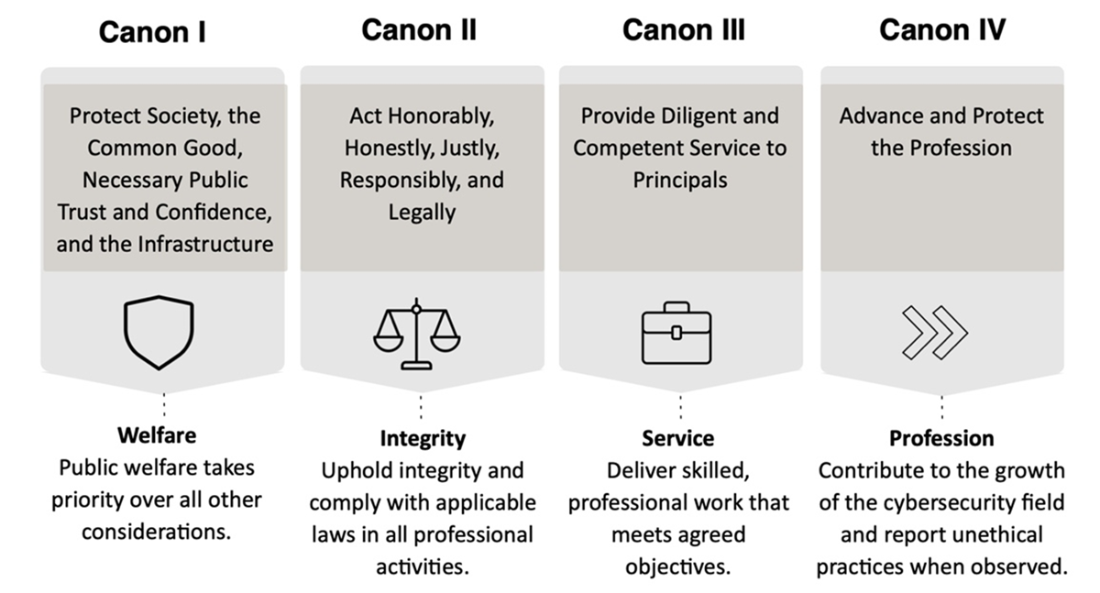
The chapter also walks through the certification journey, from exam registration and test-day procedures to what happens after passing. It emphasizes careful attention to identity requirements, exam rules, time management, and the adaptive, one-question-at-a-time format of the test. Beyond the exam itself, candidates must complete the certification process and agree to professional expectations, especially the ISC2 Code of Ethics. That code centers on protecting society, acting honorably and legally, serving clients competently, and advancing the profession, reinforcing the idea that cybersecurity requires both technical skill and trustworthy conduct.
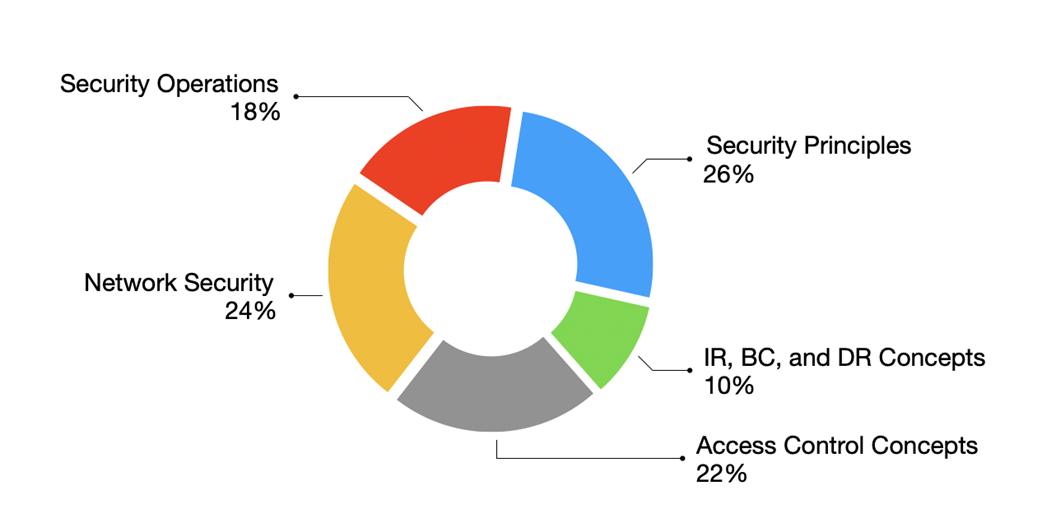
Approximate relative weight distribution of question topics in the exam
Summary of ISC2 Canons and their main goals
Answers to Review Questions
The correct answer is B. While reporting security vulnerabilities is an important aspect of information security; it is not explicitly stated as a principle within the ISC2 Code of Ethics Canons.
The correct answer is C. Provide diligent and competent service to principals. This principle emphasizes the importance of providing quality service to clients or employers and fulfilling professional responsibilities with due care and expertise.
The correct answer is A. Protect society, the common good, necessary public trust and confidence, and the infrastructure. This Canon emphasizes a security analyst's duty to avoid harm and uphold public well-being by protecting society, the common good, necessary public trust and confidence, and the infrastructure.
The correct answer is D. Having fake social media profiles and accounts can be socially objectionable but does not violate the ISC2 Ethics Canons. That being said, seeking to gain unauthorized access to resources on the internet, compromising the privacy of users, and disrupting the intended use of the internet are all considered unethical behaviors by ISC2, as well as by other similar professional organizations. Aside from being violations of professional codes of conduct, such actions may also be in violation of laws and regulations.
The correct answer is C. The ISC2 Code of Ethics applies specifically to ISC2 members and certified professionals, not to all members of the information security. All the other statements are true. Adherence to the code is a condition of certification, failure to comply with the code may result in revocation of certification, and members who observe a breach of the code are required to report the possible violation.
FAQ
Why do cybersecurity certifications matter?Cybersecurity certifications matter because they provide an independent, verifiable way to prove knowledge and skills. They help employers trust that a candidate meets an established standard and give professionals a common, recognized credential.What are the main benefits of earning a cybersecurity certification?Benefits include helping you pass hiring filters, increasing professional credibility, supporting career advancement and earning potential, encouraging continuous learning, and providing a pathway into cybersecurity for people changing careers.What are the main levels of cybersecurity certifications?Cybersecurity certifications are generally grouped into three levels: entry-level, intermediate, and advanced. Entry-level certifications are best for beginners, intermediate certifications are for professionals with some experience, and advanced certifications are for senior or leadership roles.Why is the ISC2 Certified in Cybersecurity (CC) a good starting certification?The CC is designed for people with little or no cybersecurity experience. It covers foundational concepts, is widely recognized, and provides a structured way to validate readiness for entry-level cybersecurity roles.What is the difference between vendor-neutral and vendor-specific certifications?Vendor-neutral certifications focus on general concepts, principles, and best practices that apply across many technologies. Vendor-specific certifications validate skills with a particular company’s products or platforms, such as cloud or networking tools.How do you register for the ISC2 CC exam?You register by logging into your ISC2 account, completing the Exam Account Information form, and then using Pearson VUE to choose the exam, language if applicable, location, and time. You also review the non-disclosure agreement and pay for the exam.What should you know about taking the CC exam on exam day?You must arrive early with two valid forms of identification, complete check-in, store personal belongings in a locker, and follow proctor instructions. Unscheduled breaks count against your exam time, and you cannot return to a question after moving on.How is the ISC2 CC exam scored?The CC exam uses computerized adaptive testing and lasts up to two hours. It includes about 100 to 125 multiple-choice questions, and a passing score is 750 out of 1000 on a scaled scoring system.What happens after you pass the CC exam?After passing, you receive a provisional pass and then complete the certification application by confirming your details and agreeing to the ISC2 Code of Ethics. Once approved, you receive your certification, digital badge, and related member benefits.What are the four canons of the ISC2 Code of Ethics?The four canons are: protect society, the common good, necessary public trust and confidence, and the infrastructure; act honorably, honestly, justly, responsibly, and legally; provide diligent and competent service to principals; and advance and protect the profession.
pro $24.99 per month
access to all Manning books, MEAPs, liveVideos, liveProjects, and audiobooks!

 Fundamentals of Cybersecurity ebook for free
