Security awareness is presented as a necessary complement to technical controls because human behavior can weaken even strong defenses. Attackers often target people through pressure, trust, urgency, and social engineering, so organizations need programs that help employees recognize threats, understand policies, appreciate consequences, and know how to respond appropriately. The goal is not to make everyone a security expert, but to reduce human-related risk and strengthen everyday decision-making.
Over time, repeated awareness efforts can evolve into a security culture, where secure behavior becomes a shared expectation rather than a special effort. In a strong culture, leaders model good behavior, employees feel safe reporting mistakes, security is considered in business decisions, and peers reinforce good habits. This cultural maturity improves reporting, compliance, engagement, and resilience without necessarily requiring major new technology investments.
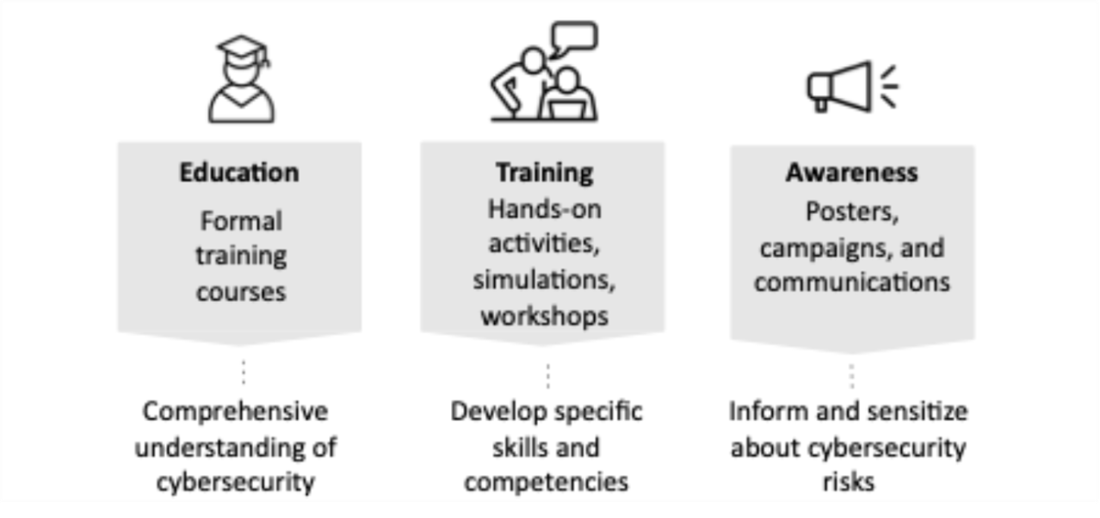
To achieve these results, organizations use structured security awareness programs built on leadership support, careful planning, role-based content, varied delivery methods, and continuous evaluation. The chapter also distinguishes education, training, and awareness: education builds foundational understanding, training develops practical skills, and awareness keeps security visible through reminders and campaigns. Together, these approaches reinforce secure habits, address different job roles and risk levels, and help create a stronger overall security posture.
Education, training, and awareness mapped to delivery methods, and outcomes in a security program
Answer to Review Questions
The correct answer is A. An awareness poster or campaign can be effective in engaging a user's attention and encouraging them to consider their password practices.
The correct answer is B. Program Planning and Design, aligning the program with what the business needs, which is exactly what the question describes.
The correct answer is C. Phishing is an attack on information systems that attempts to fraudulently acquire sensitive information such as usernames, passwords, or credit card details by posing as a legitimate entity. Therefore, security awareness training programs must teach users how to recognize and report common phishing attempts to minimize the amount of information that malicious actors can gain access to.
The correct answer is D. Smishing is a social engineering attack that consists of sending fraudulent text messages to trick the recipient into divulging personal information. For example, a help desk employee might receive a bogus text message requesting immediate payment of a large and unfamiliar bill in order to trick the recipient into clicking on a hyperlink that may lead to a fraudulent Web site designed to capture their personal and financial information.
The correct answer is B. Workshops and Group Sessions emphasize collaboration, discussion, and group problem-solving to reinforce learning through interaction.
FAQ
What is security awareness in cybersecurity?Security awareness is the practice of helping people recognize threats, understand security policies and expectations, and follow secure behaviors to protect themselves and the organization.Why is the human factor considered a major security risk?Because attackers often exploit human behavior, mistakes, trust, urgency, and poor judgment to bypass technical controls and gain access to systems or information.What are the four fundamental capabilities of security awareness?They are awareness of security policies and expectations, understanding consequences, recognizing threats, and knowing how to act when a security issue occurs.What is the difference between security awareness and security culture?Security awareness focuses on understanding risks and expected behaviors, while security culture is the long-term mindset where secure behavior becomes embedded in everyday work and organizational norms.What benefits does a strong security culture provide?It can increase reporting of suspicious activity, reduce security incidents, improve compliance with policies, and increase employee engagement with security responsibilities.What is a security awareness program?A security awareness program is the structured way an organization delivers security awareness, training, and education to employees in order to build and reinforce a security culture.Why do organizations implement security awareness programs?Common reasons include compliance requirements, building a stronger security culture, and responding to security incidents, emerging threats, or audit findings.What are the key components of an effective security awareness program?Strong management support, program planning and design, role-based training, varied delivery mechanisms, and ongoing evaluation and improvement.How do education, training, and awareness differ?Education builds foundational understanding of what security is and why it matters, training develops practical role-specific skills, and awareness reinforces secure behavior and ongoing vigilance.What are some examples of awareness activities used in security programs?Examples include posters, phishing/smishing/vishing/quishing simulations, security campaigns, newsletters, reminders, and security communications about policies or emerging threats.
pro $24.99 per month
access to all Manning books, MEAPs, liveVideos, liveProjects, and audiobooks!

 Fundamentals of Cybersecurity ebook for free
