4 Memoizing immutable quadtrees to make a better Life
The chapter introduces Conway’s Game of Life as a simple but surprisingly rich cellular automaton, then uses it as a playground for exploring better representations and faster algorithms. It starts with the basic rules for births, survival, and death, showing classic patterns like still lifes, oscillators, and gliders, and emphasizes that the real goal is not the game itself but the algorithmic thinking behind it. From there, it contrasts a straightforward array-based implementation with more advanced approaches, making the broader point that performance can improve either by tuning an existing method or by reframing the problem entirely.
The first implementation stores the world in a fixed rectangular grid and computes each tick by scanning every cell, counting neighbors, and writing the next state into a second array before swapping. This version is easy to understand and reasonably fast, especially with small optimizations like a dead border, byte storage instead of booleans, and the use of SIMD or GPU hardware, but it remains fundamentally linear in the number of cells. The chapter then sketches a more selective strategy based on change tracking: if a region is empty or stable and surrounded by dead cells, it can be skipped, reducing work to the active part of the grid instead of the whole board.
The main contribution is the HashLife approach, which models the board as an immutable quadtree and uses memoization to deduplicate identical substructures. Because quads are immutable and repeatedly recurring patterns can be shared, memory use depends more on irregularity than on raw grid size, and a general memoizer lets the implementation cache both quad construction and stepping results. The recursive stepping algorithm exploits the fact that larger quads contain enough information to predict the future of their centers, then combines those results to advance by powers of two ticks at a time. Although naïve memoization can create huge caches and memory pressure, the chapter shows that in practice the method can become extraordinarily fast for Life patterns that settle into repeated structure, ultimately approaching constant-time stepping on stable worlds.
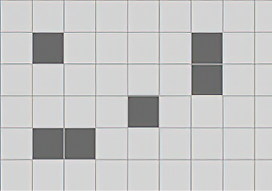
Death from loneliness: every cell will be dead in two ticks. Dark cells are alive; light cells are dead.
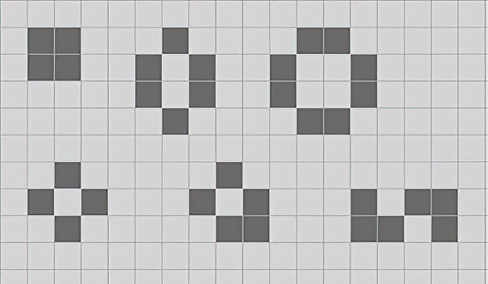
The block, beehive, pond, tub, boat, and snake are unchanging still lifes.
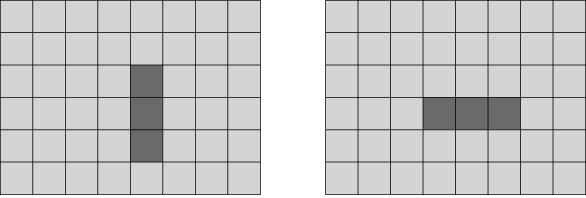
The blinker is the simplest oscillator.
The first spaceship

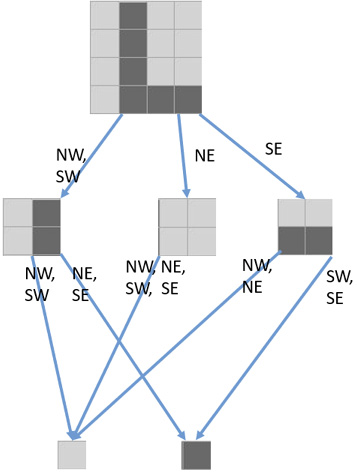
A 2-quad consists of four 1-quads, but there are only two 0-quads.
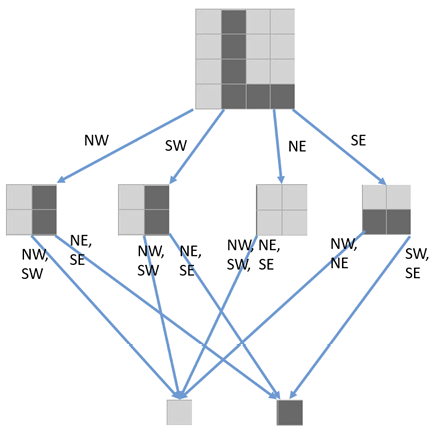
We can get away with reusing one of the 1-quads, slightly reducing the memory burden.
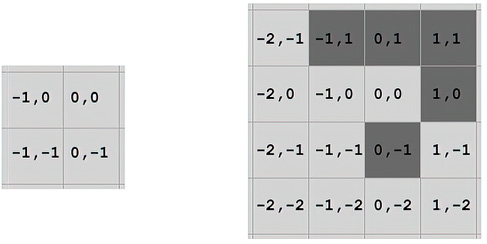
A 1-quad is indexed from −1,−1 in the southwest corner to 0,0 in the northeast corner. A 2-quad is indexed from −2,−2 in the southwest corner to 1,1 in the northeast corner. The coordinates of the central cells are always the same for quads with more than one cell.
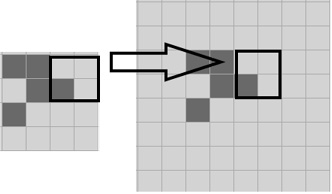
A 2-quad is “embiggened” so that we have a 3-quad with the cells of the 2-quad in its center. Notice what happens to the northeast portion of the 2-quad when we place it in the 3-quad.
If we’re given only a 2-quad and want to step it ahead one tick, we know only what the 1-quad at its center will be next. Cells are labeled with the variable names that represent them in the code in listing 4.8.
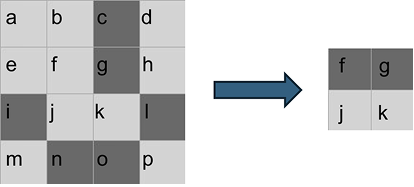
Given a 3-quad, we can extract nine 2-quads from it and step each of them forward one tick to get nine 1-quads one tick in the future.
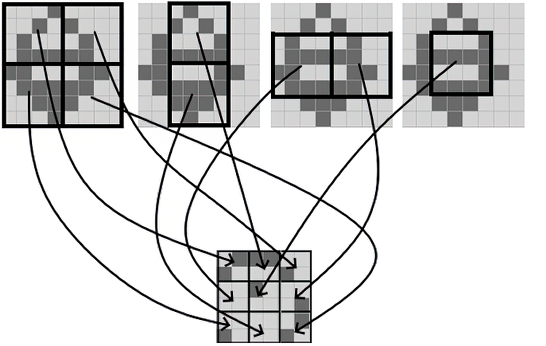
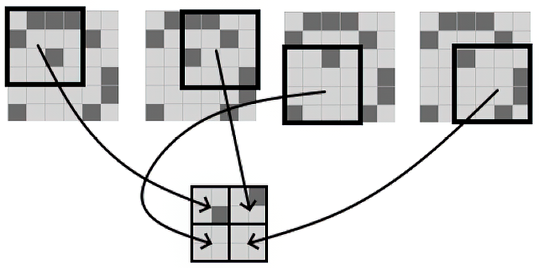
Given nine 1-quads all one tick in the future, we can form them into four 2-quads. We take the center 1-quad from each of those four 2-quads and use them to build a 2-quad that’s the center of the original 3-quad one tick in the future.
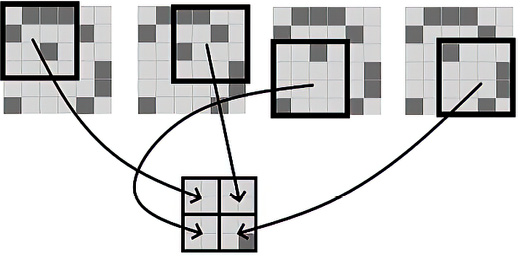
Given nine 1-quads, all one tick in the future from the original 3-quad, we can form them into four 2-quads. Instead of simply taking their centers, we step each of those 2-quads forward one tick. That gives us a 1-quad from each 2-quad, and from them, we build a 2-quad that’s the center of the original 3-quad two ticks in the future, not one.
Summary
- The specific problem we looked at in this chapter is recreational, not practical. I’ve never had to evolve a cellular automaton trillions of generations to solve an on-the-job problem. Fun is a good enough reason to do anything.
- The techniques we used in this chapter deeply affected my work, however. I’ve have often used memoization as a technique for deduplicating complex data structures and trading cache space for improved performance. I’ve also had to consider how to tune the performance of those caches to ensure they don’t become memory leaks.
- Most important, learning about the HashLife algorithm got me into the habit of asking whether I can use any aspect of the specific problem to advantage when designing an algorithm. It reminds me to look for frame-changing attacks on problems when incremental improvements on existing algorithms have gone as far as they productively can.
FAQ
What is the Game of Life, and how does its grid evolve?
The Game of Life is a cellular automaton on a two-dimensional grid of alive and dead cells. The grid evolves in discrete ticks, and each cell’s next state depends only on its eight neighbors from the previous tick.
What are the basic rules that determine whether a cell lives or dies in Life?
A cell is alive on the next tick if it has exactly three living neighbors. If it has exactly two living neighbors, it stays the same. Otherwise, it is dead on the next tick.
What is a still life in the Game of Life?
A still life is a pattern that does not change from one tick to the next because every living cell has two or three living neighbors and no dead cell has exactly three living neighbors.
What is a blinker, and why is it important?
The blinker is the simplest oscillator in Life. It alternates between two states forever, making it a classic example of a repeating pattern.
What is a glider in the Game of Life?
A glider is a spaceship pattern that reappears every four ticks one square diagonally away from where it started, so it appears to move diagonally across the grid over time.
Why does a typical first Life implementation use two arrays?
It uses a current array and a temporary array so the next state can be computed without corrupting neighbor counts in the current state. After computing the next generation, the arrays are swapped.
Why is the naive array-based Life implementation still O(n) per tick?
Because it examines every cell in the grid on every tick and counts its neighbors, so both memory use and work per step scale linearly with the number of cells.
What is an immutable quadtree in this chapter?
An immutable quadtree, or quad, is a recursive tree representing a square grid of cells. A 0-quad is a single cell, and an n-quad for n > 0 is made of four (n−1)-quads: NW, NE, SE, and SW.
How does memoization help with quadtrees and HashLife?
Memoization deduplicates repeated quad patterns so identical structures share the same objects. This saves memory, makes emptiness checks cheap, and also lets the algorithm reuse previously computed results.
What makes HashLife much faster than the naive Life algorithm?
HashLife combines immutable quadtrees, memoization, and recursive stepping to skip redundant work. It can compute larger regions many generations ahead at once, and for stable or repetitive patterns it can approach near-constant time per step after enough caching.

 Fabulous Adventures in Data Structures and Algorithms ebook for free
