Overview

12 Conversational summarization for smooth handoff

This chapter explains why concise, targeted conversation summaries are essential for smooth handoffs from conversational AI to human agents. Blind transfers or dumping full transcripts slow agents down and frustrate users who have to repeat themselves. A good summary gives the agent just enough context to continue seamlessly: a compact free-text overview paired with a few high-value data points, enabling faster resolution, less repetition, and a better user experience.

The chapter defines two complementary components of an effective summary: structured metadata and a brief prose recap. Metadata should capture only the essentials for the use case (for example, user identifiers, verification status, and the latest objects of interest like member, provider, or claim IDs), ideally presented as a screen pop in agent tools to avoid re-asking questions. The prose summary should be 1–2 sentences, non-redundant with the metadata, and focused on what has happened and what remains. To enable this, teams should instrument their bots to record transcripts and key fields via platform features, session variables, and webhooks; decide transcript formats; add optional context like timestamps and transfer reasons; and handle sensitive data minimally and compliantly.

The chapter then shows how to improve summaries with generative AI, even without modifying the bot. With a transcript and a clear target format, LLMs can generate compact text summaries and extract structured details (for example, JSON fields) using well-crafted prompts. Instruction tuning, one-shot/few-shot examples, and schema guidance help steer outputs, reduce speculation, and enforce exact key names and data types; deterministic decoding (e.g., greedy) improves repeatability. Teams should validate extracted values against transcripts to catch hallucinations and weigh control versus cost when adding examples. The result is a reliable, scalable method to deliver combined text-and-structure summaries that let agents pick up instantly where the bot left off.

An effective summary helps an agent get up to speed quickly, even if the user previously had a lengthy conversation with a bot.
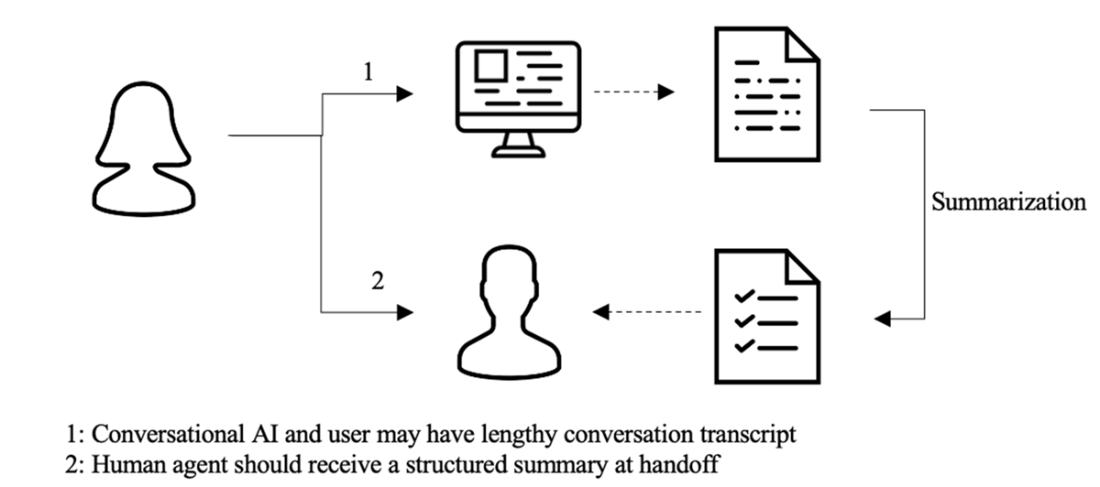
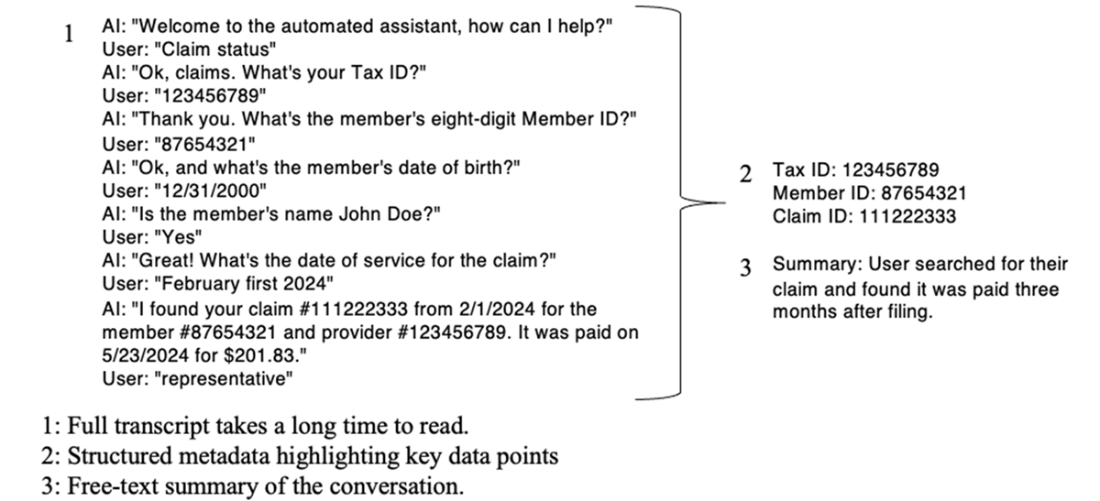
An effective summary pulls out key details from the conversation. Here the summary includes a summary of the conversation and the last claim searched. The AI portion of the call may have taken two minutes but the human agent can read the summary in seconds.
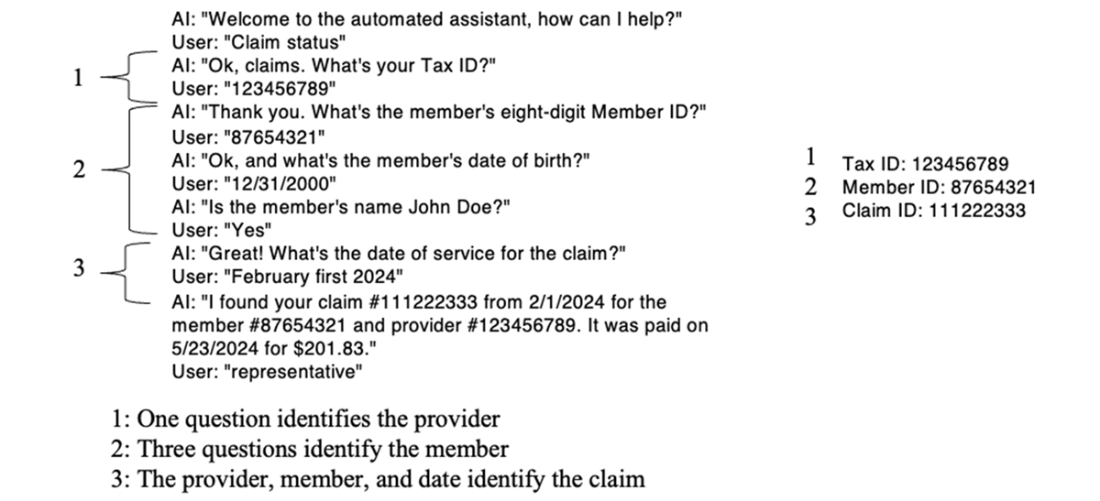
Not every closed-form question needs to be stored in the summary. In this medical insurance claim review, the most important information is the provider ID, member ID, and claim ID.
When a summary is integrated with contact center software the human agent can have a wealth of information at their fingertips. When an insurance agent clicks on the member ID in their software, they could get additional details on that member.

Accessing the conversation transcript in through the "Session History" variable.
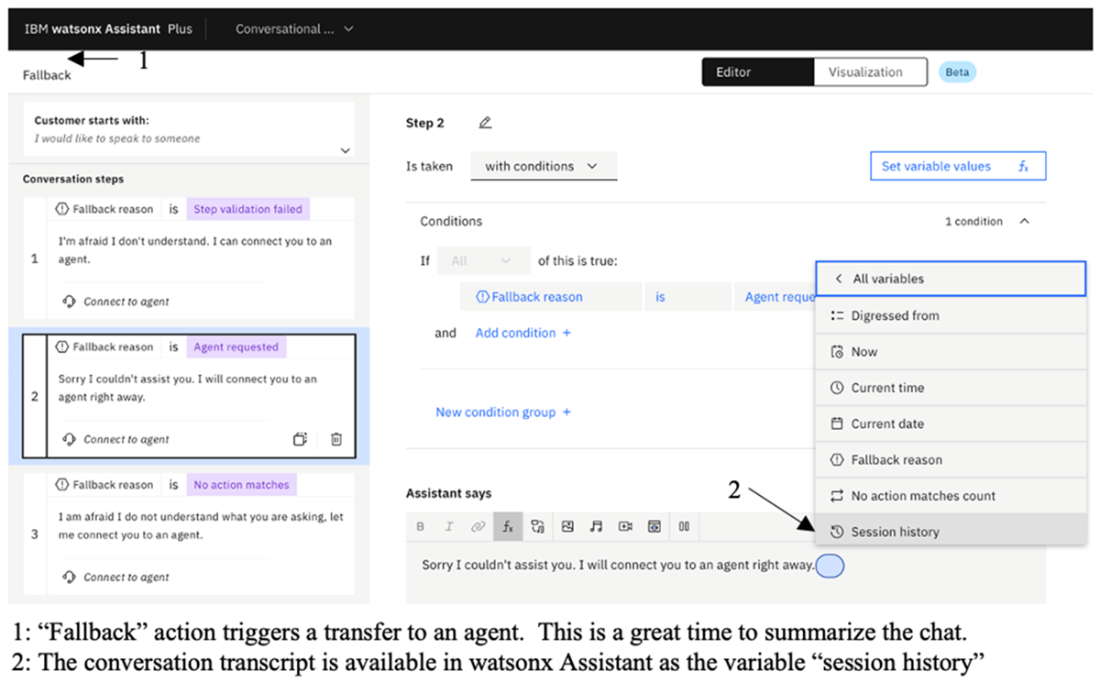
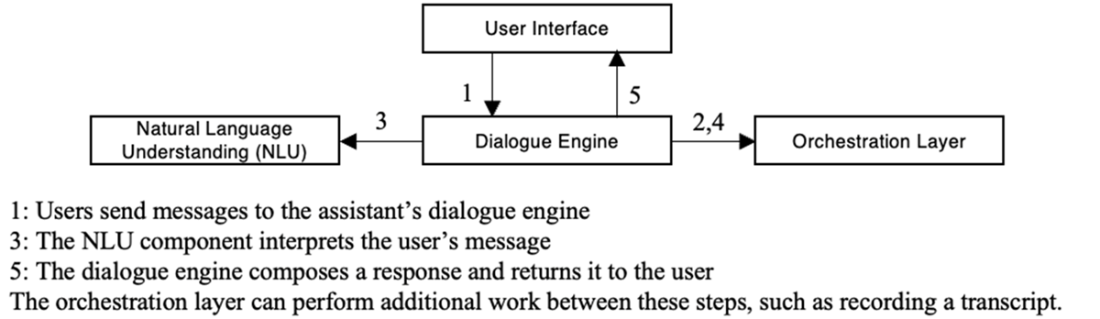
You can use your chatbot’s orchestration layer to create a conversational transcript in whatever format you need.
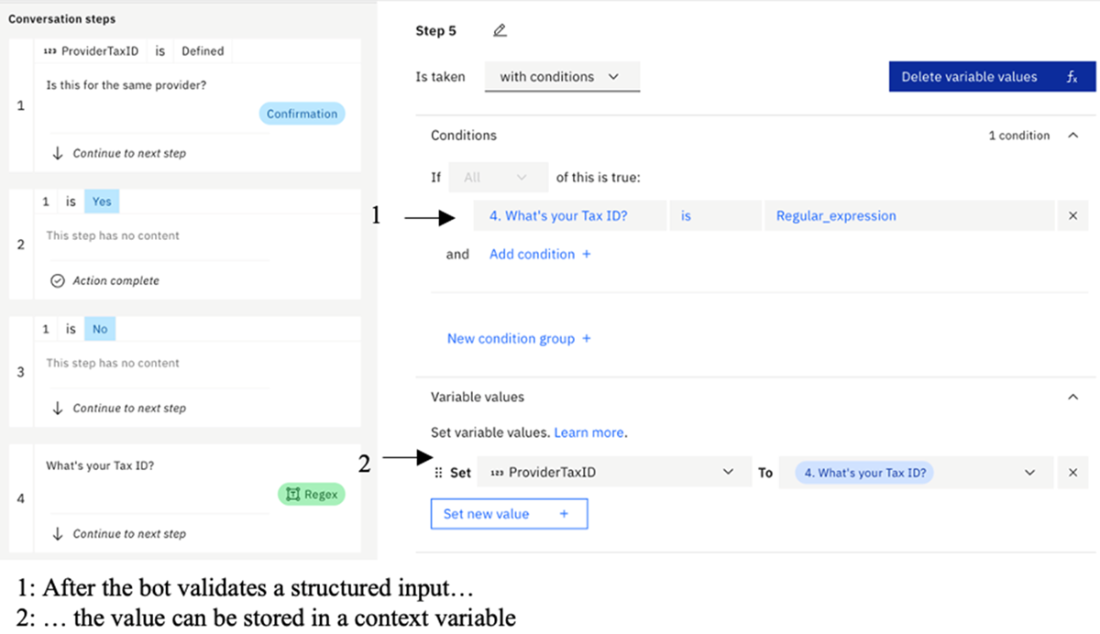
Storing contextually important information into a context variable so that it can be retrieved later by a summary.
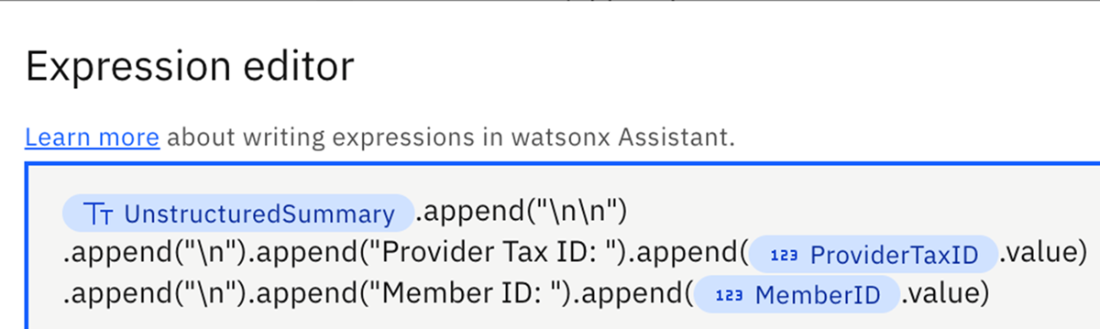
Using a low-code expression editor to combine multiple data elements into a summary.
Summary

  • Transfers to human agents are an inevitable part of many conversational AI solutions. Agents benefit from receiving brief summarizations that extract key highlights from the conversation, both in prose and in structured format.
  • A summary requires a conversational transcript. Most conversational AI platforms generate a transcript for you, but you can configure your conversational AI to generate one in your desired format.
  • Structured summaries can be generated by enhancing your conversational AI to store key data points as they are collected or can be extracted using LLMs when the conversation completes.
  • You need a clear picture of a good summary before you ask an LLM to generate one.
  • LLMs can generate prose summaries and extract key details from transcripts. Use clear instructions and examples to generate the summary you desire.

FAQ

What problem do conversation summaries solve in AI-to-human handoffs?They let agents grasp the user’s goal and progress in seconds instead of reading a long transcript. This reduces user wait time, avoids re-asking questions, and helps the agent pick up exactly where the bot left off.
What are the essential elements of an effective conversation summary?An effective summary combines: - Structured metadata: key IDs and context needed for lookup and continuity. - A brief free-text synopsis (1–2 sentences) that captures what happened and why the user is escalating. It should be minimal yet complete for the agent to proceed without rereading the transcript.
Which structured metadata should I include (and what can I omit)?Include only the high-value, actionable fields for your use case. Examples: - User/caller identifier (login ID or phone number) - Collected or found IDs (e.g., member, provider, claim) - Session count or sentiment (optional) Omit intermediate validation details (e.g., DOB or name confirmations) if a single verified ID suffices. In the claims example, provider ID, member ID, and claim ID were enough.
How should I write the free-text portion of the summary?Keep it simple, 1–2 sentences. Avoid repeating structured fields or step-by-step questions. Capture: - The core task completed or attempted - The immediate context before escalation - Any likely reason for transfer (without speculation) Example: “User searched a claim and saw it was paid; requested a representative for more details.”
How can I capture the conversation transcript on my platform?Use your platform’s built-in transcript/session variable (e.g., “Session History”) if available. If not, construct your own transcript via orchestration (webhooks) by appending user and bot messages to a context variable. Optionally include timestamps, button clicks, and normalized inputs.
How do webhooks help build custom transcripts and summaries?Pre/post webhooks can: - Append each turn (User/Bot) to a transcript in your preferred format (string, array, JSON) - Initialize and enrich context (session start time, channel, transfer reason) - Assemble a structured summary at transfer time by reading stored context variables
How do I instrument my bot to capture domain-specific identifiers safely?Store meaningful, fixed-format responses (e.g., claim, member, provider IDs) in context/session variables. Be minimalist with sensitive data (PII/PHI): collect only what’s needed, store it securely for the minimum time, and review logging/summarization with legal compliance.
How can I use LLMs to generate concise prose summaries?Provide the transcript (JSON or human-readable) and clear instructions to produce 1–2 sentence summaries emphasizing the last user task before escalation. Use instructible models and greedy decoding for repeatability; add one-shot/few-shot examples to shape tone and reduce speculation.
How can I extract a structured JSON summary with an LLM without changing my bot?Prompt the LLM with: - A schema (exact keys and types) and strict instructions (e.g., numeric values, allowed keys) - One-shot/few-shot examples illustrating minimal, valid JSON Verify outputs by checking that each extracted value appears in the transcript; adjust prompts to fix key names, types, and duplication.
How should I present the summary to agents for maximum impact?Use a screen pop that highlights structured fields (e.g., MemberID, ClaimID) and links them to back-end systems (click-through to member profile or claim). Pair with the brief text summary. This avoids re-asking questions, speeds resolution, and improves user experience.

pro $24.99 per month

  • access to all Manning books, MEAPs, liveVideos, liveProjects, and audiobooks!
  • choose one free eBook per month to keep
  • exclusive 50% discount on all purchases
  • renews monthly, pause or cancel renewal anytime

lite $19.99 per month

  • access to all Manning books, including MEAPs!

team

5, 10 or 20 seats+ for your team - learn more


choose your plan

team

monthly
annual
$49.99
$499.99
only $41.67 per month
  • five seats for your team
  • access to all Manning books, MEAPs, liveVideos, liveProjects, and audiobooks!
  • choose another free product every time you renew
  • choose twelve free products per year
  • exclusive 50% discount on all purchases
  • renews monthly, pause or cancel renewal anytime
  • renews annually, pause or cancel renewal anytime
  • Effective Conversational AI ebook for free

choose your plan

team

monthly
annual
$49.99
$499.99
only $41.67 per month
  • five seats for your team
  • access to all Manning books, MEAPs, liveVideos, liveProjects, and audiobooks!
  • choose another free product every time you renew
  • choose twelve free products per year
  • exclusive 50% discount on all purchases
  • renews monthly, pause or cancel renewal anytime
  • renews annually, pause or cancel renewal anytime
  • Effective Conversational AI ebook for free
choose your plan

team

monthly
annual
$49.99
$499.99
only $41.67 per month
  • five seats for your team
  • access to all Manning books, MEAPs, liveVideos, liveProjects, and audiobooks!
  • choose another free product every time you renew
  • choose twelve free products per year
  • exclusive 50% discount on all purchases
  • renews monthly, pause or cancel renewal anytime
  • renews annually, pause or cancel renewal anytime
  • Effective Conversational AI ebook for free