Authentication is presented as the foundation of digital trust because it preserves the integrity of the relationship between a system and the entity claiming access. The chapter opens with the Twitter breach to show that failures in governance, process, and human behavior can undermine security even when the underlying cryptography is sound. The key lesson is that authentication is not just about verifying a password or credential; it is about making sure the current requester is truly the same party that originally established the account.
The chapter then explains the identity life cycle, from enrollment through propagation, use, updates, and termination. Enrollment is especially important because it co-creates the relationship by establishing identifiers, credentials, and context such as roles, attributes, and proofing level. It distinguishes self-service from admin-driven onboarding, discusses assurance levels for identity proofing, and emphasizes that recovery, stale attributes, and failure to deactivate old accounts are common weak points that can expose systems to risk.
Finally, the chapter surveys authentication factors, methods, and attack models to show how strength and usability must be balanced. It covers knowledge, possession, and inherence factors, plus contextual signals like behavior, location, and time, and compares identifier-only, token-based, multifactor, and challenge-response approaches. The overall message is that stronger methods such as passkeys, cryptographic challenge-response, and well-designed MFA improve both security and usability, while weak authentication undermines every authorization decision that follows.
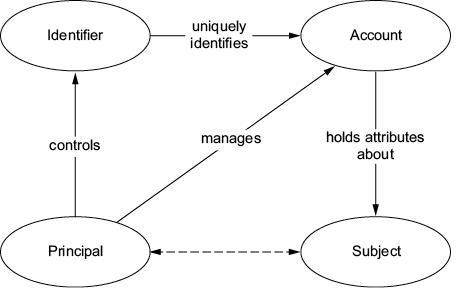
```Relationships among key identity concepts used in authentication and authorization. A principal (an actor such as a user or service) controls an identifier that uniquely identifies an account. The account stores attributes about a subject, which might be the principal itself or another entity the principal manages.
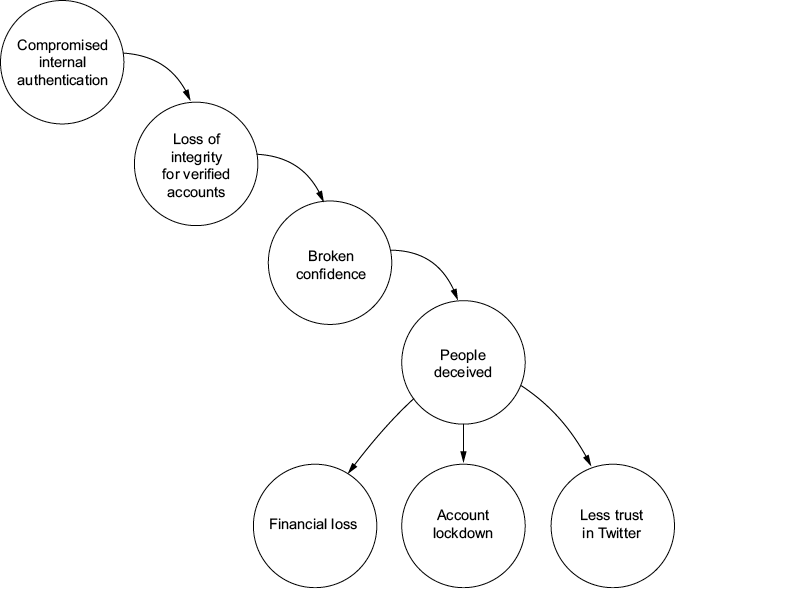
The cascade of consequences triggered by a loss of relationship integrity. Compromised internal authentication undermines the trusted relationship between administrators and the system, leading to a broader loss of integrity for verified accounts. As confidence diminishes, individuals are deceived, which can result in financial loss, account lockouts, and reduced trust in the platform.
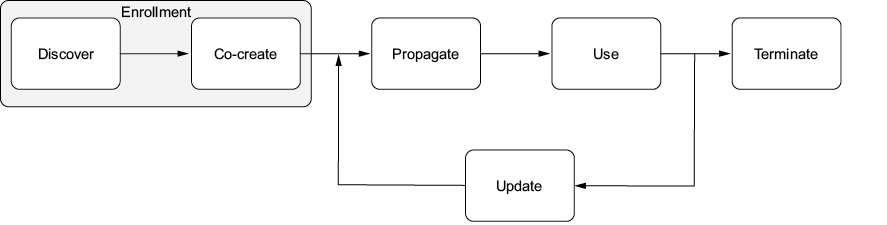
Phases in the digital relationship life cycle. The life cycle begins with enrollment, comprising discovery and co-creation, and continues through propagation, use, and eventual termination. The update phase ensures that changes to the account or its attributes are integrated back into propagation, keeping the relationship accurate and aligned with current conditions.
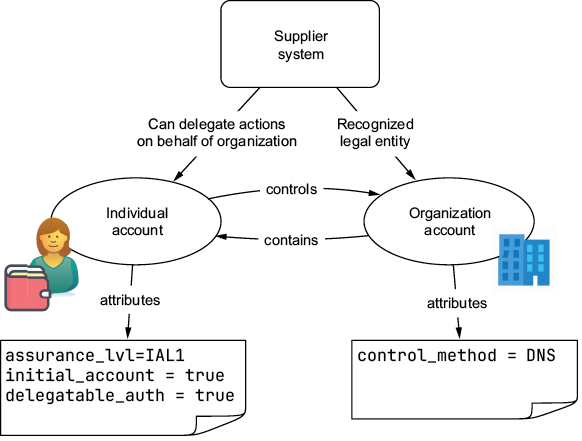
Enrollment relationships between an individual, their organization, and a supplier system. The individual account is authenticated and proofed to IAL1, while the organization account is established through domain control. Delegation rights originate from the enrollment context and enable the individual to act on behalf of the organization within the supplier system.
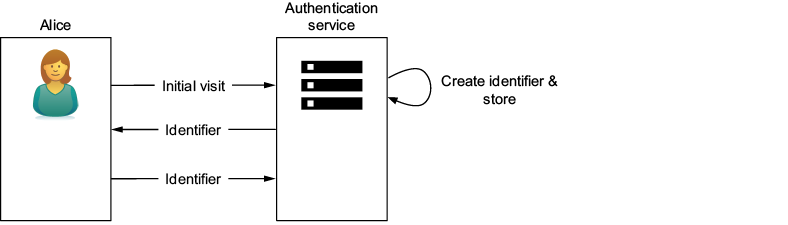
Identifier-only authentication flow. When Alice first visits, the authentication service creates and stores an identifier (such as a session cookie) and returns it to her client. For subsequent requests, Alice’s client presents this identifier to indicate her relationship with the system. No additional authentication factors are used. This approach relies entirely on the secrecy of the identifier, making it vulnerable to interception, guessing, or reuse if not properly secured with transport encryption and randomness.
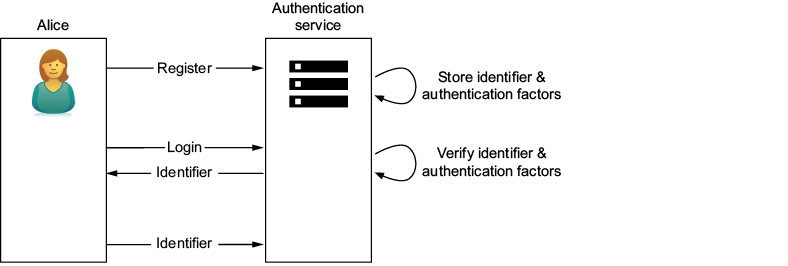
Token-based authentication flow. Alice begins by registering with the authentication service, which stores her identifier along with one or more authentication factors. During login, she presents her identifier and authentication factors. If verified, the service issues a cryptographically verifiable token that represents her authenticated session. For subsequent requests, Alice presents only the token, which the service uses to link the request to her previously authenticated session. This method improves usability by eliminating the need to reenter credentials, but it depends on the token being stored and transmitted securely to prevent hijacking.
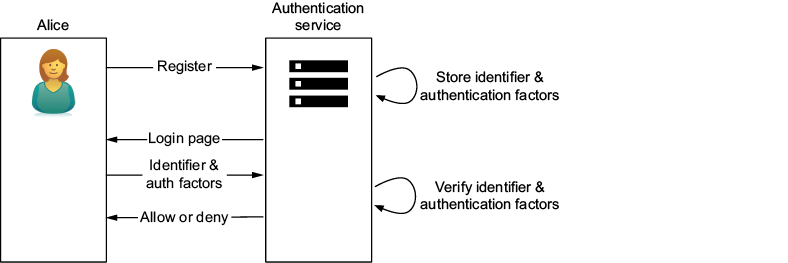
Identifier with authentication factors flow. During registration, Alice provides an identifier (such as a username or email) and one or more authentication factors (such as a password or biometric). The authentication service securely stores them. At login, Alice is prompted for her identifier and corresponding authentication factors. The service verifies both before granting or denying access. This is the most common authentication pattern, and it serves as the foundation for multifactor authentication, where the combination of factors improves security by requiring control over multiple types of evidence.
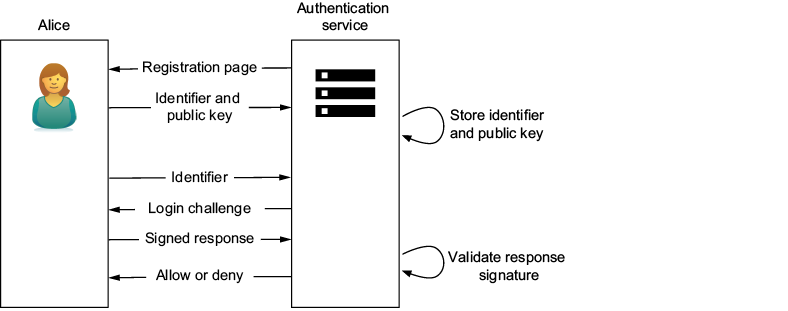
Challenge–response authentication flow using public-key cryptography. Alice registers by providing an identifier and a public key. At login, the service sends a challenge, which Alice signs with her private key. The service verifies the signature using the stored public key, confirming heridentity without exposing the private key. This method offers strong resistance to phishing and replay attacks.
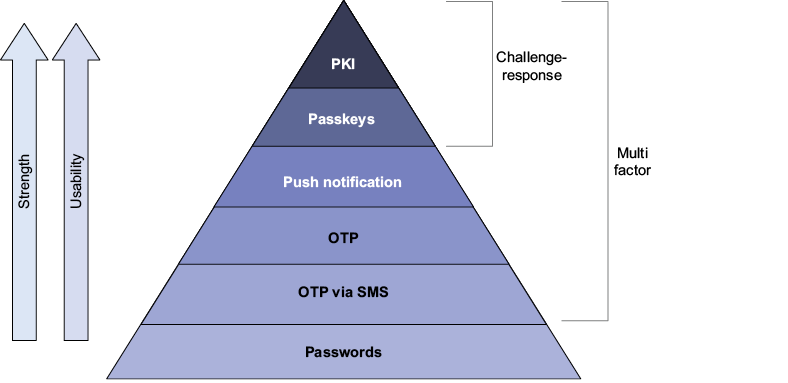
The strength and usability pyramid for authentication methods. As you ascend the pyramid, authentication mechanisms become more resistant to phishing, replay attacks, and credential theft, though some may require a more technical setup or infrastructure. Passwords, located at the base, offer poor security and usability, while challenge–response methods such as passkeys and PKI provide high assurance with an improved user experience. Multifactor approaches (MFA) are positioned across the middle tiers, balancing security and usability by combining various types of factors.
Summary
- Authentication ensures the integrity of digital relationships by verifying that the entity interacting with the system is the same one that originally established the account.
- Relationship integrity is central to system trust; when authentication fails, it can compromise not only direct relationships but also those that depend on them indirectly.
- The identity relationship life cycle includes enrollment, propagation, use, update, and termination; each phase plays a role in maintaining secure, accurate access.
- Enrollment establishes the account and binds it to attributes and authentication credentials; weak enrollment processes can undermine even strong authentication systems.
- Authentication relies on a combination of factors, including knowledge, possession, inherence, behavior, location, and temporal context, to determine whether an account holder is legitimate.
- Authentication methods vary in strength and usability, from simple identifier-only approaches to cryptographic challenge–response protocols that resist phishing and replay.
- Strong authentication methods use multifactor or challenge–response techniques to better protect against common attack models such as phishing, credential stuffing, and session hijacking.
- Authentication sets the stage for authorization by validating the account and its context, allowing access decisions to reflect the true nature of the digital relationship.
- Without strong authentication, authorization policies are applied to potentially false identities, creating risk and undermining the security of the entire system.

 Authorization in Action ebook for free
