Overview

2 Understanding digital identity

Digital identity is presented as the way systems recognize, remember, and relate to people, organizations, devices, services, and agents. Rather than being just logins, passwords, or account records, identity supports the relationships that make digital interaction possible. The chapter opens with the idea that identity is fundamentally relational: the real purpose of identity systems is to enable recognition, continuity, and useful action across repeated interactions, especially when authorization decisions depend on who or what is involved.

The chapter then explains why digital identity is difficult at scale. Distance between people and systems creates the proximity problem, while the lack of a shared identity layer leads to interoperability issues, rigid schemas, privacy and consent concerns, and scalability limits. These problems directly affect authorization because policies depend on accurate, timely, and trustworthy identity data. The text also shows how naming, namespaces, and identity models shape these outcomes: centralized systems offer control, federated systems offer convenience and cross-organization reach, and decentralized systems aim to return more control to individuals, each with different tradeoffs in trust, discovery, privacy, and operational complexity.

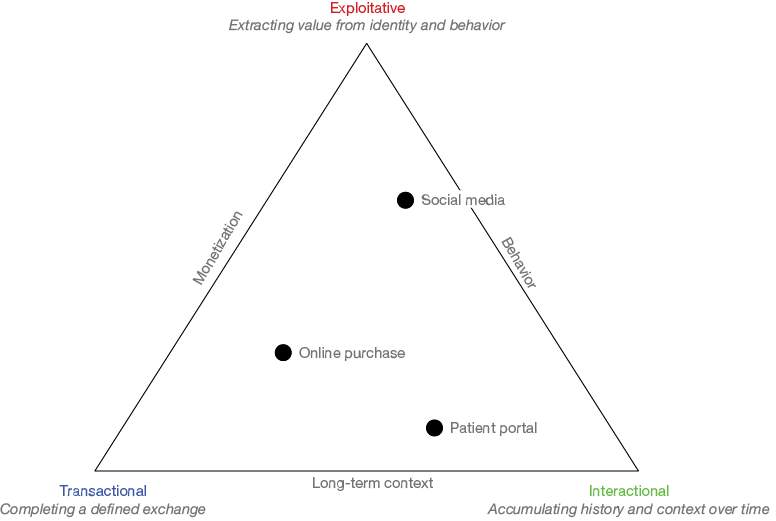
Finally, the chapter emphasizes that identity exists to support different kinds of digital relationships, including transactional, interactional, and exploitative ones, and that the type of relationship should influence system design and policy. It distinguishes trust from confidence, arguing that technical mechanisms such as authentication, verification, auditing, and policy enforcement create confidence, while governance and social norms are still needed to establish trust and fairness. Privacy, confidentiality, and authenticity are treated as connected but distinct goals, and the chapter concludes by showing that strong authorization depends on all of these identity foundations before moving on to authentication.

Digital relationships occupy a space where transactional, interactional, and exploitative dynamics combine in varying degrees. Understanding which type of relationship your system supports is critical to designing effective identity and authorization policies.
Summary

  • Digital identity powers digital relationships, allowing systems to recognize, remember, and relate to people and organizations, forming the foundation for personalization, security, privacy, and access control.
  • Namespaces and discovery are critical to authorization. If a system can’t uniquely name and reliably find identities, policies fail. Structured namespaces help ensure clarity, uniqueness, and correct policy application.
  • Identity system models shape control and trust. Centralized, federated, and decentralized systems distribute authority differently, affecting portability, governance, and attribute availability.
  • Confidence comes from technology; trust comes from governance. Strong authentication builds confidence, but governance ensures fairness, compliance, and accountability.
  • Privacy, confidentiality, and authenticity are tightly linked to digital identity. Good identity systems and well-crafted authorization policies minimize unnecessary data exposure, while ensuring only the appropriate parties gain access.


FAQ

```html
What is digital identity in the context of authorization?Digital identity is the way systems recognize, remember, and relate to people, organizations, things, services, and digital agents. It provides the context that authorization systems use to make access decisions.
Why is identity more than just a username and password?Identity is not only about logging in. It also includes relationships, attributes, trust, and context. In digital systems, identity helps determine who or what is making a request and what they are allowed to do.
What are the main problems digital identity systems face?The chapter identifies six core problems: proximity, interoperability, flexibility, privacy, consent, and scale. These problems make it harder for identity systems to support reliable authorization decisions.
What is the proximity problem in digital identity?The proximity problem happens when human relationships are replaced by remote, computer-mediated interactions. Because systems are far away from the people they represent, they rely on weaker signals such as usernames, passwords, or biometrics.
How does the interoperability problem affect identity systems?There is no universal identity layer for people on the internet, so every organization builds its own silo. This creates many different accounts, formats, and user experiences, which makes identity sharing and authorization across systems difficult.
Why does naming matter for authorization?Naming matters because authorization depends on identifying the correct person, device, or service. Poor naming can cause incorrect access decisions, such as denying the wrong person or granting access to the wrong entity.
What are centralized, federated, and decentralized identity models?Centralized identity is controlled by one organization, federated identity lets one organization rely on another for authentication and attributes, and decentralized identity gives users more control over their own credentials. Each model balances control, interoperability, and security differently.
How do privacy, confidentiality, and authenticity differ?Confidentiality protects the content of information, privacy is about controlling what information is shared and under what conditions, and authenticity is about knowing the parties and transactions are legitimate. These concepts overlap but solve different problems.
What is the difference between trust and confidence in digital identity?Confidence comes from evidence, technical verification, and direct observation. Trust involves relying on another person or organization and accepting some risk. Good identity systems try to increase confidence while still supporting the trust needed for governance.
Why does authentication matter before authorization?Authorization depends on knowing that the requester is really who they claim to be. Authentication renews the relationship at the moment of interaction, providing the confidence that access decisions depend on.
```

pro $24.99 per month

  • access to all Manning books, MEAPs, liveVideos, liveProjects, and audiobooks!
  • choose one free eBook per month to keep
  • exclusive 50% discount on all purchases
  • renews monthly, pause or cancel renewal anytime

lite $19.99 per month

  • access to all Manning books, including MEAPs!

team

5, 10 or 20 seats+ for your team - learn more


choose your plan

team

monthly
annual
$49.99
$499.99
only $41.67 per month
  • five seats for your team
  • access to all Manning books, MEAPs, liveVideos, liveProjects, and audiobooks!
  • choose another free product every time you renew
  • choose twelve free products per year
  • exclusive 50% discount on all purchases
  • renews monthly, pause or cancel renewal anytime
  • renews annually, pause or cancel renewal anytime
  • Authorization in Action ebook for free

choose your plan

team

monthly
annual
$49.99
$499.99
only $41.67 per month
  • five seats for your team
  • access to all Manning books, MEAPs, liveVideos, liveProjects, and audiobooks!
  • choose another free product every time you renew
  • choose twelve free products per year
  • exclusive 50% discount on all purchases
  • renews monthly, pause or cancel renewal anytime
  • renews annually, pause or cancel renewal anytime
  • Authorization in Action ebook for free