19 Authorization as strategy
ACME’s experience shows how authorization can begin as a small operational concern and gradually become a strategic capability. At first, the company simply needed a safer, clearer way to share information and support collaboration, so teams improved access controls, connected identity services, and refined policies as problems appeared. These early fixes were valuable, but over time they revealed a broader truth: authorization was not a side issue. It was shaping how the platform worked, how people used it, and how the business could grow.
As the platform expanded, authorization pressure increased because the number of situations requiring decisions grew faster than the systems used to manage them. Access checks moved beyond simple role rules and began relying on relationships, attributes, contextual signals, delegation, and runtime evaluation across many services. ACME responded by building shared policy services, clearer governance, decision logs, and policy-aware testing. These changes made decisions more consistent, visible, and explainable while reducing duplication and helping teams manage collaboration, automation, and risk in a more deliberate way.
The chapter’s larger message is that most organizations are already on this path, even if they have not fully recognized it. Many are still dealing with fragmented authorization logic, inconsistent experiences, and difficult-to-audit decisions, but they can improve by making decisions observable, externalizing policy domains, standardizing policy models, and governing signals and delegation. The future of digital trust depends on continuous, policy-driven authorization that adapts as systems, partnerships, and automation become more complex. In that world, authorization is not just plumbing; it is a core business capability that enables scale, speed, and control.
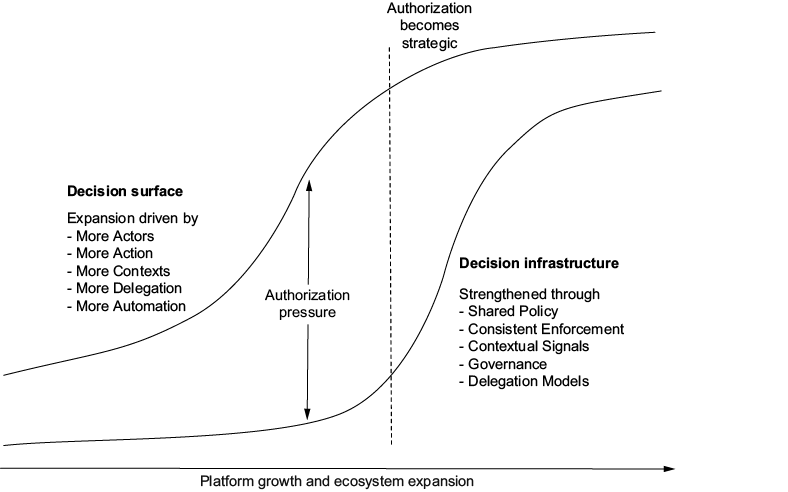
Decision surface and decision infrastructure. As systems grow, the decision surface, the set of situations where access must be evaluated, expands faster than the infrastructure that governs those decisions. This gap creates authorization pressure: the growing difficulty of making decisions consistently, explaining outcomes, and maintaining control. Incremental architectural investments can close this gap, enabling organizations to manage trust reliably as complexity grows.
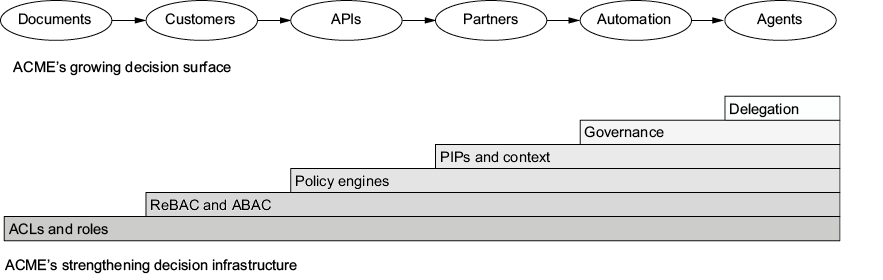
ACME’s expanding decision surface and strengthening decision infrastructure. As ACME moved from document sharing to customer collaboration, APIs, partners, automation, and agents, the situations requiring authorization decisions became broader and more dynamic. ACME responded by building cumulative decision infrastructure: ACLs and roles, relationship and attribute models, policy engines, contextual signals from PIPs, governance, and explicit delegation. These layers are not one-to-one mappings to the items above them; together they show how authorization became shared infrastructure for governing authority across the enterprise.
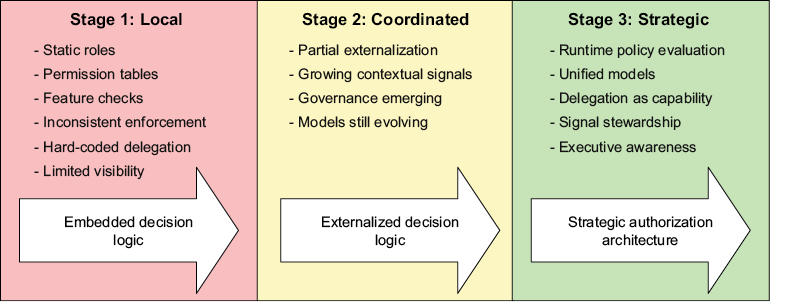
Authorization maturity spectrum. The maturity spectrum generalizes the pattern illustrated by ACME’s journey in figure 19.2. Organizations often progress from local, embedded decision logic to coordinated policy externalization and then to a strategic authorization architecture. Each stage strengthens the organization’s ability to manage growing decision surfaces, incorporate context, govern delegation, and make consistent authorization decisions at runtime.
Summary
- Authorization typically starts as a local implementation problem but grows into a system-wide limitation as complexity increases.
- Incremental improvements to access control accumulate over time, influencing how systems develop and how organizations function.
- Inconsistent authorization logic causes fragmented user experiences, operational friction, and missed opportunities.
- As systems grow, the decision surface(i.e., the set of situations in which access must be evaluated) expands rapidly across people, services, and contexts.
- When the decision surface outpaces the infrastructure used to govern it, organizations experience authorization pressure, leading to inconsistent decisions, reduced visibility, and increased operational risk.
- Treating authorization as shared infrastructure allows for more consistent and predictable behavior across systems.
- Externalizing decision logic reduces duplication and enables policies to be evaluated consistently at runtime.
- Managing authorization pressure requires strengthening decision infrastructure so access can be evaluated consistently, explained clearly, and adapted as systems evolve.
- Relationship-based, attribute-based, role-based, and delegation models can be combined to support complex, real-world scenarios.
- Governance is crucial for maintaining the trustworthiness and effectiveness of signals, policies, and delegation mechanisms.
- Decision visibility, including logs and analysis, helps organizations understand and improve how authorization functions.
- Authorization maturity develops incrementally through deliberate architectural and governance choices.
- Beginning with a clear, straightforward access problem offers a practical way to start improving.
- Standardizing policy language and evaluation enables teams to make consistent decisions across systems.
- Designing systems for runtime evaluation enables authorization to adapt to changing contexts and conditions.
- As systems grow more distributed and automated, ongoing decision-making becomes essential.
- Authorization is becoming the primary control plane for managing trust among people, services, and agents.

 Authorization in Action ebook for free
