Overview

18 Authorization for AI agents

The chapter introduces AI agents as a new kind of software actor that can plan dynamically, use tools, revise strategies, and operate across enterprise systems. This flexibility makes them powerful, but it also makes authorization harder than in traditional applications, because it is no longer enough to authenticate who the agent is; the system must govern what the agent is allowed to do at each moment, in each context. The core lesson is that authorization for agents must move from being a static gate at the edge of a system to becoming part of the agent’s runtime decision-making.

To address this, the chapter describes a policy-aware agent loop in which every proposed tool use or action is checked by a policy enforcement point before execution. Requests are evaluated using the familiar principal-action-resource-context model, with the policy engine deciding whether the action is permitted or denied. Denials are not just blocks; they also feed back into the agent’s reasoning, helping it replan. The chapter also shows how policies can do more than stop unsafe behavior: they can define operational boundaries, guide planning through partial evaluation or constraint queries, and reduce trial-and-error by telling the agent what paths are available before it commits to them.

The final sections extend this model to delegation, control-plane protection, and cross-domain cooperation. Agents may delegate work to subagents, but delegation must be explicit, bounded, time-limited, and enforced at runtime so that subagents cannot exceed the authority they were given. The chapter emphasizes that control-plane operations must remain off-limits to agents, even when they can perform useful operational work. It also shows that when authority crosses organizational boundaries, policy alone is not enough: systems need explicit promises, credentials, and reputation to support a practical “society of agents.” Overall, the chapter argues that safe agentic systems require policy to shape behavior, constrain delegation, and preserve control without eliminating flexibility.

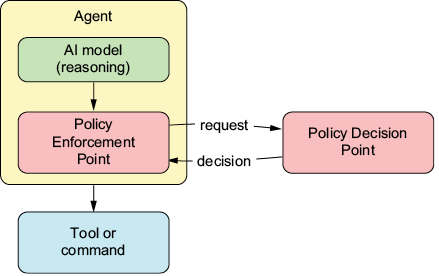
 Authorization during agent tool invocation. When an agent invokes a tool or command, the request passes through a policy enforcement point. The enforcement point asks the Policy Decision Point whether the action is permitted before the tool executes.
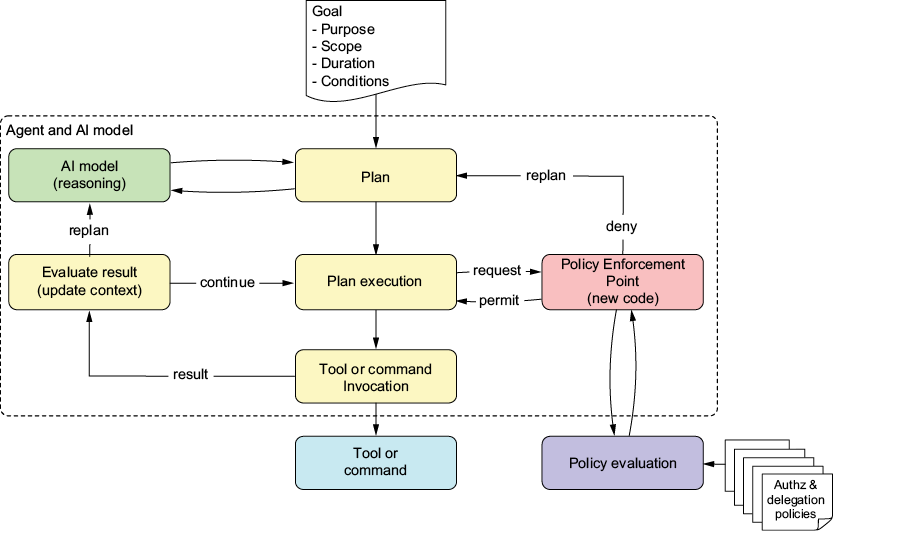
A policy-aware agent loop. An agent iteratively plans and executes actions while a PEP evaluates each proposed action before execution. Authorization decisions become part of the agent’s feedback loop, allowing it to revise its plan when an action is denied.
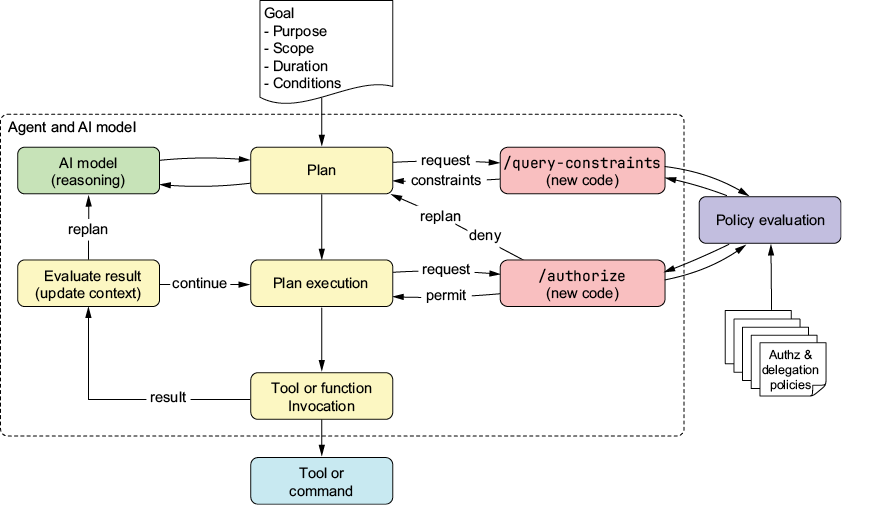
Policy constraints guiding agent planning. During planning, the agent queries the policy system with a partial request. The policy engine returns constraints, such as permitted actions or accessible resources, that the agent incorporates into its plan. Each action is still evaluated at execution time to ensure consistent enforcement.
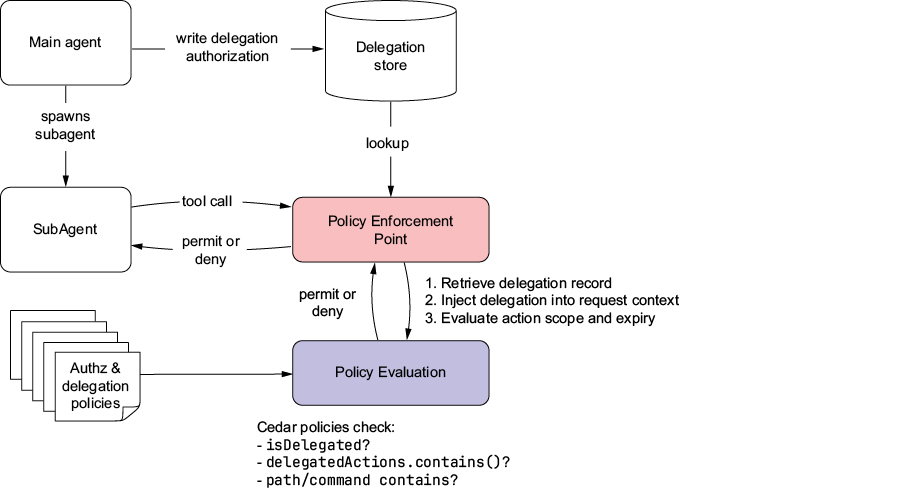
Policy enforcement for delegated agents. When a primary agent delegates work, a delegation record defines the scope of authority. When a subagent invokes a tool, the policy enforcement point includes the delegation data in the authorization request. The policy engine evaluates both the request and the delegation constraints before returning a decision.
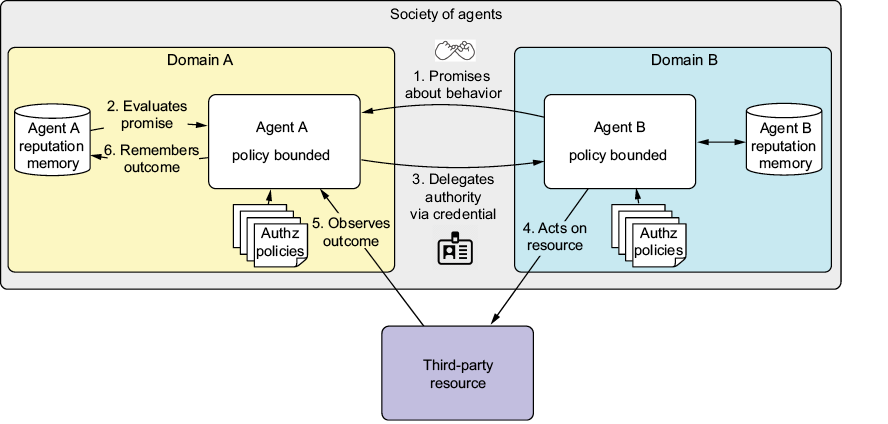
Cross-domain delegation in a society of agents. Two policy-limited agents collaborate across domains. The receiving agent makes promises about its future behavior, and the requesting agent assesses those promises and the partner’s reputation and then grants authority using a credential. The receiving agent operates under its own policies, and both domains log the outcome for future decisions.
Summary

  • AI agents introduce a new authorization challenge because they dynamically plan actions and interact with many systems during execution.
  • Authentication alone cannot govern agent behavior because it verifies identity but does not constrain what actions an agent may attempt.
  • Policy-aware agent loops integrate authorization directly into the agent’s planning and execution cycle, ensuring that each action is evaluated against policy at runtime.
  • Policies can serve as both enforcement gates and constraint systems that guide agent planning using techniques such as Cedar’s typed partial evaluation.
  • Separating operational actions from control-plane operations helps protect the systems that define workflows, infrastructure, and authorization rules.
  • Delegation allows agents to distribute work among specialized subagents, while policies ensure that delegated authority remains within defined limits.
  • Cross-domain delegation requires additional mechanisms, including policies, promises, credentials, and reputation, to enable cooperation between independent systems.
  • Verifiable credentials can transport delegated authority across organizational boundaries, while local policies still determine whether specific actions are permitted.
  • A society of agents emerges when independent systems interact under shared agreements, using policies to enforce behavior, promises to communicate intent, and reputation to evaluate past outcomes.

FAQ

Why is authorization considered the hardest problem in agentic AI systems?Authorization is hardest in agentic AI because agents do not follow fixed workflows. They plan dynamically, choose tools at runtime, and revise their behavior as they learn more. That makes it impossible to rely on static access checks alone; authorization must continuously govern each action the agent proposes.
How do AI agents typically interact with enterprise systems?They usually interact through tools such as document search, databases, internal APIs, command-line interfaces, or workflow engines. The agent chooses which tool to use while working toward a goal, and each tool invocation becomes an authorization-relevant request.
Why isn’t authentication enough for AI agents?Authentication only answers who is making the request. For agents, that is not sufficient because knowing the identity of the agent does not reveal what it may try to do next. Each action still has to be evaluated against policy in real time.
What is a policy-aware agent loop?A policy-aware agent loop is a design where every proposed agent action is checked by a Policy Enforcement Point before execution. If policy permits the action, the tool runs; if policy denies it, the agent receives the denial and replans its next step.
How does authorization influence an agent’s behavior beyond simply blocking actions?Authorization can guide behavior by helping the agent understand which actions are allowed before it tries them. In a constraint-aware model, the policy system provides usable constraints during planning, which reduces trial and error and helps the agent choose valid paths from the start.
What is the PARC model and how is it used with agents?PARC stands for principal, action, resource, and context. In agent systems, each tool invocation is modeled as a PARC request: the agent is the principal, the tool call is the action, the target system or data is the resource, and the task or runtime conditions form the context.
How does the chapter prevent the confused deputy problem in agent systems?The chapter emphasizes that policy must consider the authority behind the action, not just the capabilities of the agent or tool. By evaluating the initiating principal, the task, delegation, resource, and context, the system avoids letting a capable agent be tricked into using authority on behalf of someone who should not have it.
Why should agents not be allowed to modify the control plane?The control plane contains the systems that define workflows, infrastructure, and policy. If agents can change those systems, they could weaken the safeguards that constrain them. So ACME uses policy to separate operational actions from control-plane actions and reserve the latter for trusted administrators.
How is delegation handled for subagents?Delegation is treated as structured data or policy-based authority that is explicitly limited in scope. A primary agent creates a delegation record or credential that defines the subagent, allowed actions, resource scope, and expiration. The policy engine checks this data at runtime so the subagent can only act within its delegated authority.
What is the difference between reactive authorization and constraint-aware authorization for agents?Reactive authorization only decides permit or deny after the agent proposes a complete action. Constraint-aware authorization also helps during planning by returning policy-derived constraints, such as permitted actions or accessible resources. This lets the agent form better plans and reduces denied requests.

pro $24.99 per month

  • access to all Manning books, MEAPs, liveVideos, liveProjects, and audiobooks!
  • choose one free eBook per month to keep
  • exclusive 50% discount on all purchases
  • renews monthly, pause or cancel renewal anytime

lite $19.99 per month

  • access to all Manning books, including MEAPs!

team

5, 10 or 20 seats+ for your team - learn more


choose your plan

team

monthly
annual
$49.99
$499.99
only $41.67 per month
  • five seats for your team
  • access to all Manning books, MEAPs, liveVideos, liveProjects, and audiobooks!
  • choose another free product every time you renew
  • choose twelve free products per year
  • exclusive 50% discount on all purchases
  • renews monthly, pause or cancel renewal anytime
  • renews annually, pause or cancel renewal anytime
  • Authorization in Action ebook for free

choose your plan

team

monthly
annual
$49.99
$499.99
only $41.67 per month
  • five seats for your team
  • access to all Manning books, MEAPs, liveVideos, liveProjects, and audiobooks!
  • choose another free product every time you renew
  • choose twelve free products per year
  • exclusive 50% discount on all purchases
  • renews monthly, pause or cancel renewal anytime
  • renews annually, pause or cancel renewal anytime
  • Authorization in Action ebook for free