14 Policy governance
ACME’s experience shows that deploying authorization policies is only the beginning; the harder task is governing them so they stay aligned with business intent, operational reality, and regulatory expectations. Once policies spread across teams, small differences, forgotten overrides, and outdated rules can create drift, technical debt, and weakened trust. Governance addresses this by making policy decisions traceable, explainable, and accountable, rather than leaving them as isolated technical artifacts.
The chapter frames policy governance as a full life cycle: create, review and approve, deploy and use, monitor, update, and retire. Each stage is supported by practices such as documenting rationale in architectural decision records, using version control and peer review, validating policies through CI/CD, analyzing decision logs, and testing high-impact changes before broad rollout. A federated model lets product teams keep local ownership while shared standards, templates, roles, and review boards preserve consistency across the organization.
Policy governance is also shown as essential for stronger identity governance and regulatory compliance. Identity governance and administration provides authoritative data about accounts and entitlements, while policy governance defines how that data is interpreted at runtime; together they create a feedback loop that exposes stale access and policy mismatches. By tying policies to compliance controls, evidence trails, and audit-ready records, ACME turns governance into a practical foundation for organizational trust, continuous assurance, and resilient authorization.
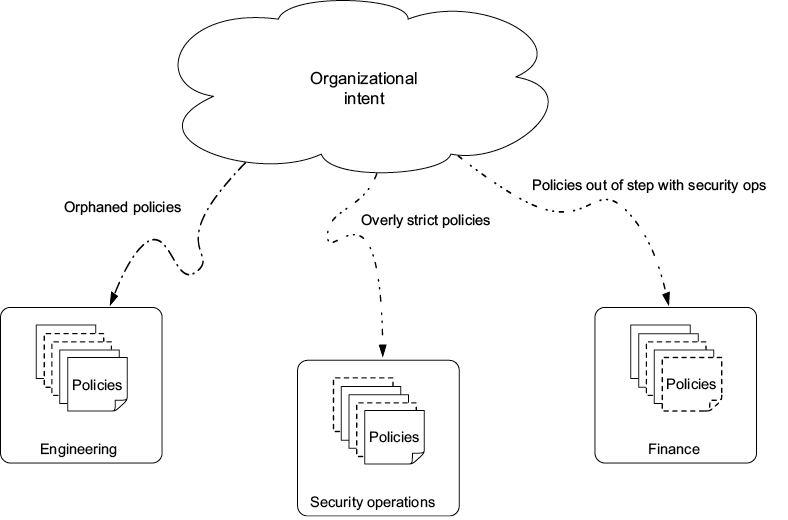
Policy drift without governance. When authorization policies are created and maintained independently across teams, their connection to organizational intent weakens. Policies can become orphaned, overly restrictive, or misaligned with operational realities, even when each policy appears correct within its local context.
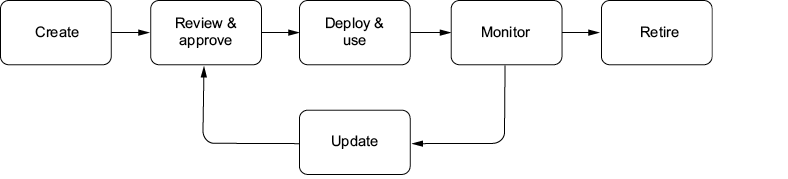
The policy management life cycle. Policies go through distinct stages (creation, review and approval, deployment and use, monitoring, and eventually retirement) with updates feeding back into the review process. The life cycle ensures that authorization policies remain current, coherent, and aligned with organizational intent.
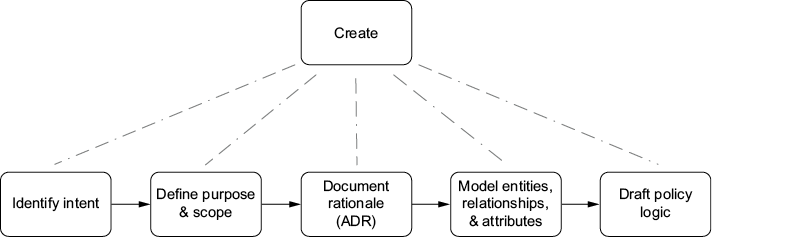
Policy creation as a governance process. The create stage of the policy life cycle expands into a sequence of governance steps. Policy authors begin by identifying intent, defining purpose and scope, and documenting rationale. Authorization logic is drafted only after entities and attributes are modeled, ensuring that every policy reflects deliberate organizational intent.
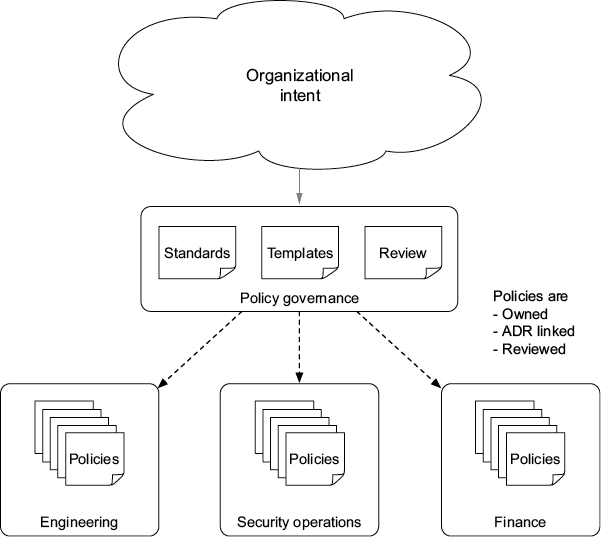
Federated policy governance restoring alignment. Policy governance sits between organizational intent and team-owned policies, providing shared standards, templates, and reviews without centralizing control. Individual teams retain ownership of their policies, while governance ensures that those policies are reviewed, ADR-linked, and aligned with organizational intent.
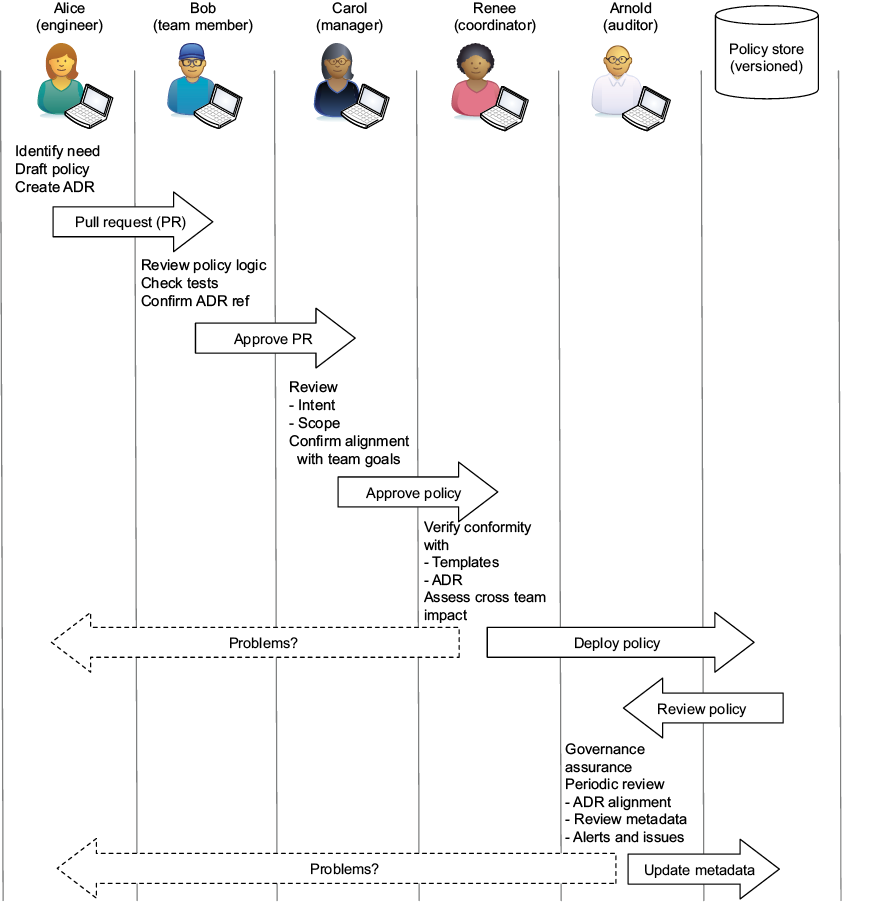
Policy governance workflow across roles. Authorization policies move through clearly defined roles, from creation to deployment and review. Engineers author and review policy logic, managers approve intent and scope, access control coordinators ensure alignment across teams, and auditors verify that governance processes are followed over time. Separation of duties and feedback loops preserve accountability without centralizing control.
Summary
- Policy governance turns authorization from a technical activity into a core organizational discipline that connects business goals to how systems behave.
- Governance creates a framework for accountability, outlining who owns, reviews, and approves each policy during its life cycle.
- The policy management life cycle guarantees that policies are created, reviewed, deployed, monitored, updated, and retired in a controlled, auditable manner.
- Clearly defined roles such as policy owner, author, reviewer, approver, coordinator, and auditor prevent confusion and ensure accountability across teams.
- Governance frameworks balance local autonomy with centralized coordination, allowing consistency without sacrificing agility.
- Architectural decision records (ADRs) document the reasoning behind policy choices, ensuring traceability from design intent to operational implementation.
- Integrating governance with engineering and operations ensures that policies adapt in response to incidents, audits, and system changes.
- Identity Governance and Administration (IGA) supports policy governance by ensuring the accuracy of identity data and entitlement assignments.
- Together, IGA and policy governance provide comprehensive assurance, validating both who can receive access and how access is granted.
- Embedding compliance controls and metadata into policies allows for ongoing verification instead of one-time audits.
- Governance promotes transparency and trust by ensuring every access decision is explainable, testable, and accountable according to institutional standards.
- Mature governance frameworks serve as the foundation of organizational security by aligning technical controls with the institution’s broader expression of will and responsibility.

 Authorization in Action ebook for free
