1 From automation to autonomy
At the heart of the chapter is a simple but consequential warning: enterprise systems are moving from predictable automation to autonomous behavior, and the old architecture for human-approved workflows is no longer enough. Through the opening fraud scenario, the text shows how an agent can act correctly in a narrow technical sense while still creating serious business, customer, and regulatory problems because authority, accountability, and oversight were never designed into the system. The central idea is that autonomy is not just “smarter automation”; it is software making bounded decisions at runtime, often at machine speed, with real-world impact.
The chapter carefully distinguishes automation, agentic systems, generative AI, and copilots. Automation follows predefined rules and deterministic paths, while autonomy means selecting among multiple valid actions based on live context. Agentic systems perceive, reason, and act within defined boundaries, and copilots support humans without taking delegated authority. The chapter stresses that the defining issue is not whether AI is involved, but where decision authority resides and whether those boundaries are explicit, enforceable, and observable. It also explains why traditional governance breaks down when behavior cannot be fully specified in advance.
To address this shift, the chapter introduces the Foundation for Autonomy, which extends the older Foundation for Execution with runtime supervision, policy enforcement, observability, escalation paths, and accountability mechanisms. Using manufacturing examples, it shows how autonomous systems succeed only when they operate within a “blueprint plus control room” model: existing architecture remains valuable, but it must now govern behavior as well as structure. The chapter concludes that autonomy is becoming unavoidable due to technological readiness, operational pressure, and market and regulatory forces, and that architects must deliberately design for safe, governable autonomy rather than discover its risks after deployment.
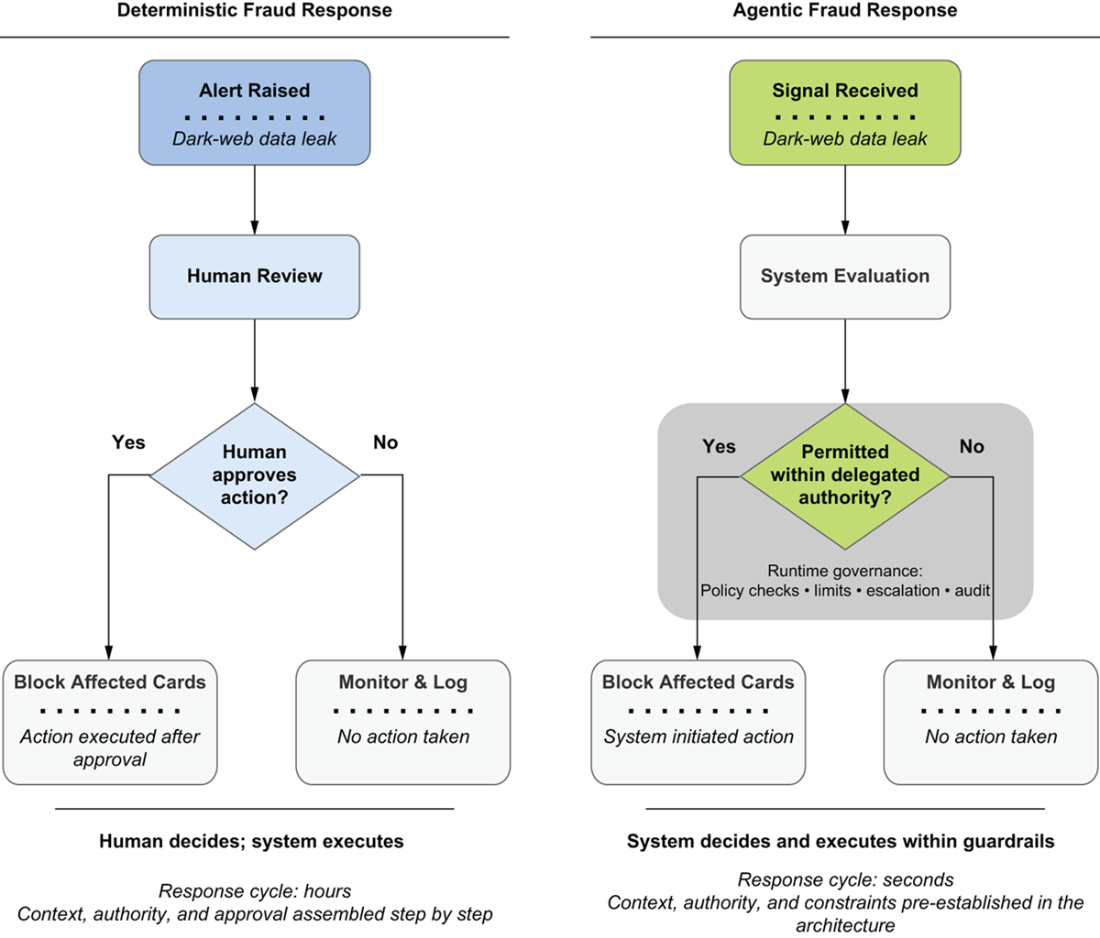
Deterministic and agentic fraud response flows, showing the shift from human approval to delegated system authority and the move from hours-long governance cycles to autonomous action in seconds.
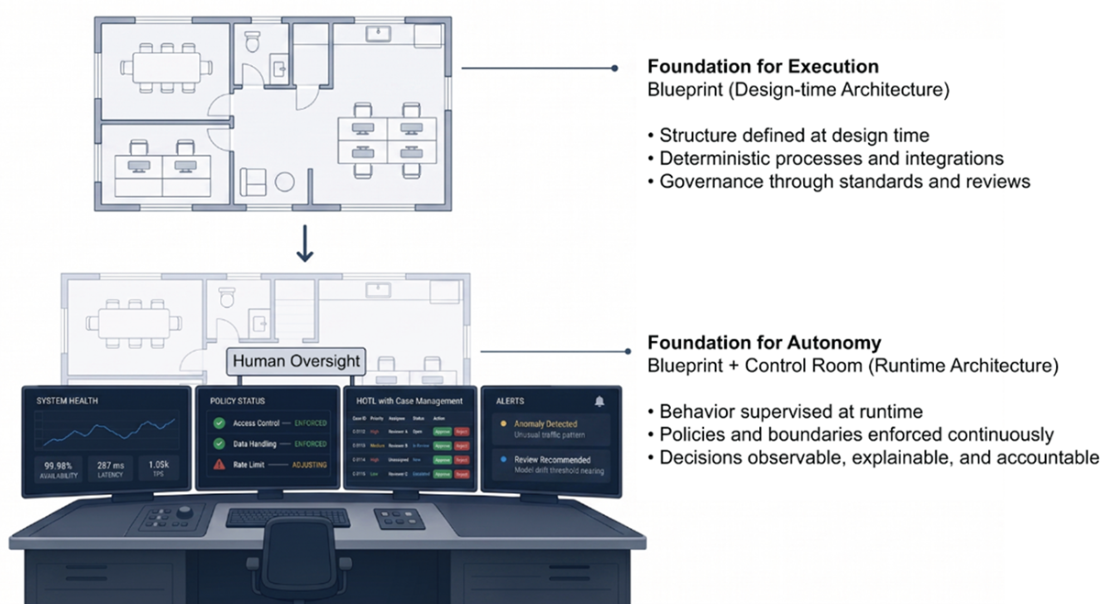
From a blueprint to a blueprint plus a control room
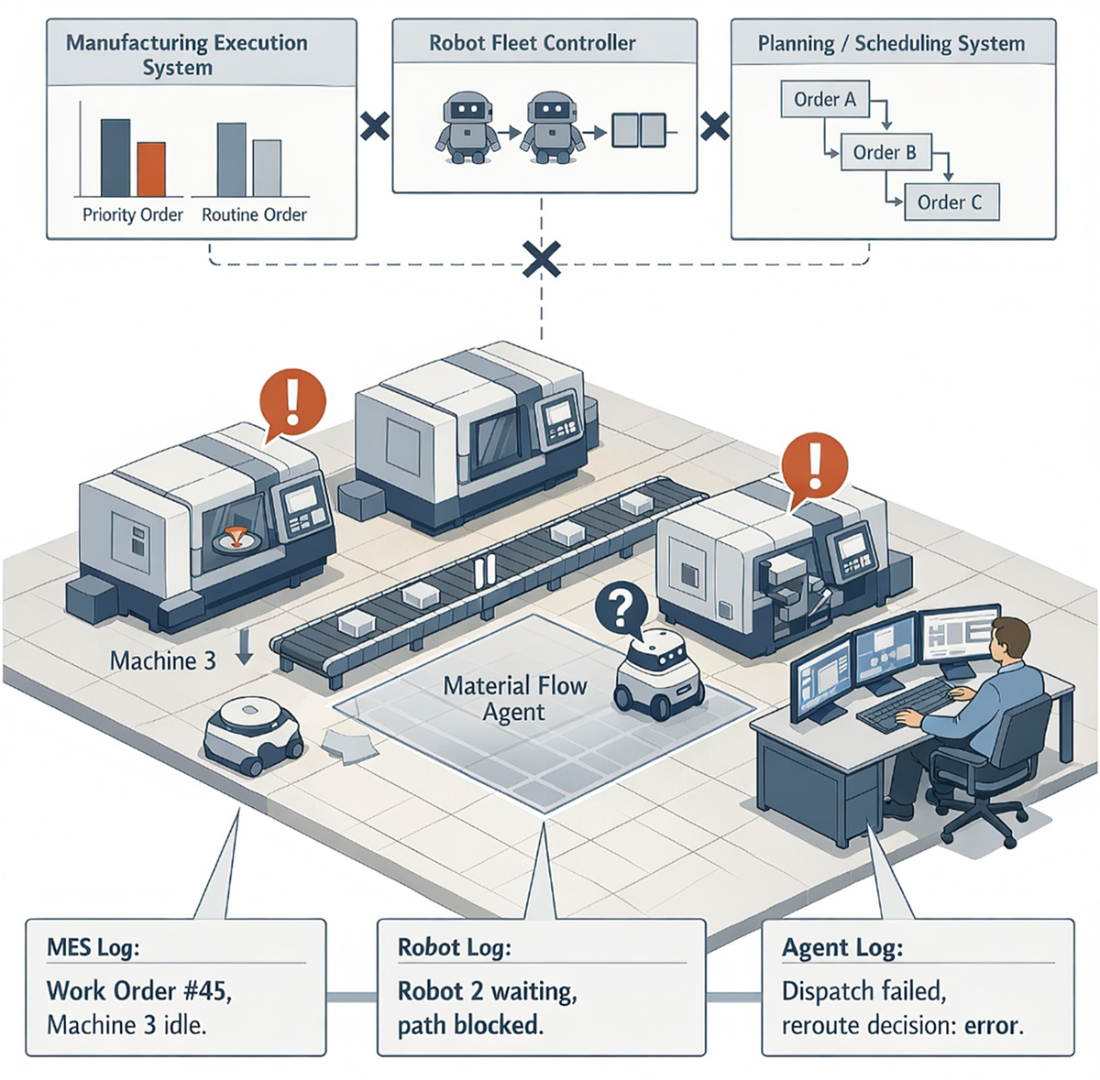
Autonomous components without a coordinating architectural foundation
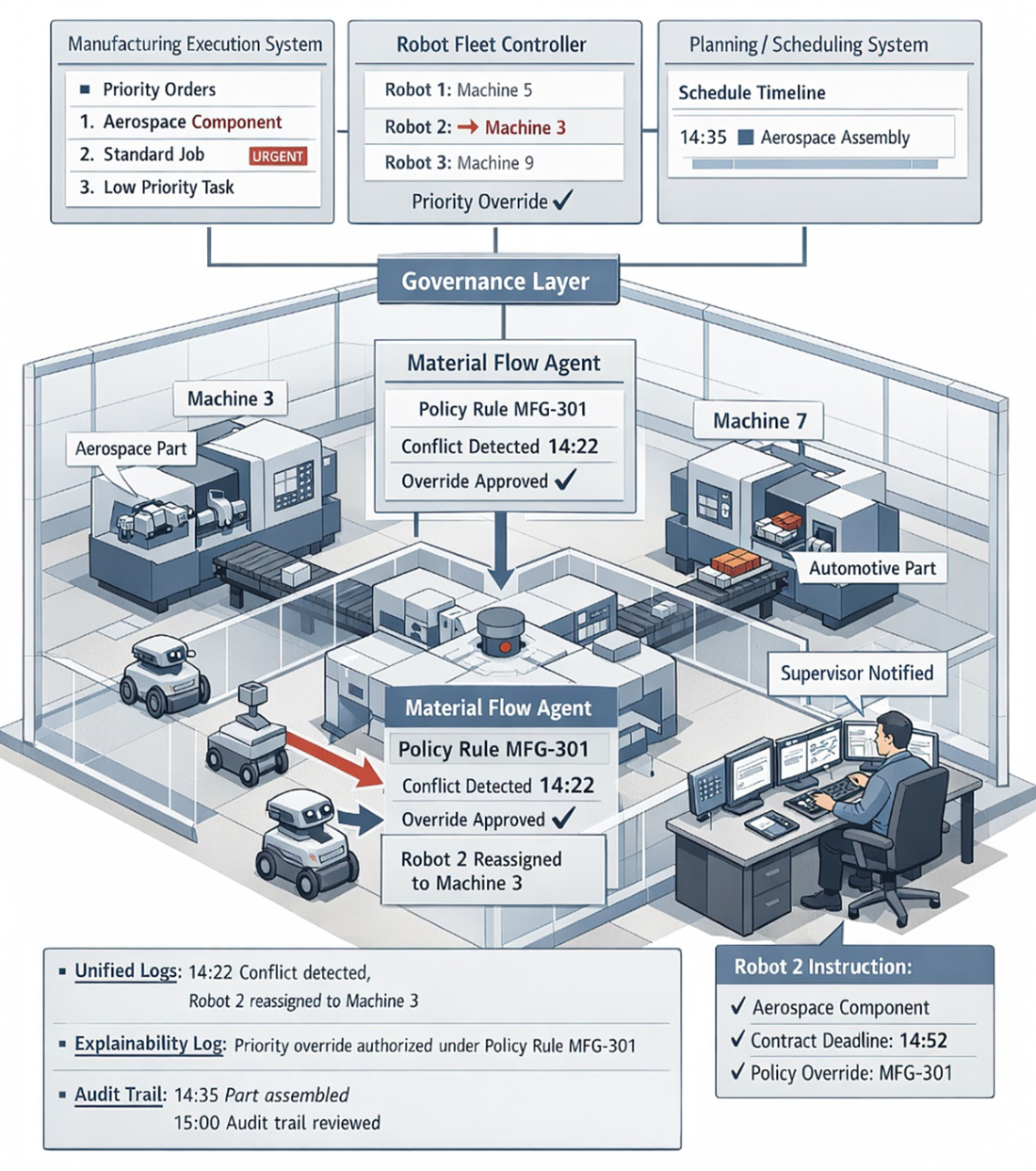
Coordinated autonomy through a blueprint plus a control room
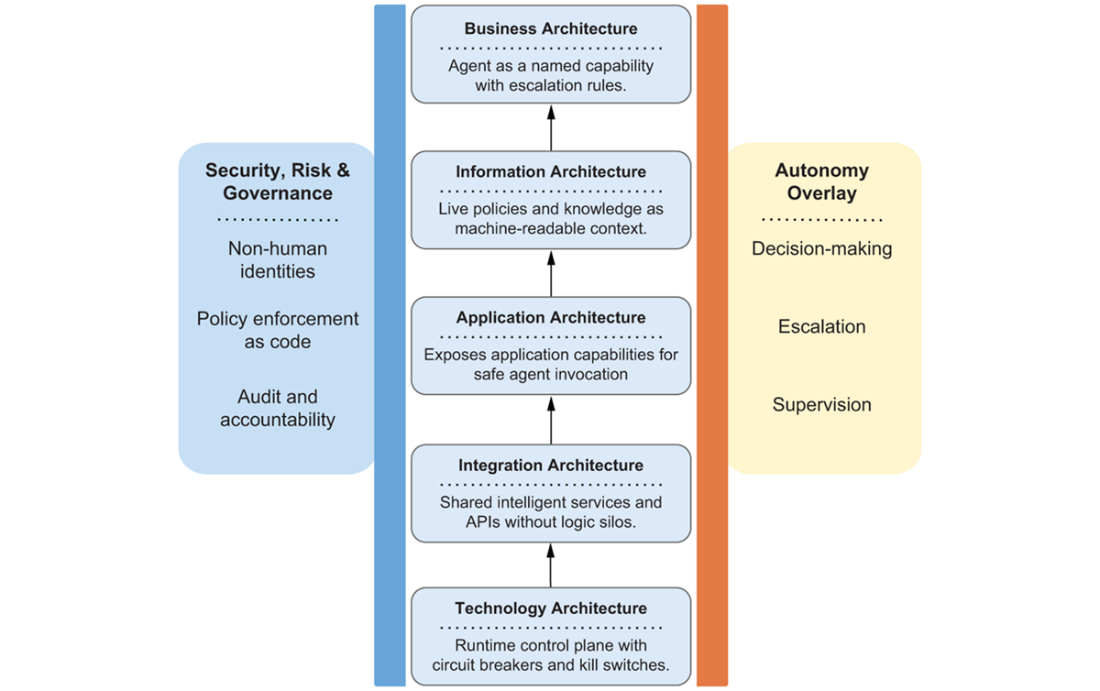
Autonomy across architectural layers, showing how each layer acquires a runtime governance dimension without replacing existing structures.
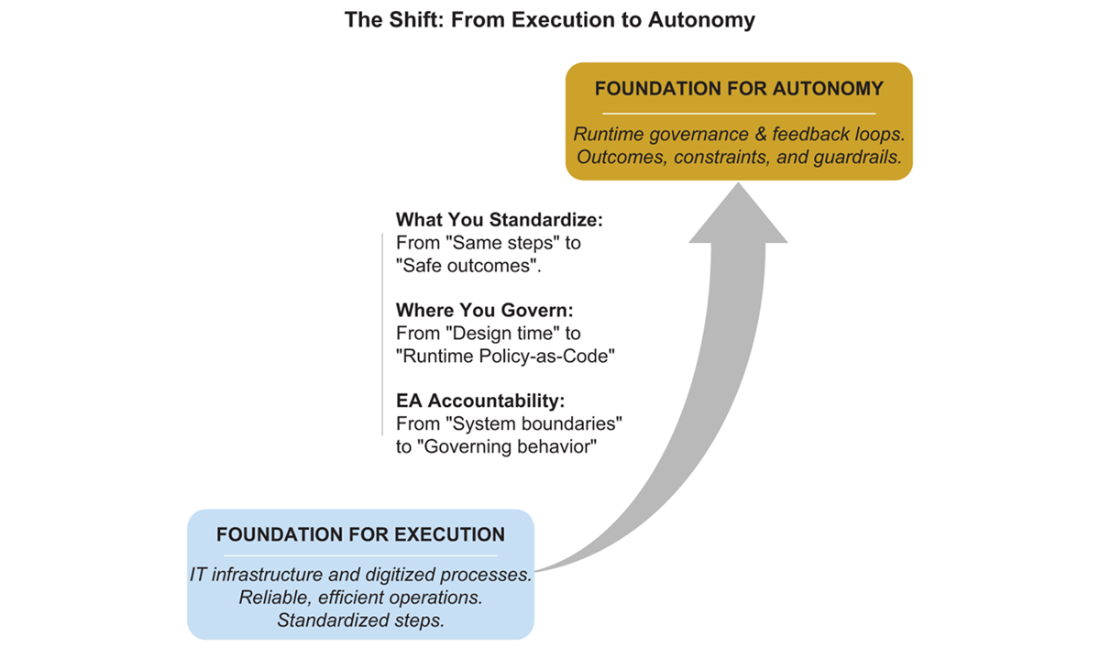
The Foundation for Autonomy adds a runtime governance layer and feedback loops to the existing IT infrastructure, shifting the focus from standardized steps to standardized outcomes
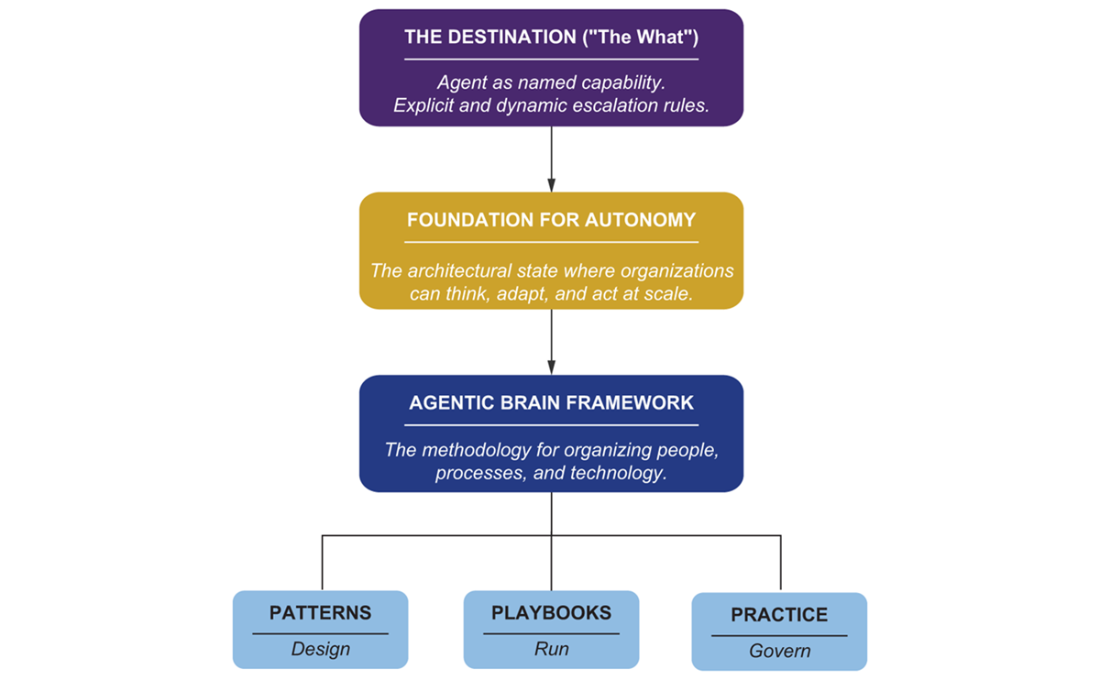
The Agentic Enterprise Framework organizes the architect’s work into three actionable streams: patterns, playbooks, and practice, moving from theoretical design to a governed, operational Foundation for Autonomy.
Summary
- Enterprise systems are moving away from automation that simply executes predefined steps and toward autonomy, in which systems make goal-oriented decisions at runtime.
- In practical terms, automation gives the enterprise reliable muscle memory, while autonomy introduces cognitive capability that can adapt to context.
- Organizations must augment their Foundation for Execution with a Foundation for Autonomy, a new architectural layer that governs runtime behavior through decision boundaries, policy-as-code, and continuous supervision rather than design-time controls alone.
- The Agentic Enterprise Framework provides the method through three pillars: patterns (architectural blueprints), playbooks (implementation guides), and practice (governance structures).
- Traditional design-time governance breaks down when systems act faster than human intervention cycles, forcing a shift from static controls to dynamic guardrails.
- This shift requires moving from a static blueprint to a blueprint-plus-control-room model, in which architecture actively supervises and constrains autonomous behavior at runtime.
- As a result, the human role shifts from directly operating systems to defining the boundaries and constraints within which autonomous agents are permitted to act.
- Succeeding in the agentic era does not require becoming an AI engineer; it requires applying architectural rigor to systems whose behavior is probabilistic rather than fully predictable.

 Architecting for Autonomy ebook for free
