5 Privacy
Privacy in generative AI goes beyond keeping data confidential and secure; it is about lawful, fair, purpose-bound use that preserves individual control. The chapter explains that traditional privacy practices—minimization, purpose limitation, accuracy, storage limitation, transparency, and user rights—still apply, but GenAI stretches them by learning from data and producing outputs that can leak or fabricate personal information. This shift expands the privacy surface from databases and logs to model weights, embeddings, retrieval pipelines, and generated text, requiring a mindset change from governing static data stores to governing dynamic model behaviors.
The chapter organizes risks around four pillars. In Collection & Purpose, training and fine-tuning on large, mixed datasets often lack a valid legal basis, over-collect personal data, and enable hidden secondary uses by vendors; teams should minimize upfront, apply privacy-enhancing techniques, secure clear notices/opt-outs, and govern vendor defaults by contract. In Storage & Memorization, personal data can persist in weights, embeddings, logs, and caches, enabling memorization, membership or attribute inference, and hard-to-execute deletion; mitigations include strict retention, encryption, traceability, leakage testing, and plans for data-subject rights. In Output Integrity, models can hallucinate, infer sensitive traits, or leak cross-context information, creating defamation and fairness risks that demand filters, isolation, red-teaming, and meaningful human oversight. In User Rights & Governance, erasure, rectification, and access collide with technical limits (machine unlearning and precise edits remain immature), so organizations should prevent personal data from entering models, maintain deletion-aware lineage, offer opt-outs, filter harmful outputs, and document constraints transparently.
Privacy posture hinges on deployment model. SaaS consumers rely heavily on vendor promises and settings; API integrators share responsibility and can add local guardrails; model hosters hold full control and full accountability across data, weights, embeddings, and outputs. Regulators increasingly expect operational evidence, not policies alone: mapped data flows, lawful-basis records, retention and deletion proofs across pipelines (including embeddings and backups), output-moderation tests, DSAR fulfillment logs, and clear transparency artifacts (disclosure of AI use, sources/categories of data, explanation routes for impactful decisions). The chapter’s practical message is to collect less, limit where data travels, harden retrieval and outputs, verify vendor behavior, and build audit-ready governance so that, when rights are exercised or incidents occur, organizations can both reduce harm and demonstrate they did the right things.
How models link names to real images. Left: NASA public-domain portrait of Neil Armstrong. Middle: Stable Diffusion v1.5 output for the prompt “Neil Armstrong”. Right: ChatGPT-5 generated output for the same prompt[26]
ChatGPT is leaking an uploaded document of a customer to another one in an unrelated query
Summary
This chapter showed that the familiar principles of data protection such as minimization, purpose limitation, accuracy, retention, and enforceable rights still apply to GenAI. However, GenAI systems introduce additional challenges because personal data is no longer confined to rows in a database. It can be memorized inside weights, reproduced in embeddings, leaked across retrieval indexes, or hallucinated in outputs. Privacy considerations therefore extend in three directions: what the model itself outputs, how vendors handle and possibly misuse the underlying data, and how both end users and professionals using these systems can be given clear explanations and controls.
We organized the risk surface into four pillars:
- Collection & Purpose. Models are often trained or fine-tuned on personal data without a valid legal basis, using “public” content or re-using customer data beyond their original purpose. Even where lawful, overcollection is a risk: entire repositories or chat logs may be ingested when a small, curated set would suffice. Secondary use by vendors further makes the blast radius bigger.
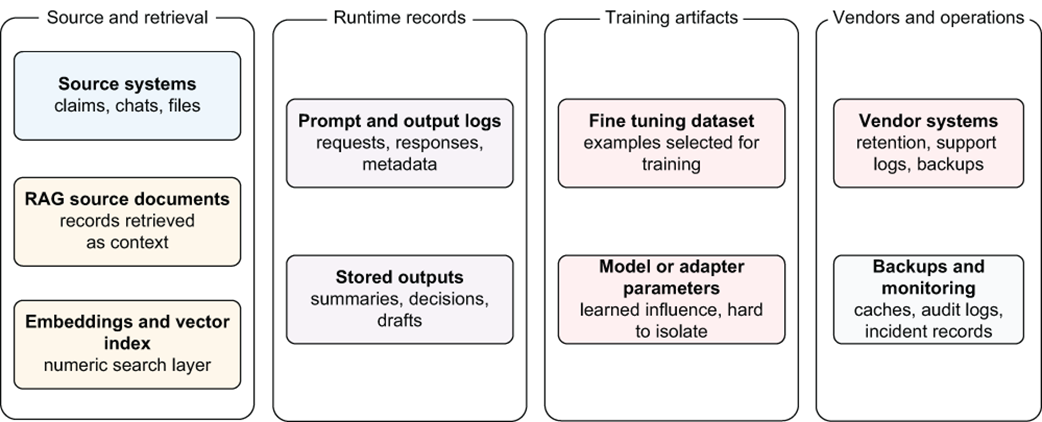
- Storage & Memorization. In GenAI, deletion is never straightforward. Information persists in weights, embeddings, caches, and backups. Research shows large models can regurgitate training snippets, and retrieval databases treated as “anonymous” can leak identity or sensitive traits. Organizations need auditable deletion pipelines and stress tests to prove data doesn’t linger in hidden layers.
- Output Integrity. GenAI introduces a novel privacy risk: harmful or false statements about real people. Hallucinations and defamation count as processing of personal data. If overreliance is present, those hallucinations may lead to unfair treatment of individuals and sometimes those treatments might have significant effects. Vendor guardrails help but are often insufficient.
- User Rights & Governance. The right to access, rectify, or erase clashes with how models absorb data. Machine unlearning remains immature. That gap forces transparency: explain clearly what you can and cannot deliver, and build deletion-aware pipelines now rather than promising what technology cannot yet provide.
We also showed that adoption posture shifts where these risks hit hardest. SaaS consumers live with vendor opacity and contractual assurances. API integrators have leverage through pre- and post-processing, but remain exposed to vendor logs. Model hosters take back every lever (collection, storage, outputs, and rights) but also inherit the full accountability and operational burden.
Finally, we stressed that privacy is proven through evidence. Policies are not enough. Evidence means deletion job logs, data-flow diagrams, DSAR packages, red-team results, and lineage records showing how data moved and where it was erased.
The lesson of this chapter is blunt: privacy in GenAI cannot be reduced to encryption or access control. It is about constraining collection, showing deletion, testing outputs, and honoring rights even when the technology resists. Teams that treat these as optional guardrails will find themselves exposed. Teams that build privacy into their systems from the start are not only compliant by default, they are also more resilient. Retrofitting privacy later is expensive; fines are only part of the cost. Redesigning systems, rewriting workflows, and repairing lost trust can be far more damaging. By contrast, organizations that treat output integrity and transparency as design principles avoid costly rework and can adapt quickly when regulations or expectations shift.
FAQ
Why isn’t good security enough for good privacy in GenAI?
Security protects confidentiality and integrity (e.g., encryption, access control), but privacy governs what you’re allowed to collect, use, share, and keep, and ensures individuals retain control. In GenAI, privacy can be violated by what the model outputs (e.g., revealing training data, inferring sensitive traits, leaking across sessions) even when infrastructure is secure. Privacy demands lawfulness, fairness, purpose limitation, minimization, accuracy, transparency, and enforceable user rights.What makes GenAI privacy risks different from traditional software?
Traditional apps handle discrete records with predictable deletion paths; GenAI learns patterns and can regenerate or infer personal data. Risks span four pillars: (1) Collection & Purpose (massive, mixed sources and hidden secondary uses), (2) Storage & Memorization (personal data in weights, embeddings, and logs), (3) Output Integrity (hallucinations, profiling, cross-context leaks), and (4) User Rights & Governance (erasure/rectification clash with model internals). Compliance must now monitor models, embeddings, retrieval pipelines, outputs, and behavior—not just databases.What lawful basis do I need to train or fine‑tune on personal data, and what are common mistakes?
Under GDPR Article 6, you need a valid basis (e.g., informed consent, contract necessity, or legitimate interest) and must stick to the stated purpose. Common errors: assuming “public” data is free to use; repurposing service or chat logs for training without notice/consent; claiming contract necessity or vague “legitimate interest” for broad profiling; and overlooking that fine‑tuning on customer data makes you a controller with full obligations. If you can’t clearly justify and document the basis and purpose, the use is likely unlawful.How do I avoid overcollection and apply data minimization in GenAI and RAG?
- Start with the smallest dataset that supports the use case; add only with a documented need and short retention.- Filter/redact before embedding or uploading; avoid indexing entire drives when a few de‑identified docs suffice.
- Sanitize prompts and disable vendor training/logging where possible; train employees to avoid oversharing.
- Go beyond redaction: use generalization/aggregation, k‑anonymity, differential privacy, or synthetic data where suitable.
- Stress test with privacy attacks (e.g., membership/attribute inference) to measure residual risk.
Are “anonymized” datasets and embeddings actually anonymous?
Often not. Seemingly anonymized text can be re‑identified via indirect identifiers or model synthesis; large models can memorize or reconstruct snippets. Embeddings can leak content or sensitive attributes through reconstruction or inference attacks, and similarity search can re‑link vectors to individuals. Regulators warn that if personal data can reasonably be extracted or inferred, the model/embeddings may themselves be personal data, triggering data protection duties.How can I reduce memorization and leakage from models in practice?
- Baseline: filter outputs for obvious PII, rate‑limit queries, and red‑team for verbatim leaks or seeded “secret phrases.”- Advanced: add answer variation to foil brute‑force extraction; apply generalization, noise/differential privacy, or synthetic data in training/fine‑tuning; monitor for probing patterns. Maintain provenance and run leakage tests before release, especially for public or multi‑tenant deployments.
How should I govern third‑party GenAI vendors to prevent secondary use of my data?
- Demand no‑training/no‑retention settings, clear opt‑outs, deletion APIs, and documented data flows/retention.- Put terms in contract and verify in configuration; request audit trails and sub‑processor transparency.
- Use DLP/anonymization gateways; map which prompts/fields call external APIs; validate vendor deletion of logs.
- Minimize prompts, prefer references/embeddings over raw PII; train staff and enforce internal usage policies. Design for containment so any incident has a small blast radius.
What does “deleting” personal data mean in GenAI systems, and how do I make it real?
Deletion must cover every copy and transformation: prompts/outputs in logs, embeddings/vector stores, caches/backups, session memories, and (if trained) model weights. Practices include vector traceability to source records, short retention with “tombstone sweeps,” per‑tenant isolation, RAG access checks, and operational proofs that erasure propagates to replicas and backups. Red‑team to confirm memorized data can’t be elicited post‑deletion.When do hallucinations and automated decisions trigger privacy obligations?
Outputs about identifiable people are personal data—even if false. Defamatory or sensitive claims can breach fairness, accuracy, and special data rules, triggering rectification duties. If AI outputs drive decisions with legal or similarly significant effects (e.g., jobs, credit), GDPR Article 22 requires meaningful human oversight and contestability; U.S. rules (CFPB, EEOC) require specific, intelligible reasons and compliance with anti‑discrimination laws. Disclaimers alone don’t absolve responsibility.How can I honor user rights (access, rectification, erasure) when data is “baked into” a model, and what evidence should I keep?
- Today’s approach: prevent and prepare. Minimize personal data in training; keep deletion‑aware lineage; track which data went into which model; offer opt‑outs; apply output filters to reduce harm.- DSAR reality: extract from tangible layers (inputs, outputs, RAG documents/metadata/embeddings) and explain technical limits of weights. Provide transparent notices about sources/types of training data and commit to exclude flagged data from future training.
- Evidence regulators look for: lawful‑basis and provenance records; data‑flow maps and minimization logs; retention/deletion job logs for embeddings/caches/backups; red‑team reports for leakage; filter configurations and blocked‑output logs; DSAR artifacts (what was provided/deleted); transparency records (AI disclosures, data‑source notices, explanation reports for decisions).
AI Governance ebook for free