The Thinking Programmer bundle 
Before you commit to a solution, take a closer look at how you reached it. This four-ebook collection starts with how your brain handles code, helping you recognize what’s making unfamiliar logic difficult to understand. From there, learn to work through your reasoning explicitly, question assumptions, and use creative techniques to develop alternatives you might otherwise overlook. You can then compare those possibilities with a sharper understanding of their costs in maintenance, performance, and flexibility. Reading all four books takes you through that whole progression, with techniques to apply to your current work and revisit as you tackle more demanding projects. Get the complete ebook collection for $99.99.
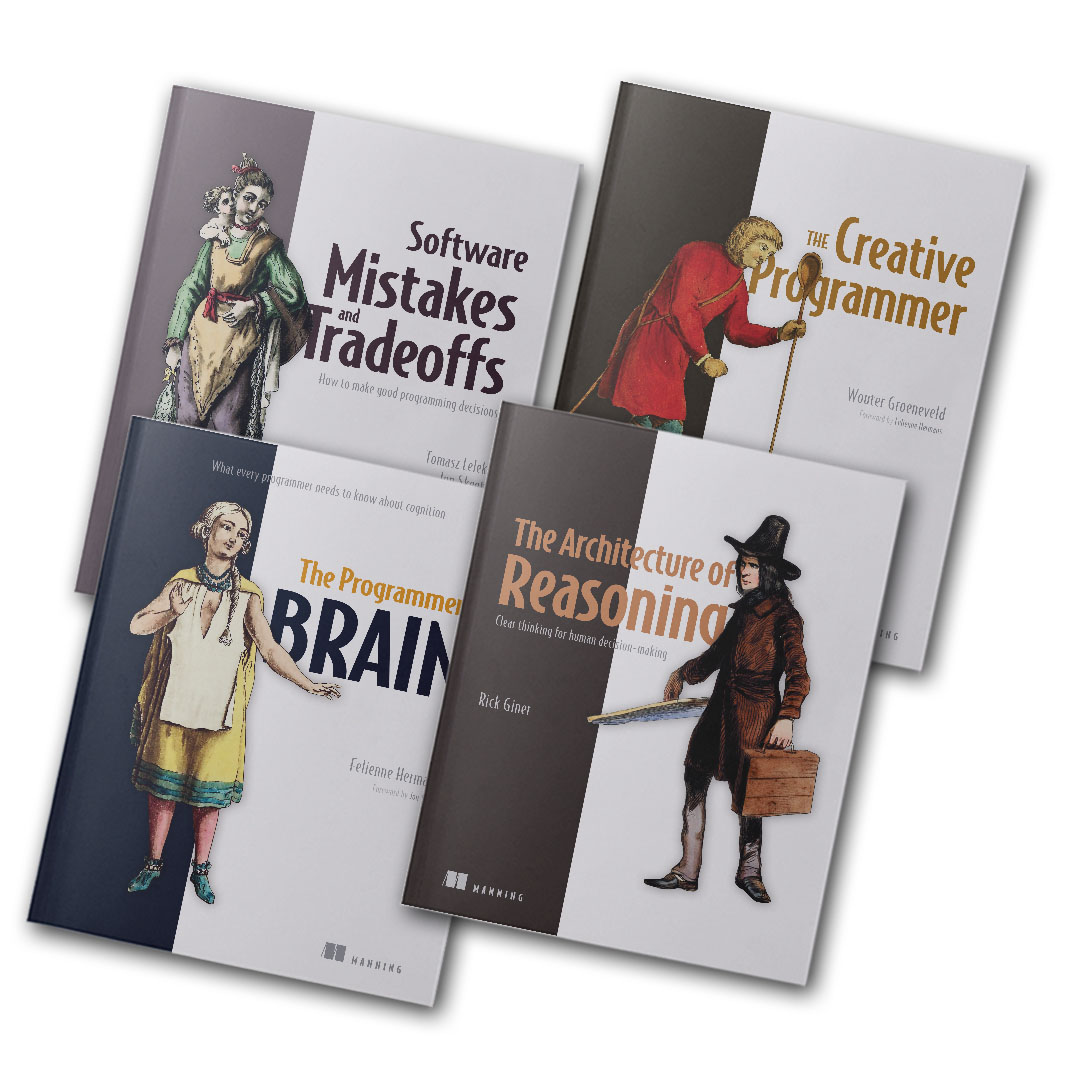


The Architecture of Reasoning 
 AI models “reason” by applying specific, reproducible patterns to break down tasks, solve multi-step problems, and produce complex documents, images, and code. In The Architecture of Reasoning, author Rick Giner examines these reasoning patterns and shows how you can apply them to make better decisions and work more effectively—even in tasks and interactions that do not involve AI.
You’ll begin by identifying the five reasoning structures revealed through AI research: Direct Q&A for bounded problems, Chain-of-Thought for surfacing hidden assumptions, Tree-of-Thought for genuine exploration, Chair-of-Thought for rotating perspectives, and ReAct for looping between reasoning and evidence. Then, you’ll see how each can be applied in your personal and team work. You’ll learn to match the reasoning pattern to the task at hand and choose the most efficient architecture to get the results you want.
Each reasoning pattern you’ll explore is grounded in familiar situations, from the team that leaves the same meeting optimizing for three different outcomes to the AI rollout that improves every metric except the one that actually mattered. You’ll learn to recognize reasoning compression, diagnose the shape of a problem, expand the solution space without descending into brainstorming chaos, and turn conclusions into testable hypotheses. Plus, you’ll develop the ability to design documents, reviews, and workflows as reasoning systems, removing the need for an expert on hand to rescue you from poor decision processes.
Even the most carefully structured reasoning process can fail in the wrong environment. The Architecture of Reasoning explores how attention, status, tempo, evidence quality, and psychological conditions shape how people reason, and gives you the cognitive infrastructure you can use to help good ideas survive contact with organizational pressure. Throughout the book you’ll find compact tools such as the 60-second problem-shape check, reasoning-selection tables, and Chain-of-Thought scaffolds that help you make better decisions, fast.
The Creative Programmer
 The Creative Programmer explores seven dimensions of creativity in software engineering—technical knowledge, collaboration, constraints, critical thinking, curiosity, a creative state of mind, and creative techniques. As you read, you’ll apply insights about creativity from other disciplines to the challenges of software development. Numerous relevant examples and exercises drive each lesson home. You’ll especially enjoy the unique Creative Programming Problem Solving Test that helps you assess how creative you’ve been with a programming task.
Software Mistakes and Tradeoffs
 Software Mistakes and Tradeoffs explores real-world scenarios where the wrong tradeoff decisions were made and illuminates what could have been done differently. In it, authors Tomasz Lelek and Jon Skeet share wisdom based on decades of software engineering experience, including some delightfully instructive mistakes. You’ll appreciate the specific tips and practical techniques that accompany each example, along with evergreen patterns that will change the way you approach your next projects.
The Programmer's Brain
 The Programmer’s Brain unlocks the way we think about code. It offers scientifically sound techniques that can radically improve the way you master new technology, comprehend code, and memorize syntax. You’ll learn how to benefit from productive struggle and turn confusion into a learning tool. Along the way, you’ll discover how to create study resources as you become an expert at teaching yourself and bringing new colleagues up to speed.
Some bundled books and liveVideos are part of the Manning Early Access Program. You'll get all the available content now, new content as it's created, and the final product when it's ready.
