Runtime Intelligence: The New AI Architecture bundle 
AI is entering a new phase. For years, progress meant building bigger models with more parameters and more training data. But the most important shift happening right now isn’t about model size, it’s about how systems think at runtime. AI labs are discovering that models can become dramatically more capable not by getting larger, but by getting more time and structure to reason. From OpenAI’s reasoning systems to DeepSeek’s R1, a new architecture is emerging: one where intelligence improves the longer a system has to think. This book bundle explores why test-time compute, reasoning loops, and reinforcement learning are becoming the foundation of modern AI systems and how forward-thinking teams are already building around this approach. If you’re working with LLMs, agents, or AI-powered products, understanding this shift is no longer optional. It’s the difference between building yesterday’s chatbots and tomorrow’s intelligent systems.
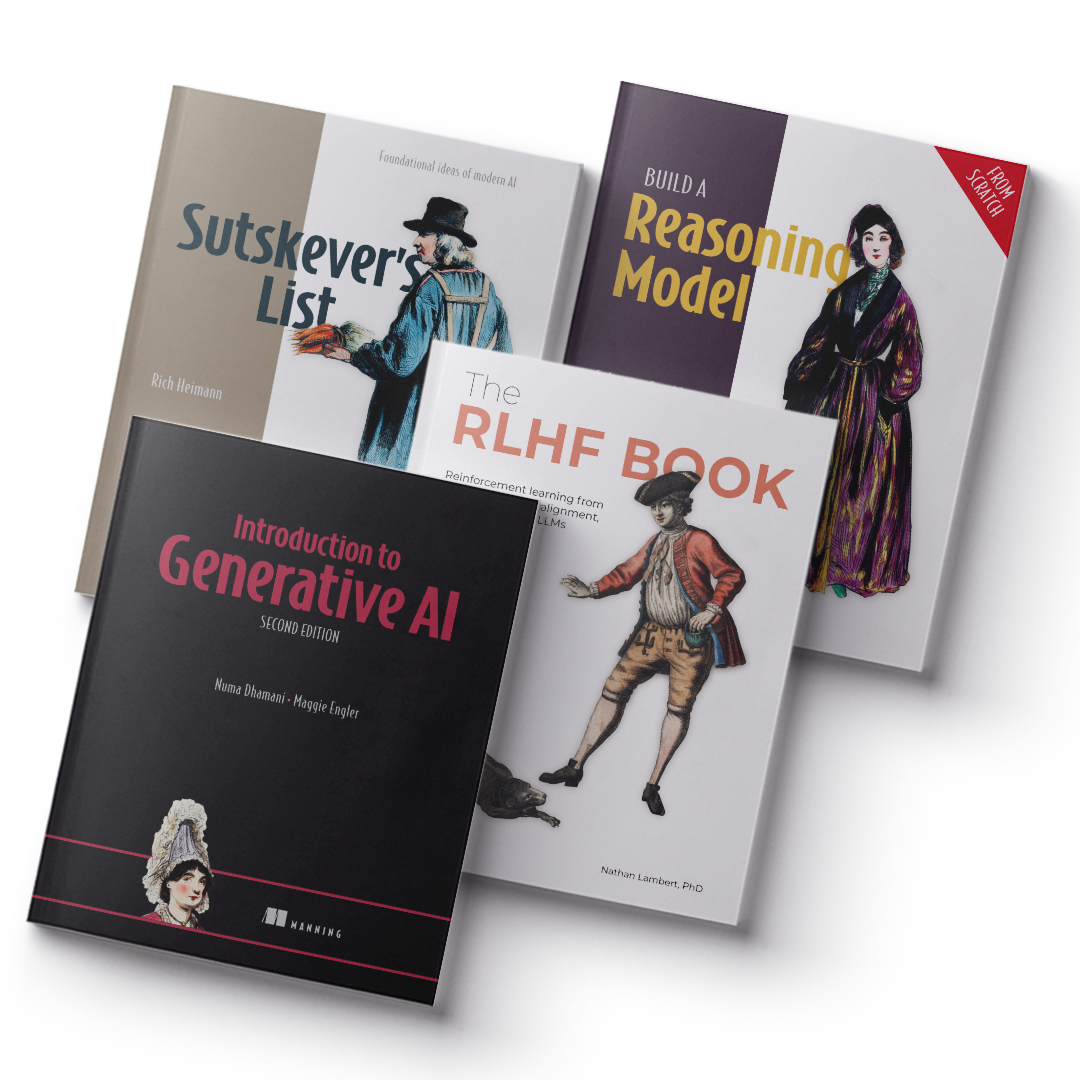

Build a Reasoning Model (From Scratch)
 "An exceptional deep dive into the next frontier of AI.”
—Aman Chadha, Google
Build a Reasoning Model (From Scratch) is a practical guide to understanding how modern reasoning-oriented LLMs work by building their core methods step by step. The book tells a clear engineering story: start with a conventional pre-trained LLM, learn how text generation works, build reliable evaluation tools, improve reasoning through inference-time methods, then move into training-based approaches such as reinforcement learning and distillation.
The progression is deliberate. Early chapters establish the baseline model and explain text generation, KV caching, and evaluation with math verifiers. The middle chapters show how reasoning can be improved without changing model weights, using chain-of-thought prompting, sampling, self-consistency, response scoring, and self-refinement. Later chapters move to changing the model itself through reinforcement learning with verifiable rewards, GRPO improvements, format rewards, and finally distillation from stronger reasoning models into smaller ones.
The book is especially useful because it implements the core methods from scratch rather than treating them as black-box library calls. Readers see how self-consistency, self-refinement, Best-of-N, and training-based methods actually work, including their cost and latency trade-offs. It also discusses common failure modes, including cases where refinement can make answers worse. Difficult concepts such as softmax, temperature, and top-p sampling are clarified with code-linked explanations and diagrams, and visual workflows make pipelines and scoring methods easier to follow.
Reading the book feels like following a guided technical build rather than a loose survey of AI topics. Each concept is introduced because the project now needs it. Diagrams, roadmaps, code listings, exercises, and repeated workflow summaries help readers stay oriented through advanced material. This structure reflects Sebastian Raschka’s professional strength: explaining complex machine learning topics by making every detail concrete and showing exactly where each section fits in the larger story. He does not treat mechanisms like evaluation, log-probabilities, KL regularization, or distillation as isolated abstractions; he connects them to the goal of making reasoning models understandable and implementable.
Physically and organizationally, the book has eight chapters and seven substantial appendixes. That design keeps the main narrative focused while moving supporting material like references, exercise solutions, model source code, larger models, batching, evaluation alternatives, and chat interfaces into ordered appendixes. The result is a logically flowing book that remains hands-on, navigable, and technically deep without constantly interrupting the central build.
Introduction to Generative AI, Second Edition
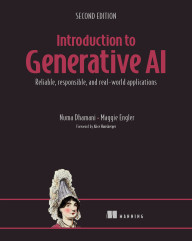 Introduction to Generative AI, Second Edition is a completely revised and updated guide to the capabilities, risks, and limitations of generative AI. You’ll understand the latest innovations in AI, AI agents, multimodal training, reasoning models, retrieval-augmented generation (RAG), and more. Along the way, you’ll explore how AI is impacting the world, with an expert-level look at AI in industry, education, and society.
Sutskever's List
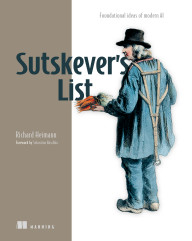 "A perspective the field has needed. Sutskever’s List delivers it with care and historical accuracy.”
—Yanping Huang, Google
Sutskever’s List is a guided intellectual journey through the ideas that made modern AI suddenly possible. Each chapter is anchored in specific papers, books, or other sources from Sutskever’s list. The papers themselves are not the focus. Instead, the author uses them as entry points into the larger breakthroughs, arguments, interconnections, and shifts in thinking that transformed the field.
It begins with AlexNet, where data, GPUs, and training craft made neural networks impossible to dismiss, then moves to ResNet, where depth becomes a superpower rather than a liability. From there, the story accelerates through sequence models, speech systems, attention, Transformers, and hyperscale, showing how AI escaped older bottlenecks and became built to grow.
Later chapters ask whether these systems can reason, why simplicity can emerge from complexity, and what intelligence and safety mean once AI capabilities begin to feel uncanny. Reviewers praise Heimann’s “exquisitely deep, detailed, and nuanced knowledge” and the “massive amount of gold material” gathered here. Yet the book remains remarkably easy to read, turning difficult papers into a “guided initiation those papers were never designed to provide on their own.”
As you go, you’ll understand how abstract lab results have translated into real-world consequences, including shifting architectures and internal organizational politics. With lucid explanations of the core technologies of AI as defined in Sutskever’s collection of seminal papers, Heimann explores common engineering choices, evaluating the strengths and limits of deep learning without falling for hype or cynicism. Complex concepts are clarified through relevant examples, vivid anecdotes, and practical engineering insights.
Each of the core papers examined in Sutskever’s List represents a crucial steppingstone in the evolution of the AI. You’ll love how Richard Heimann combines a deep technical background with a journalistic eye, never losing sight of practical considerations and providing a stepping off point to understand where the technology goes next.
Sutskever’s List features nine chapters, an epilogue, and a practical appendix, smoothly blending technical instruction with cultural and historical context. The result is a logically flowing book that remains highly accessible, navigable, and technically deep without requiring the reader to have a specialist’s background.
Reinforcement Learning from Human Feedback
 "A masterful synthesis of the field’s intellectual roots and its practical tools.”
—Saurabh Sawant, Microsoft
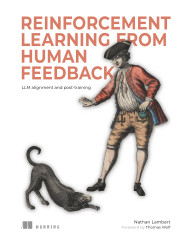
Reinforcement Learning from Human Feedback: LLM alignment and post-training helps you understand how modern AI models can be adapted to better match the needs and expectations of their users. Rather than surveying the vast field of reinforcement learning, elite AI researcher Nathan Lambert concentrates exclusively on RLHF and its immediate importance to post-training generative AI models.
This compact book gets right to the point. Early chapters establish the training overview, explain instruction fine-tuning, and build reliable reward models. The middle chapters transition into the heart of alignment, exploring core policy gradient algorithms, Direct Preference Optimization (DPO), and inference-time scaling. Later chapters tackle the messy reality of data, guiding you through preference data collection, synthetic data generation, and the nuances of function calling.
As you go, you will see how these post-training methods actually work, including their unique compute costs and latency trade-offs. You will explore common failure modes, such as qualitative over-optimization, reward hacking, and the unreliability of external evaluation comparisons. Difficult concepts like KL regularization, proximal policy optimization, and generative reward modeling are clarified with hands-on experiments.
Reinforcement Learning from Human Feedback avoids irrelevant academic details in favor of immediate, practical value. Everything author Nathan Lambert includes appears because a modern RLHF project requires it. He skillfully explains complex post-training pipelines by making every detail concrete, connecting isolated abstractions directly to the goal of making models safer, smarter, and perfectly tuned to a desired style.
The book’s seventeen short chapters lay out the core material, while supplements like vocabulary definitions, compute cost management, evaluation variance, and training performance tracking appear in handy appendixes. The result is a logically flowing book that remains highly navigable and technically deep without getting bogged down in unnecessary theory.
Runtime Intelligence: The New AI Architecture bundle is not available for sale.
