Inference Engineering bundle 
You have model up and running. What comes next? Get all five ebooks for $99.99 and build your skills from inference through production. Establish an inference workflow, optimize attention, weigh quantization’s memory savings against output quality, accelerate GPU execution with fused Triton kernels, and prepare an LLM service for deployment. The full collection connects these decisions, giving you practical techniques for today’s bottlenecks and a foundation for tackling more demanding projects.
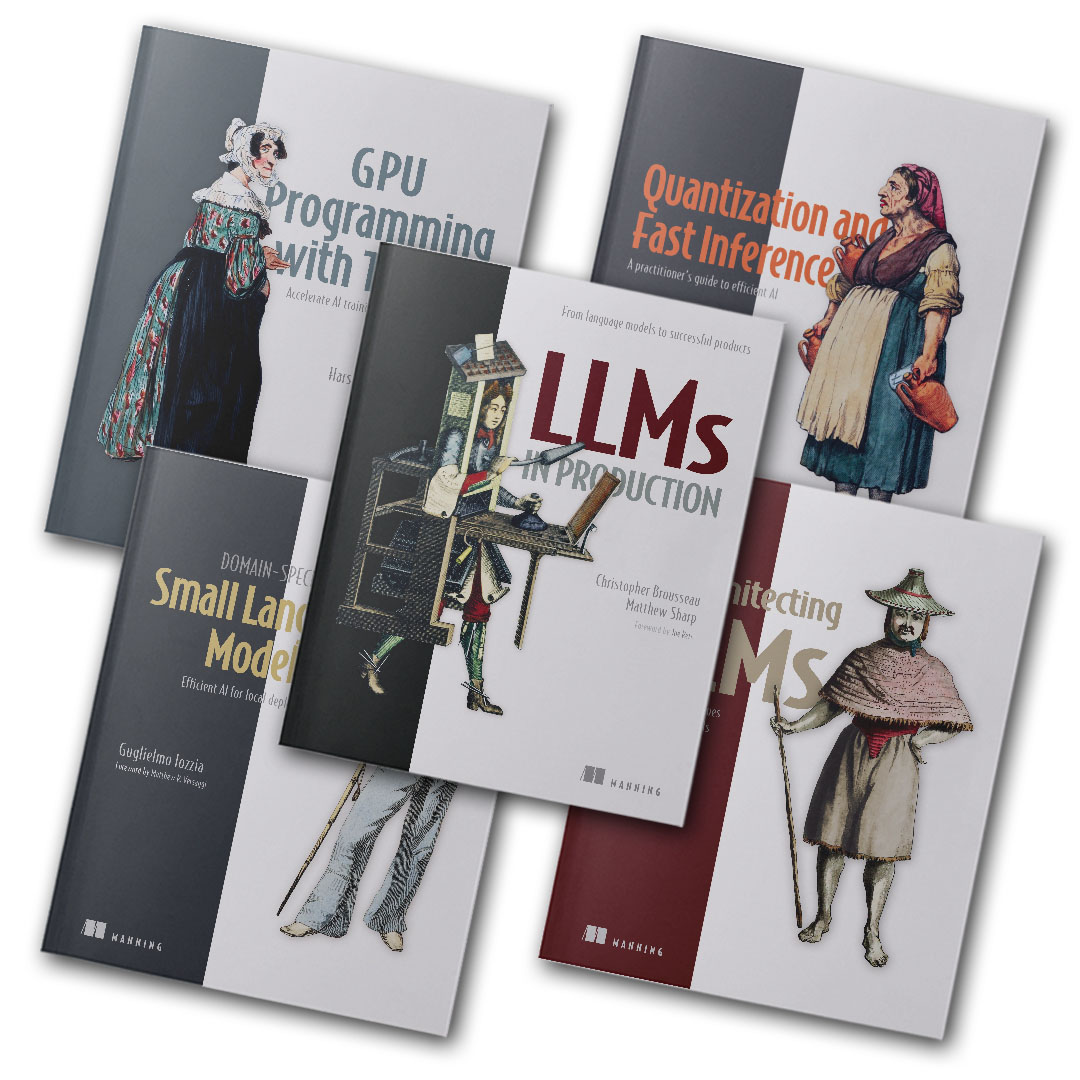


Rearchitecting LLMs 
 By default, general purpose LLMs are not optimized for specific domains and business goals. Using techniques like specialized fine-tuning, pruning unnecessary neural components, and knowledge distillation, you can rearchitect your models to cost less, run faster, and deliver more accurate results.
Rearchitecting LLMs: Structural techniques for efficient models turns research from the latest AI papers into production-ready practices for domain-specific model optimization. As you work through this practical book, you’ll perform hands-on surgery on popular open-source models like Llama-3, Gemma, and Qwen to create cost-effective local small language models (SLMs). Along the way, you’ll learn how to combine behavioral analysis with structural modifications, identifying and removing parts that don’t contribute to your model’s goals, and even use “fair pruning” to reduce model bias at the neuron level.
Domain-Specific Small Language Models
 This is a practical book that shows you how to adapt pretrained open source models to your domain using transfer learning and parameter-efficient fine-tuning. You’ll learn to minimize cost through optimization and quantization, develop secure APIs to serve your models, and deploy SLMs on commodity hardware—including small devices. The hands-on examples include integrating SLMs into RAG systems and agentic workflows.
Quantization and Fast Inference
 Today's AI models demand a lot of memory, compute, and server horsepower—which quickly translates into cost. Quantization and Fast Inference shows you how you can optimize AI models without architectural redesigns or task-specific compression. It reveals practical techniques for quantization, systematically reducing numerical precision to achieve faster inference, lower memory usage, and cheaper deployment—all with minimal accuracy loss.
From quantization fundamentals to runtime packaging, the book gives you a complete and comprehensive overview of the full quantization pipeline. It starts by deriving quantization mapping from first principles and then builds your knowledge and skill through techniques for production-tested PTQ and QAT workflows and a fully compressed deployment. You'll learn to apply post-training quantization to production models, run quantization-aware training using fake quantization and straight-through estimators, and handle subtle tradeoffs like activation outliers in LLMs, KV cache pressure, and sub-8-bit formats like NF4 and FP4.
GPU Programming with Triton
 Until recently, writing GPU kernels for LLM training and inference meant learning low-level programming tools like CUDA and C++. Triton, an open source, Python-based DSL created by OpenAI, bridges the gap between high-level machine learning frameworks and low-level GPU programming. Triton is built into PyTorch 2 and backed by NVIDIA, Intel, AMD, and Red Hat.
In GPU Programming with Triton, you'll learn how to work within the Triton ecosystem, from writing your first kernel to implementing advanced LLM features like FlashAttention and Native Sparse Attention. You'll use Triton to deliver the kernel-level control, fusion power, and acceleration that frameworks like PyTorch need under the hood without dropping down to CUDA and C++.
In this practical book written for readers with no previous GPU programming experience, author Harshwardhan Fartale introduces Triton’s innovative block-level programming model that replaces the tedious manipulation of low-level threads required by CUDA. Written for the latest hardware and LLMs, this book teaches GPU programming and Triton together, in Python, by profiling real workloads, identifying bottlenecks, and understanding why each optimization (coalescing, tiling, shared memory, reductions, and fusion) actually works.
As you go, you'll build the kernels that power modern AI systems, including FlashAttention, Native Sparse Attention, sparse matrix multiplication, and on-chip fused operations. You'll learn to profile real workloads, find the bottlenecks, wrap your kernel for production, and integrate it end to end into PyTorch. Each chapter includes handpicked practice problems designed to build the fluency that makes working in Triton feel like second nature.
LLMs in Production
 LLMs in Production teaches you how to develop an LLMOps plan that can take an AI app smoothly from design to delivery. You’ll learn techniques for preparing an LLM dataset, cost-efficient training hacks like LORA and RLHF, and industry benchmarks for model evaluation. Along the way, you’ll put your new skills to use in three exciting example projects: creating and training a custom LLM, building a VSCode AI coding extension, and deploying a small model to a Raspberry Pi.
Some bundled books and liveVideos are part of the Manning Early Access Program. You'll get all the available content now, new content as it's created, and the final product when it's ready.
