
books & videos by Alessandro Negro

Building Specialized AI Systems
AI systems using large models like GPT or Gemini can produce impressive results across an astounding range of subjects and domains. In areas like clinical coding, legal contract review, financial due diligence, fraud detection, compliance monitoring, and other specialized business or technical disciplines, however, broad general ability is far less important than efficient output that can be trusted, audited, and controlled. Building Specialized AI Systems: Fine tuning models, agents, and applications teaches you how to adapt pretrained language models to your exact domain, data, and operational constraints.
In this hands-on guide, authors Walid Amamou, CEO of UbiAI.tools and Alessandro Negro, Chief Scientist at GraphAware, walk you through the complete process of building production-grade AI systems around Specialized Language Models. In it, you'll learn how to choose the right pretrained base models, and how to work directly with supervised fine-tuning and modern parameter-efficient techniques including LoRA, QLoRA, DoRA, adapters, and Half Fine-Tuning. You'll also explore reinforcement learning–based approaches such as RLHF and GRPO, along with knowledge distillation for transferring the capabilities of large teacher models into smaller, faster student models.
Building Specialized AI Systems puts working code in front of you and walks through practical implementations step by step. You'll load and quantize models, configure fine-tuning methods, prepare datasets, run reproducible training jobs on accessible hardware, and evaluate whether your specialized model is actually improving on the task that matters.
Complete real-world projects connect these techniques from design to deployment, showing how specialized models can be applied to practical industry problems and giving you reusable patterns for your own AI systems. Along the way, you'll work with the modern fine-tuning ecosystem, including open-source and commercial platforms and tools used to train, evaluate, deploy, and operate specialized language models.
By the end, you'll have a practical framework for deciding when specialization is the right strategy and the technical skills to build, fine-tune, evaluate, and deploy language models tailored to your own domain, tasks, and constraints.
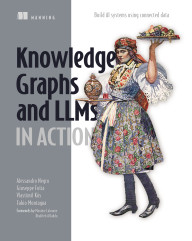
Knowledge Graphs and LLMs in Action
Knowledge Graphs and LLMs in Action shows you how to introduce knowledge graphs constructed from structured and unstructured sources into LLM-powered applications and RAG pipelines. Real-world case studies for domain-specific applications—from healthcare to financial crime detection—illustrate how this powerful pairing works in practice. You’ll especially appreciate the expert insights on knowledge representation and reasoning strategies.
Advantages of Graph-Based Machine Learning Systems
How do you apply graphs to machine-learning projects such as recommendation engines and chatbots?

Graph-Powered Machine Learning
Graph-Powered Machine Learning teaches you how to exploit the natural relationships in structured and unstructured datasets using graph-oriented machine learning algorithms and tools. In this authoritative book, you’ll master the architectures and design practices of graphs, and avoid common pitfalls. Author Alessandro Negro explores examples from real-world applications that connect GraphML concepts to real world tasks.
