10 Your codebase is the bottleneck: code organization for the agent era
At team scale, AI stops being mainly a prompt-writing problem and becomes a codebase-organization problem. The chapter argues that once multiple agents work across many services, the real bottleneck is context: if the system’s structure does not make relationships obvious, agents will confidently edit the wrong place, miss deprecated paths, or misunderstand what is production versus experimental. The remedy is to make the codebase machine-readable in the same way it is human-readable, so agents can discover the system rather than guess at it.
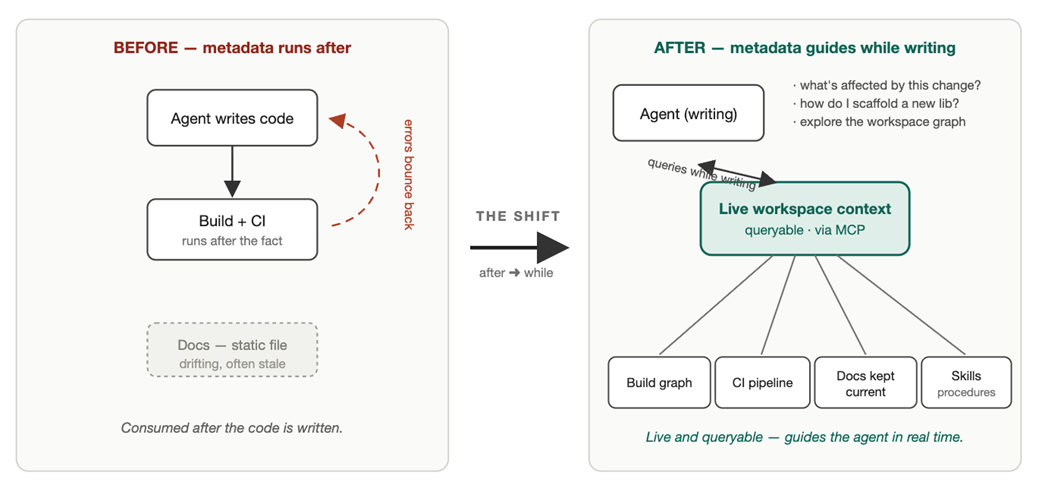
The core structural answer is to turn repository layout, dependency information, and conventions into an explicit navigation and safety layer. Monorepos, or at least monorepo-like ergonomics through a meta-repository, give agents a single search space, a queryable dependency graph, and root-level rules that encode architecture. Strict dependency enforcement makes the graph truthful, target granularity shrinks reasoning and blast radius, and build metadata should ideally be exposed live so the agent is guided by current reality rather than stale documentation. In the same spirit, sandboxes, remote caching, and progressive validation make the build system part of the collaboration loop instead of a passive checker.
Once agents can move quickly and trust their feedback, new bottlenecks appear: flaky tests, overloaded review queues, and neglected legacy systems. The chapter shows that test reliability has to come before speed, because a fast liar is worse than a slow one, and review must be triaged so humans focus on judgment, not formatting or routine correctness. Finally, the same automation that accelerates new code can continuously modernize old code and close the loop with production telemetry, while measurement must shift from raw throughput to outcomes such as iteration count, cost per iteration, auto-merge quality, and cost per feature. The end result is a codebase and workflow designed not just for coding, but for agents, governance, and sustained judgment at scale.
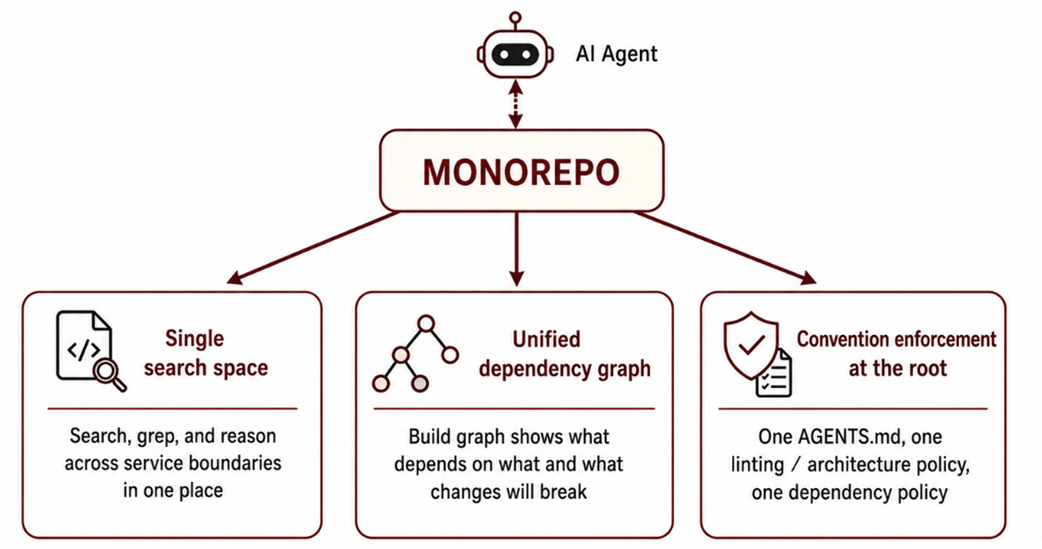
Monorepo as a Context Delivery Mechanism.
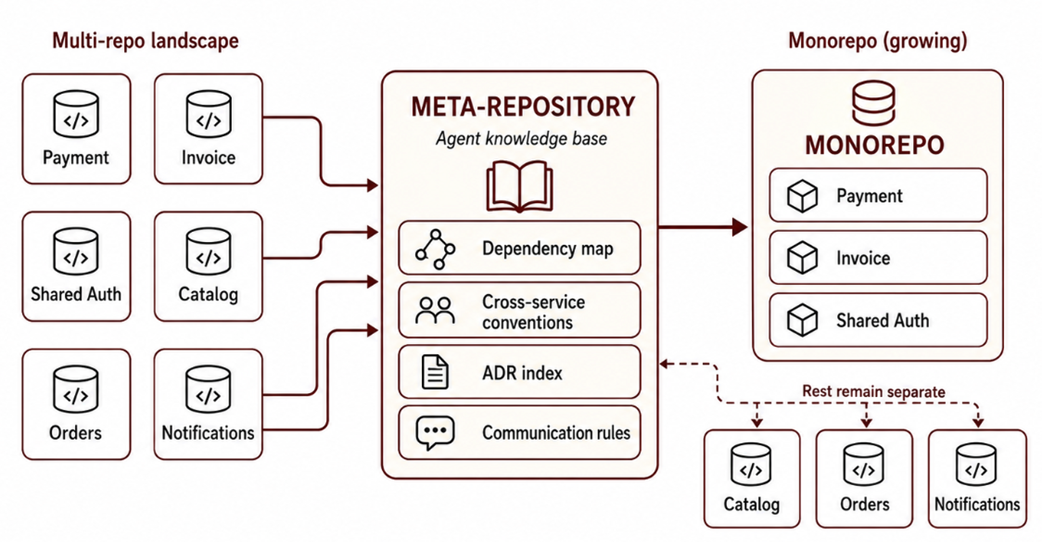
Meta-Repository Pattern.
Build Metadata Becomes a Live Context Layer.
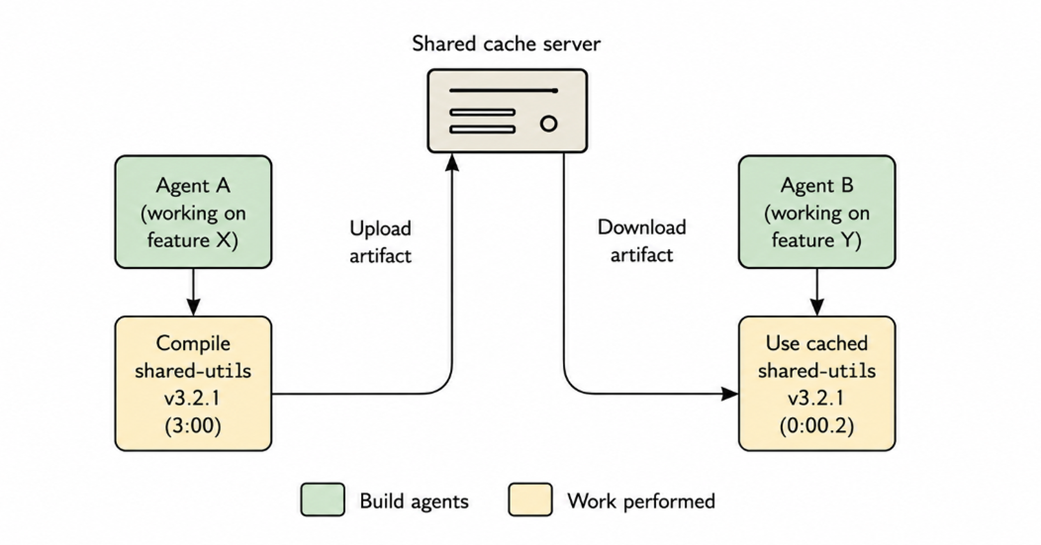
Remote caching: Shared cache gets warmer as more agents run.
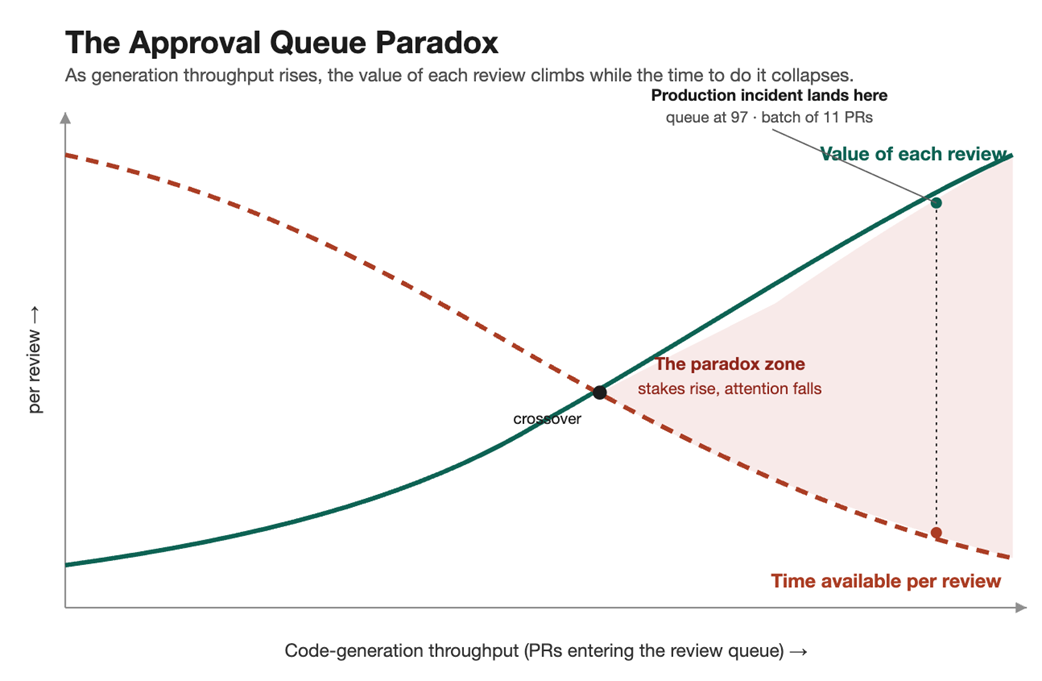
Approval Queue Paradox.
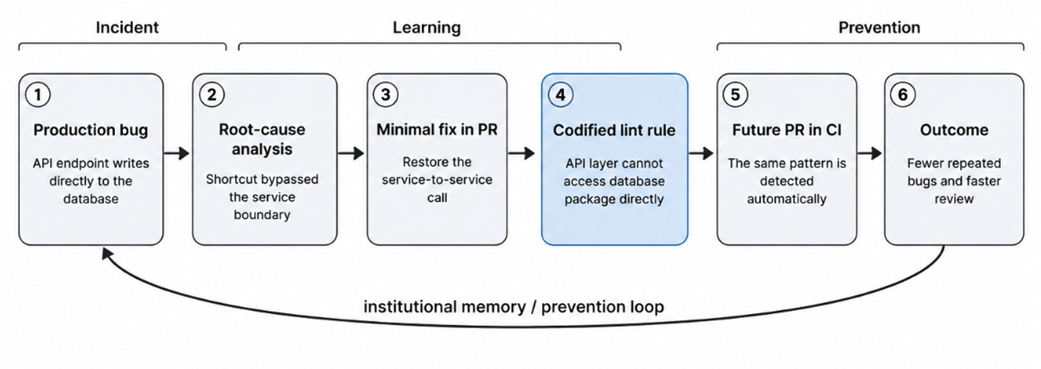
Bug → Codify → Lint Rule.
Summary
- The Context Fragmentation Tax, every missing cross-repo relationship, is the biggest invisible cost of AI-assisted development at team scale.
- The dependency graph is the agent's GPS and safety net. Target-level dependency tracking enables both navigation (finding the right code) and blast radius computation (predicting what a change breaks)..
- The path from 15-minute CI to sub-minute feedback runs through hermetic sandboxed environments, remote caching as a team-scale force multiplier, progressive validation with a pragmatic iteration cap, and module architecture that eliminates disk I/O bottlenecks.
- Test reliability is the prerequisite for everything else. Flaky tests cause agents to chase ghosts. Circular tests create false confidence. Agent shortcutting games the oracle. The correct order is: fix the lies first, then fix the speed. A fast liar is worse than a slow truth-teller.
- The Approval Queue Paradox: faster code generation creates slower code delivery, is solved by lint-as-architecture and policy-based triage.
- Agents modernizing the codebase overnight is the integration test for your entire SDLC. It requires all five previous pillars (context, navigation, speed, honest tests, automated review) to function. Start with one dead project. Prove the ROI. Then scale.
- The maturity gap between Level 1 and Level 5 is not a model gap; it's an infrastructure gap. Stripe's agent is almost a commodity. The six-layer architecture around it is the moat. The system runs the model, not the other way around.
- Judgment is the job. AI writes the code. You decide whether the code should exist, whether the architecture holds, and whether the trade-off is right. That's what remains for the Tech Lead in the agent era, and it's enough.
FAQ
What is the main idea of “your codebase is the bottleneck” in the agent era?
The chapter argues that once agents can write code quickly, the limiting factor is no longer generation but the codebase itself: its organization, context, build system, tests, and review process. If the system is poorly structured, agents will make wrong choices, waste iterations, and create hidden risk.
Why does context fragmentation become a bigger problem when teams use AI agents?
Each agent may understand its own repo well, but it usually lacks system-level context across services. At team scale, that creates mistakes like changing the wrong service, using deprecated patterns, or missing cross-service dependencies. The book frames this as an invisible tax on productivity.
Why is a monorepo useful for AI agents?
A monorepo gives agents a single search space, a unified dependency graph, and root-level enforcement of conventions. That makes relationships between projects visible and machine-readable, so agents can navigate the codebase and understand blast radius more reliably.
What is the meta-repository pattern, and when is it useful?
The meta-repository pattern is a separate repo that stores system knowledge for a multi-repo landscape, such as dependency maps, cross-service conventions, and architecture decision records. It is useful when migrating to a monorepo is too costly, but you still need agent-friendly, machine-readable context.
Why does the dependency graph matter so much for agents?
The dependency graph acts as both GPS and safety net. It helps agents find the right code to edit and also compute blast radius before merging changes. That prevents mistakes like editing an abandoned experiment instead of production code or breaking downstream services without realizing it.
What does “strict deps” mean, and why is it important?
Strict deps means every import must match an explicitly declared dependency. This turns hidden coupling into build errors instead of runtime surprises, making the dependency graph truthful and trustworthy for both humans and agents.
Why is CI speed such a big issue for agentic workflows?
Agents iterate much faster than humans, so slow CI creates a throughput wall. While waiting, agents burn tokens, expand context windows, and sometimes reason from incomplete information. Fast feedback is essential for keeping agent iterations focused and economical.
Why do hermetic sandboxes matter for AI coding agents?
Hermetic sandboxes ensure the agent’s environment matches CI, so the same source and config produce the same result everywhere. This avoids false fixes for environment mismatches and keeps agents from learning from misleading local-vs-CI differences.
Why must test reliability come before test speed?
If tests lie, faster feedback only helps the agent converge on the wrong answer sooner. Flaky, circular, or shortcut-able tests create false confidence and waste iterations. The chapter argues that honest tests are the prerequisite for safe automation and auto-merge.
What changes about the tech lead’s job in the agent era?
The tech lead is less the person who writes the hardest code and more the person who designs the system that makes agents effective. That means encoding judgment into AGENTS.md files, lint rules, dependency boundaries, validation policies, and review thresholds so the whole team can move faster without losing correctness.

 Vibe Engineering ebook for free
