This appendix offers a curated set of books to extend the troubleshooting mindset beyond tools and techniques, emphasizing deeper code comprehension, architectural judgment, and habits that make future investigations easier. The selections aim to sharpen how developers read and reason about code, make informed tradeoffs, and evolve systems toward clarity and maintainability.
For architecture, the recommendations concentrate on microservices. Monolith to Microservices guides when and how to split systems, contrasting monoliths with microservices and highlighting context-driven choices. Building Microservices expands on designing fine-grained services with pragmatic pros and cons, while Microservices Patterns catalogs essential techniques and patterns used in large-scale, service-oriented systems, all illustrated with clear examples.
On code quality and developer practice, The Programmer’s Brain explores how developers process and understand code, grounding effective investigation. Five Lines of Code promotes clean coding and the “Boy Scout rule,” encouraging refactoring after debugging to make code easier to understand. Good Code, Bad Code distills principles for writing high-quality, comprehensible software, and Software Mistakes and Tradeoffs builds skill in making informed compromises. Rounding out the list, Refactoring: Improving the Design of Existing Code remains a foundational guide to systematically improving design and maintainability.
FAQ
What is the purpose of Appendix C: Recommended further reading?It lists books related to the book’s subject that you may find useful and interesting.How can “The Programmer’s Brain” help with troubleshooting and code investigation?Felienne Hermans’s book (Manning, 2021) explores how a developer’s brain works when investigating code. Because reading code precedes applying investigation techniques, understanding these cognitive aspects helps you investigate code more effectively.What does “Monolith to Microservices” focus on?Sam Newman’s book (O’Reilly Media, 2019) examines the differences between monolithic and microservices approaches and explains where and how to use each. It’s recommended for studying microservices as an architectural style.How does “Building Microservices: Designing Fine-Grained Systems, Second Edition” complement the microservices topic?Sam Newman’s 2021 edition (O’Reilly Media) focuses on designing systems composed of fine‑grained services and analyzes the pros and cons of the techniques with clear, detailed examples.Why is “Microservices Patterns” considered a must-read?Chris Richardson’s book (Manning, 2018) clearly details essential techniques used in large‑scale microservices and service‑oriented systems, making it a must‑read for anyone working with microservices architectures.What does “Five Lines of Code” teach, and what is the “Boy Scout rule” mentioned?Christian Clausen’s book (Manning, 2021) teaches clean coding practices. After understanding how unclean code works, you should refactor it to make it easier to understand—an approach developers call the “Boy Scout rule.” Debugging is often followed by such refactoring.How will “Good Code, Bad Code” improve my coding?Tom Long’s book (Manning, 2021) teaches high‑quality code‑writing principles and is recommended to upskill in refactoring and writing easier‑to‑understand applications.What topics are covered in “Software Mistakes and Tradeoffs”?Tomasz Lelek and Jon Skeet (Manning, 2022) discuss how to make difficult decisions, handle compromises, and optimize decisions in software development, with excellent examples.Why should I read “Refactoring: Improving the Design of Existing Code”?Martin Fowler’s book with Kent Beck (Addison‑Wesley Professional, 2018) is a must‑read for developers who want to improve their skills in designing and building clean, maintainable applications.Who would benefit most from these recommended books?Developers who investigate code, work with microservices, or want to improve code quality, refactoring skills, and decision‑making in software design will find these titles especially valuable.
pro $24.99 per month
access to all Manning books, MEAPs, liveVideos, liveProjects, and audiobooks!

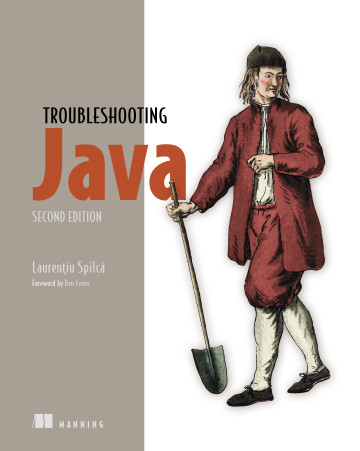 Troubleshooting Java, Second Edition ebook for free
