As a conclusion to the book, the chapter reviews the core ideas behind transfer learning for NLP and shows how prior knowledge can be reused across tasks, domains, and languages to make strong models more accessible. It revisits classic approaches such as bag-of-words and shallow embeddings, then connects them to modern pretrained language models and transformer-based systems, emphasizing how these methods transformed NLP from rule-based and task-specific systems into flexible, reusable frameworks. The chapter also reflects on the practical value of transfer learning, especially its ability to reduce the cost of training and fine-tuning large models.
The chapter then surveys major model families and adaptation strategies that shaped the field, including ELMo, ULMFiT, GPT, BERT, mBERT, DistilBERT, ALBERT, RoBERTa, XLNet, BigBird, Longformer, Reformer, T5, BART, XLM, XLM-R, and TAPAS. Across these examples, it highlights recurring themes such as contextual embeddings, multitask learning, domain adaptation, cross-lingual transfer, sequence-to-sequence modeling, and parameter efficiency. It also notes that many recent advances are best understood as refinements of a few foundational ideas: pretraining on large corpora, then adapting to downstream tasks with as little task-specific data and computation as possible.
Beyond technique, the chapter stresses the field’s emerging concerns and future directions. It points to two major trends: larger models and more efficient models, while arguing that scaling alone is not enough and that better modeling ideas remain essential. It also discusses low-resource languages, speech, multimodal applications, bias, explainability, and environmental costs as important frontiers and responsibilities. Finally, it encourages readers to stay current through competitions, papers, social media, and real-world practice, framing NLP as a fast-moving field where learning continues long after the book ends.
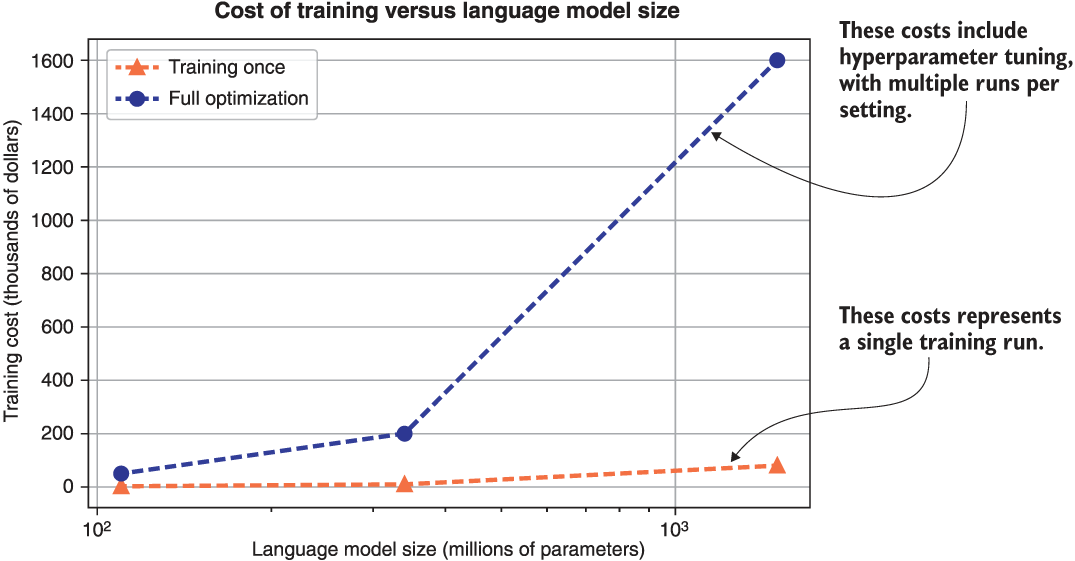
Training costs for various sizes of BERT. Two representative costs are shown—for a single run and for an entire training process that includes hyperparameter tuning. The largest size of 1.5 billion parameters costs $80k for single run, and $1.6 million when all optimization steps are accounted for!
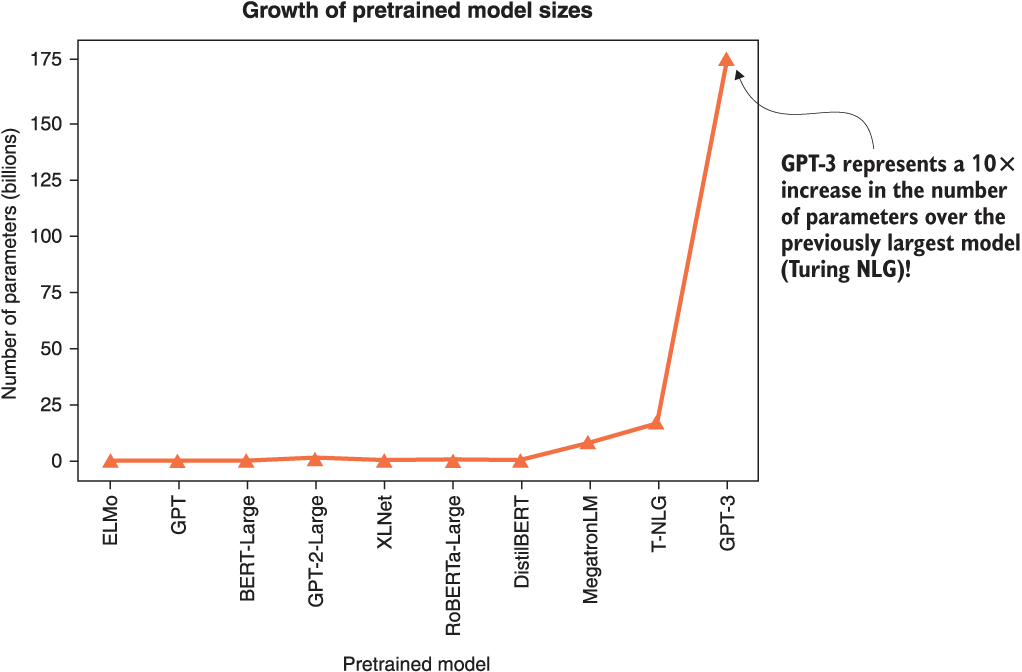
The growth in the number of parameters for the largest models over time. As can be seen in the diagram, the explosion in the size of the models appears to be accelerating, with one of the most recent advances—GPT-3—representing a growth factor of 10×.
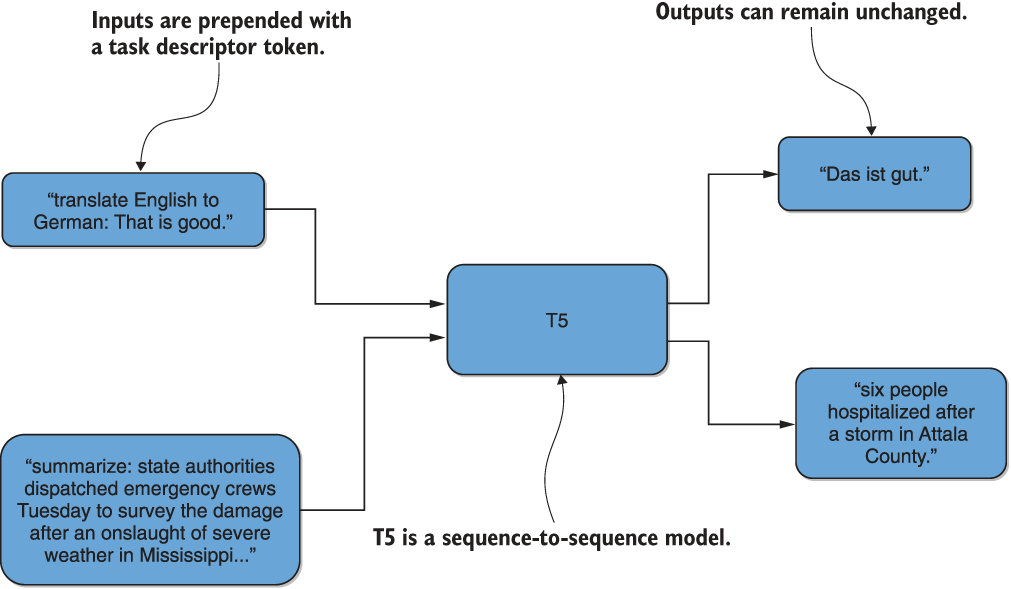
T5 is a sequence-to-sequence model that employs a number of transformations to enable a single model, decoding procedure, and objective to be trained on a variety of tasks simultaneously. It can be thought of as an interesting variation of multitask learning.
Summary
- You are only at the beginning of your journey in this rapidly evolving field; retaining a competitive edge is a journey and not a destination.
- The skills you have picked up by working through this book have put you in a good position to enable you to stay up-to-date with continued effort.
- Some key fundamental pretrained transfer-learning-enabled language modeling architectures we covered include the Transformer, BERT, mBERT, ELMo, and GPT.
- The desire to make these larger models smaller and more efficient led to the development of architectures/techniques such as ALBERT, DistilBERT, and ULMFiT, which we covered as well.
- Emerging architectures that are the descendants of the aforementioned models, which are not covered by the book in detail but which you should be aware of, include BART, T5, Longformer, Reformer, XLNet, and many more.
- It is important to be aware of potential ethical and environmental impacts of these models when deploying them in practice.
- Recent concerns about ethical and environmental impacts, as well as the desire to put model capabilities on smartphones and IoT, will likely continue to fuel the development of increasingly more efficient transformer architectures in the near future.
2. S.J. Pan and Q. Yang, “A Survey on Transfer Learning,” IEEE Transactions on Knowledge and Data Engineering (2009).
3. S. Ruder, “Neural Transfer Learning for Natural Language Processing,” National University of Ireland, Galway, Ireland (2019).
4. D. Wang and T. F. Zheng, “Transfer Learning for Speech and Language Processing,” Proceedings of 2015 Asia-Pacific Signal and Information Processing Association Annual Summit and Conference (APSIPA).
5. Lipmann Richard et al., “An Overview of the DARPA Data-Driven Discovery of Models (D3M) Program,” Proceedings of the 29th Conference on Neural Information Processing Systems (NeurIPS) (2016).
9. W. Fedus et al., “Switch Transformers: Scaling to Trillion Parameter Models with Simple and Efficient Sparsity,”arXiv (2021).
13. Z. Yang et al., “XLNet: Generalized Autoregressive Pretraining for Language Understanding,” NeurIPS (2019).
14. Z. Dai et al., “Transformer-XL: Attentive Language Models beyond a Fixed-Length Context,” ACL (2019).
18. C. Raffel et al., “Exploring the Limits of Transfer Learning with a Unified Text-to-Text Transformer,” arXiv (2020).
19. L. Xue et al., “mT5: A Massively Multilingual Pre-Trained Text-to-Text Transformer,” arXiv (2019).
20. M. Lewis et al., “BART: Denoising Sequence-to-Sequence Pre-training for Natural Language Generation, Translation, and Comprehension,” arXiv (2020).
21. Y. Liu et al., “Multilingual Denoising Pre-Training for Neural Machine Translation,” arXiv (2020).
33. A. Dosovitskiy et al, “An Image Is Worth 16x16 Words: Transformers for Image Recognition at Scale,” arXiv (2020).
34. J. Builamwini and T. Gebru, “Gender Shades: Intersectional Accuracy Disparities in Commercial Gender Classification,” Journal of Machine Learning Research 81 (2018).
38. E. Bender et al., “On the Dangers of Stochastic Parrots: Can Language Models Be Too Big?” FAccT (2021).

 Transfer Learning for Natural Language Processing ebook for free
