7 Beyond Bayesian inference: Raiffa, Schlaifer, and rational decision-making
The chapter shows how Bayesian inference was extended from a tool for updating beliefs into a practical framework for making decisions. Bayes’ Theorem alone can tell us what is likely after new evidence arrives, but it does not say what action should follow. Raiffa and Schlaifer filled that gap by combining posterior probabilities with utilities, so that each possible action could be evaluated by its expected utility rather than by probability alone. In the medical example, this means weighing the benefits and harms of treating versus not treating, using both the chance of disease and the consequences of each choice.
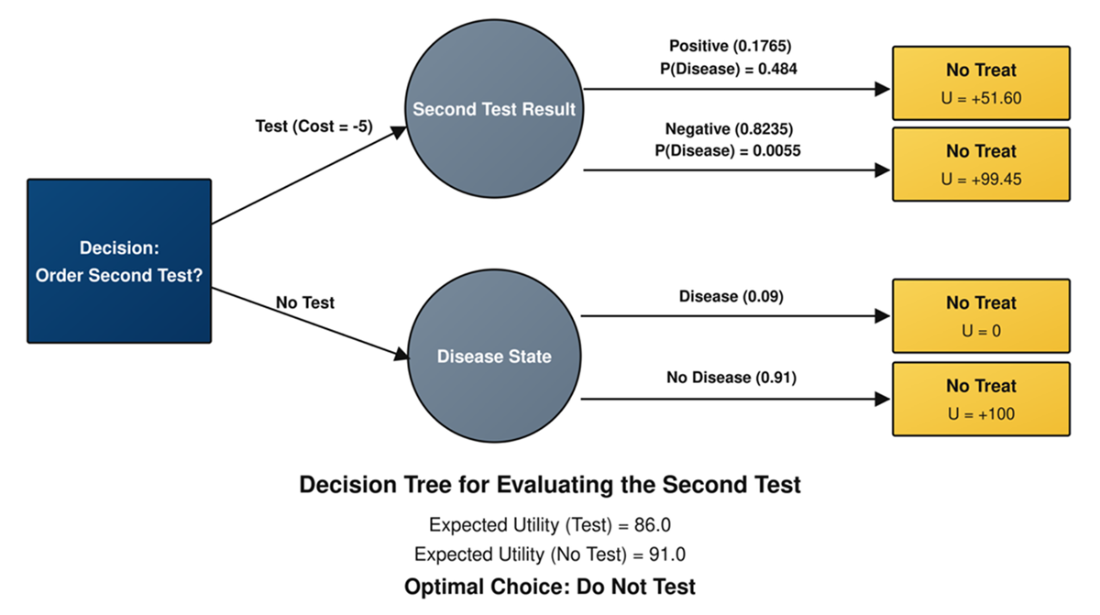
A central theme is that good decision-making must also account for information itself. Decision trees make the structure of a problem visible by laying out choices, uncertain events, and outcomes, and rollback evaluation identifies the preferred action. The same logic can be extended to ask whether an extra test, survey, or experiment is worth doing before acting. That question is answered through value-of-information analysis, which compares the expected utility of learning first with acting immediately. In the chapter’s diagnostic example, a second test changes the estimated probability of disease, but it does not change the preferred action, so it has no decision value before its cost is included.
The chapter also explains why Raiffa and Schlaifer’s framework became influential in the real world: it turned Bayesian reasoning into a repeatable decision process. Conjugate priors made updating practical by allowing posterior distributions to stay in the same family as the prior, reducing many updates to simple parameter changes instead of difficult integration. This made repeated Bayesian learning feasible in settings such as quality control, clinical testing, business strategy, and public policy. The larger lesson is that rational choice under uncertainty requires making beliefs, consequences, and learning explicit, then choosing the action with the highest expected value given the evidence available at the time.
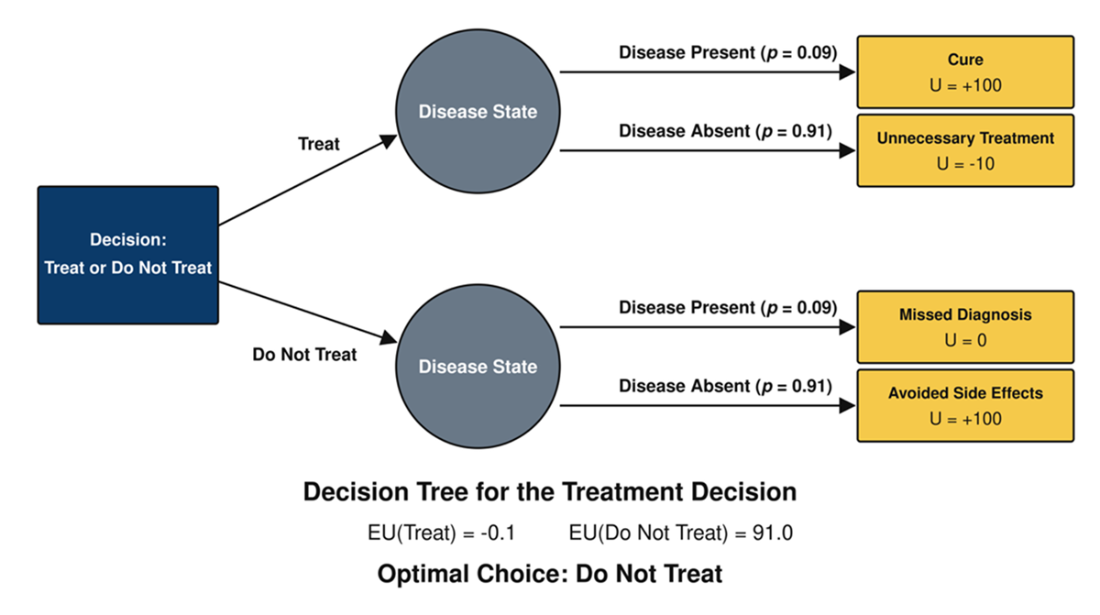
Decision tree for the treatment decision. The square node represents the choice between treating and not treating. Each action leads to a circular chance node representing whether disease is present (𝑝 = 0.09) or absent (𝑝 = 0.91). The terminal branches show the four possible outcomes and their assigned utilities. Rolling the tree back combines the probabilities and utilities to produce expected utilities of −0.1 for treating and 91 for not treating, making the latter the preferred action.
Decision tree comparing acting immediately versus ordering a second test and then acting on its result.
Raiffa and Schlaifer’s decision-analytic cycle. Prior beliefs describe uncertainty about the possible states of the world. An experiment generates data that produces posterior beliefs, which inform the selection of an act. The resulting outcome is evaluated through utility and may provide the starting point for another decision.

Summary
- Howard Raiffa and Robert Schlaifer extended Bayesian inference from a method for revising beliefs into a framework for rational decision-making. Probability indicates what may be true, but choosing an act also requires evaluating the consequences associated with each possible state of the world.
- Expected utility provides the framework’s standard for choice. The utility of each possible act–state outcome is weighted by the probability of that state, and the act with the highest expected utility is preferred.
- Decision trees make the reasoning explicit and operational. Decision nodes represent available acts, chance nodes represent uncertain events, and terminal nodes represent outcomes. Rollback works backward through the tree to identify the act with the highest expected utility.
- Value-of-information analysis determines whether additional evidence is worth acquiring. Terminal analysis selects an act after information is known, while preposterior analysis evaluates information before it is obtained. EVPI establishes the upper limit on the value of complete information, and EVSI measures the expected improvement from imperfect information before its acquisition cost is considered.
- Acts, states, and experiments provide the general structure for decisions under uncertainty: what can be controlled, what remains unknown and uncontrollable, and what can be learned before acting. This compact structure makes the framework applicable across different problems and domains.
- Opportunity loss expresses each outcome relative to the best act that could have been selected if the true state were known. Minimizing expected opportunity loss is mathematically equivalent to maximizing expected utility, so both perspectives identify the same preferred act.
- A rational decision does not guarantee the best outcome because uncertainty remains after the decision is made. The framework improves decision quality by using the available evidence coherently; it does not eliminate the possibility that a well-reasoned choice will produce an unfavorable result.
- Conjugate priors made repeated Bayesian updating practical by allowing posterior distributions to be obtained through parameter adjustment rather than renewed integration. More broadly, Raiffa and Schlaifer’s framework remains influential wherever beliefs, consequences, learning, and action must be connected—from management, policy, and science to selected applications in modern learning methods.

 Timeless Algorithms, The Foundational Ideas ebook for free
