6 Dynamic programming: Richard Bellman and recursive optimization
Dynamic programming is presented as Bellman’s way of turning hard multi-stage decisions into manageable recursive problems. The chapter situates DP as the next step after statistical inference and information theory: instead of asking only how to estimate, test, or transmit information, it asks how to optimize an entire sequence of choices. Bellman’s insight was that many problems become solvable once they are expressed as a chain of smaller subproblems whose solutions can be reused.
The core of the method is structural. A problem must have overlapping subproblems and optimal substructure, meaning repeated intermediate results exist and optimal large solutions can be built from optimal small ones. The chapter explains how to formulate such problems using recurrence relations, then make them concrete through states, transitions, and base cases. It also shows the two main implementation styles: tabulation, which works bottom-up from known base cases, and memoization, which works top-down by caching recursive results.
These ideas are illustrated with the 0/1 knapsack problem and the coin change problem. Knapsack shows how DP chooses the best combination under a resource limit, while coin change shows that the same framework can count valid solutions rather than optimize one. The chapter then extends the same recursive logic to real-world settings such as resource allocation, inventory control, network routing, sequence alignment, and Markov decision processes, where Bellman’s equation generalizes DP to uncertainty. It closes by stressing practical limits such as state explosion, memory costs, and the challenge of defining the right state.
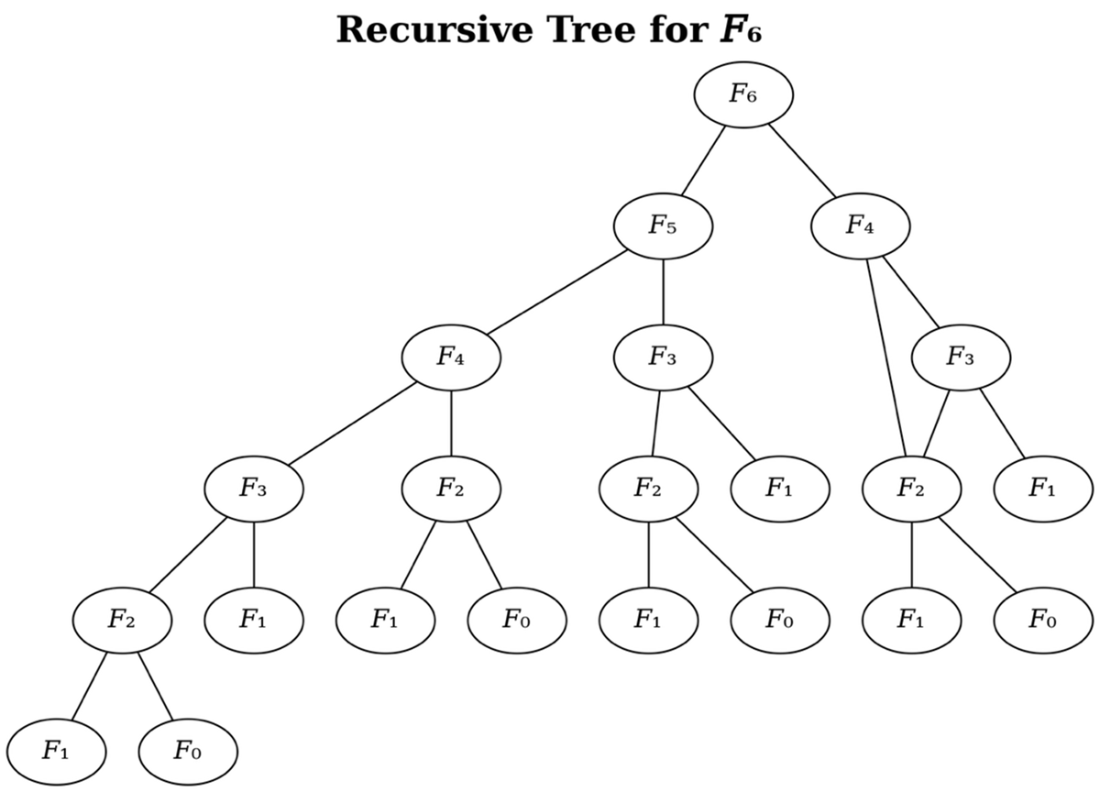
Recursive computation of the sixth Fibonacci number. Although the recursion tree branches rapidly, many intermediate values are computed repeatedly. These overlapping subproblems make the Fibonacci sequence an ideal candidate for dynamic programming, where each distinct subproblem is solved once and then reused whenever it reappears.
Summary
- Dynamic programming is a systematic framework for solving multi-stage problems by decomposing them into smaller, interrelated subproblems. By solving each distinct subproblem once and reusing its result, DP can transform otherwise computationally prohibitive problems into tractable ones.
- Dynamic programming requires two structural properties: overlapping subproblems and optimal substructure. Overlap allows previously computed results to be reused, while optimal substructure allows a solution to the full problem to be constructed from optimal solutions to its subproblems.
- The recurrence relation provides the computational logic of a DP solution. It expresses each problem state in terms of smaller states, defining how previously computed results are combined to progressively construct the solution.
- Effective application depends on careful problem formulation. States capture the information required at each stage, transitions specify how one state leads to another, and base cases anchor the computation. Poor choices—particularly in state definition—can undermine correctness or efficiency.
- Dynamic programming can be implemented through memoization or tabulation. Memoization evaluates and caches states as they are needed, while tabulation proceeds iteratively from established base cases. The better strategy depends largely on the structure and density of the state space.
- Dynamic programming applies across a remarkably broad range of real-world problems. The same underlying framework supports constrained resource allocation, inventory control, routing and networks, and sequence alignment, adapting its states and recurrence to the particular objective and constraints of each problem.
- Markov Decision Processes extend sequential optimization to settings in which the outcome of an action is uncertain but the probabilities and rewards governing those outcomes are known. The Bellman equation recursively combines immediate reward with expected future value, allowing DP to identify an optimal policy rather than simply an optimal value or combination.
- Dynamic programming retains an important but distinctive role in machine learning and AI. Its recursive logic contributes to applications such as probabilistic sequence decoding and reinforcement learning. Yet DP also remains a powerful problem-solving framework in its own right rather than primarily serving as a mathematical ingredient within other learning methods.
- The practical limits of dynamic programming arise largely from scale and formulation. State explosion can make exact solutions computationally impractical, storing intermediate results creates memory-versus-computation trade-offs, and poorly defined states can omit necessary information or introduce unnecessary complexity.

 Timeless Algorithms, The Foundational Ideas ebook for free
