13 Expanding the boundaries of learning: OpenAI and the scaling laws of neural language models
Modern language models are presented as the product of a long intellectual lineage rather than a sudden breakthrough. Ideas from probability, inference, information theory, and learning were gradually unified, then made practical through neural networks and especially transformers, which let systems learn representations from data and model relationships across long sequences. OpenAI’s work with GPT-style models showed how this foundation could be pushed much further once large datasets, specialized hardware, and distributed compute were brought together at scale.
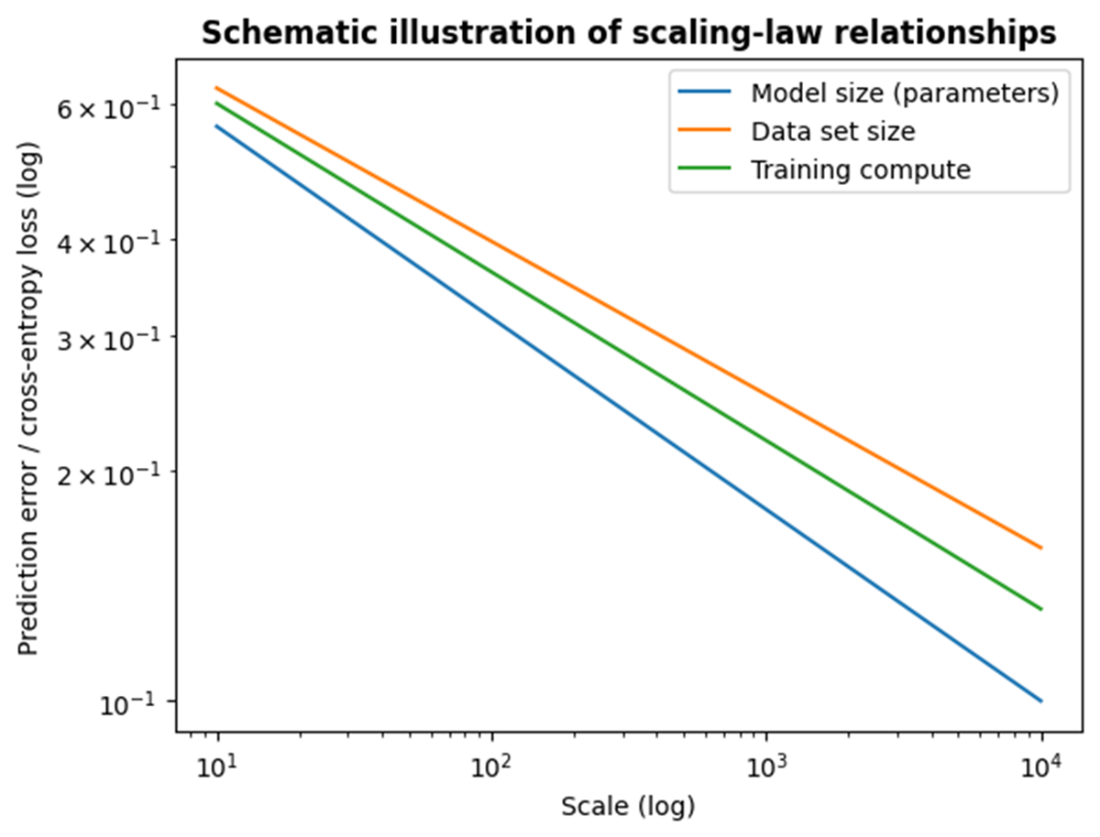
The central empirical result of the chapter is that language-model error does not improve randomly as resources grow; it falls in smooth, predictable power-law patterns. In extensive experiments across hundreds of transformer models, held-out cross-entropy loss declined as parameter count, training data, and compute increased, but only when these resources were balanced rather than expanded in isolation. This made performance more predictable, introduced the idea of a compute-efficient frontier, and showed that scaling works best when capacity, information, and computation advance together.
The chapter also emphasizes what scaling revealed beyond lower loss: larger models tend to learn more efficiently from data, generalize better on held-out text, and support transfer to tasks such as translation, summarization, and question answering through in-context learning. At the same time, it stresses clear limits. These relationships are empirical, not universal laws, and they do not eliminate physical, informational, or economic constraints such as processor capacity, memory bandwidth, data quality, and cost. The broader lesson is that modern AI extends older algorithms through new architectures and much larger resources, pushing boundaries outward without removing them.
Schematic scaling relationships. Held-out cross-entropy loss declines with model parameters, training-data volume, and compute when the other resources are not limiting. The approximately straight lines on logarithmic axes indicate power-law behavior across large changes in each resource. On standard axes, the same relationships flatten as resources increase: loss continues to decline, but progressively larger absolute increases in resources produce smaller absolute improvements.
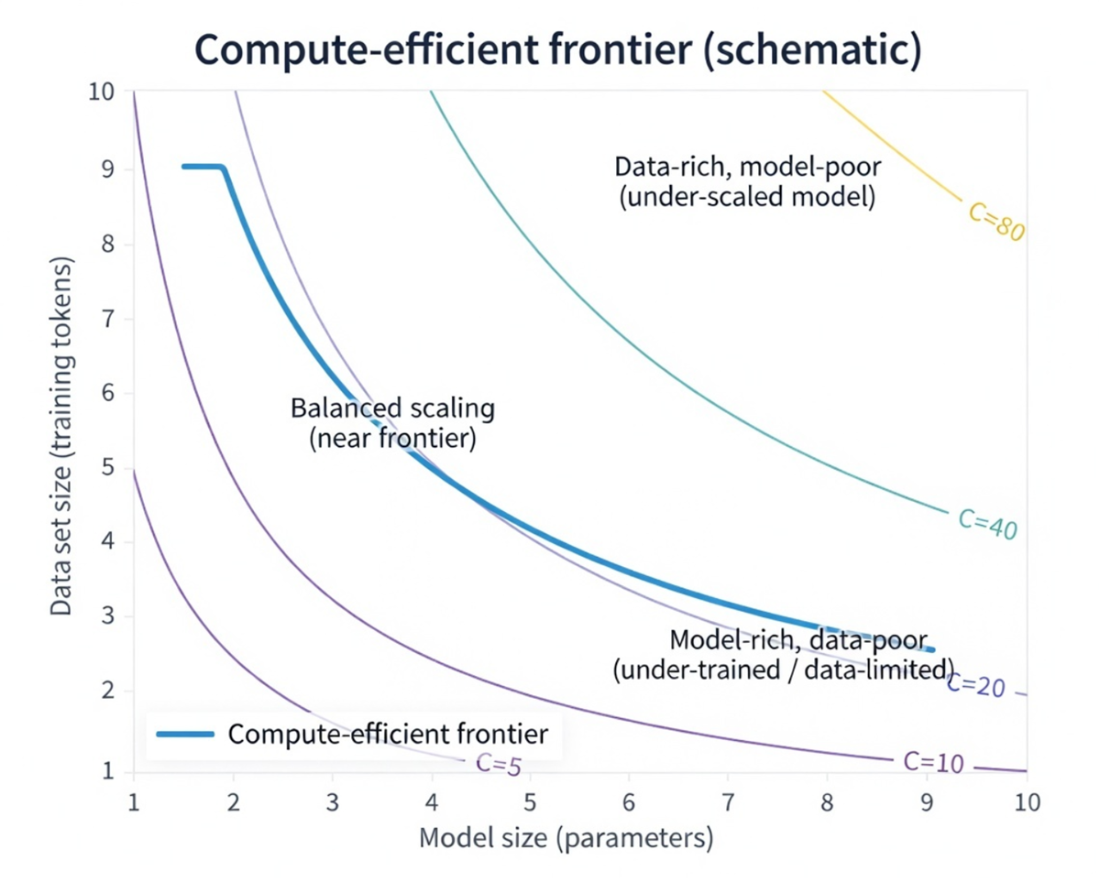
Compute-efficient combinations of model size and training-data volume. Each curved contour represents a fixed computational budget. The bold line connects the combinations that produce the lowest attainable loss at each budget. Models above the frontier are relatively parameter-limited, while models below it are relatively data- or training-limited.
Summary
- OpenAI’s scaling experiments showed that held-out loss for neural language models declines in smooth, measurable ways as model parameters, training data, and compute increase. These improvements follow power-law relationships that persist across large differences in resource levels rather than appearing only in particular models or training runs.
- The three scaling resources perform distinct but interdependent functions. Parameters provide representational capacity, training data supplies the information from which patterns are learned, and compute processes that information and updates the parameters. Effective scaling requires all three to grow in balance so that none becomes the binding constraint.
- Power laws made reductions in language-model loss reasonably predictable within the range supported by the experiments. They also showed that continued improvement becomes progressively more expensive: loss did not level off within the range studied, but each repeated proportional reduction required another multiplicative increase in resources.
- Larger models did more than attain lower loss. They reached a given performance level after processing fewer training tokens and generalized beyond their training observations. Subsequent language models also transferred learned representations across tasks through instructions and examples supplied in context, although lower loss did not guarantee reasoning, factual accuracy, or reliability.
- Scaling introduced no new principle of learning. It extended the reach of old algorithms through neural networks, transformer architecture, and unprecedented resources. The information, methods, architectures, and binding constraints changed, but MacKay’s underlying framework—using available information to reduce uncertainty under constraints—continued to apply.
- Scaling changed which constraints governed further progress rather than making learning unconstrained. Earlier limits on representation, sequence processing, and model capacity were relaxed or overcome, while requirements for compute, informative data, physical infrastructure, and investment became increasingly binding. Future gains may depend on moving those boundaries through additional resources, more efficient methods, or both.
FAQ
What are the scaling laws described in this chapter?
The scaling laws are empirical relationships showing that held-out language-model loss declines predictably as model parameters, training data, and compute increase. In Kaplan et al.’s 2020 study, these improvements followed power-law patterns over wide ranges of scale.
Why was OpenAI’s research important for discovering scaling laws?
OpenAI combined large-scale engineering, specialized hardware, distributed computing, and extensive training data, making it possible to train hundreds of transformer-based language models under controlled conditions. That scale of experimentation allowed researchers to measure how performance changed across many combinations of resources.
What does it mean for language-model loss to follow a power law?
It means that as a resource such as parameters, data, or compute increases, loss decreases according to a fixed mathematical exponent. On logarithmic axes, this often appears as a straight line, indicating smooth and consistent improvement with diminishing returns.
Why do model parameters, training data, and compute need to grow together?
They are interdependent rather than interchangeable. More parameters help only if enough data and compute are available to train them, more data helps only if the model has enough capacity, and more compute helps only if it is applied to a sufficiently capable model and informative dataset.
What is the compute-efficient frontier?
The compute-efficient frontier is the best allocation of model size and training-data volume for a fixed computational budget. It represents the combinations that achieve the lowest attainable loss for a given amount of compute.
How did the chapter distinguish between sample efficiency and computational efficiency?
Sample efficiency refers to how much training data a model needs to reach a target performance level. Computational efficiency also considers how much total computation is required, since larger models may learn from each token more effectively while still consuming more compute overall.
Did the scaling laws mean larger models always generalize better?
Not universally. Within the language-modeling settings studied, larger models did generalize better on held-out text when supported by enough data and compute. But the results did not prove that larger models would perform reliably on every task, domain, or unfamiliar distribution.
What kinds of broader capabilities were associated with larger language models?
Later large language models showed stronger transfer across tasks such as summarization, translation, question answering, coding, and in-context learning. These capabilities went beyond next-token prediction, but they were observed in subsequent systems rather than directly established by the original scaling-law experiments.
What are the main limits of scaling up language models?
Scaling faces physical, informational, and economic constraints. These include hardware availability, memory and communication limits, electricity and cooling requirements, data quality and availability, and the high financial cost of training and deployment.
What is the chapter’s main takeaway about modern AI?
Modern AI did not arise from scale alone. It emerged from the combination of older statistical ideas, neural networks, transformers, and large-scale resources. Scaling expanded what these systems could do, but it did not remove the fundamental challenge of learning under constraints.

 Timeless Algorithms, The Foundational Ideas ebook for free
