Overview

1 Seeing inside the black box

This chapter frames modern data science and AI as a situation where systems can be built and deployed faster than people can truly understand them. Like an autopilot that seems reliable until conditions change, models may perform well on historical data yet fail under drift, bias, or shifting real-world conditions. The central concern is no longer whether a model can produce output, but whether anyone can explain its behavior, recognize its limits, and intervene when it starts to break.

To address that gap, the chapter argues for moving beyond tool use toward wisdom: the ability to interpret results, question assumptions, and judge trustworthiness. It emphasizes that today’s models rest on older foundational ideas from probability, statistics, information theory, and learning theory, including contributions associated with Bayes, Fisher, Shannon, Vapnik, Breiman, and others. These ideas are presented not as historical curiosities, but as the conceptual basis for understanding how modern systems learn, generalize, and fail.

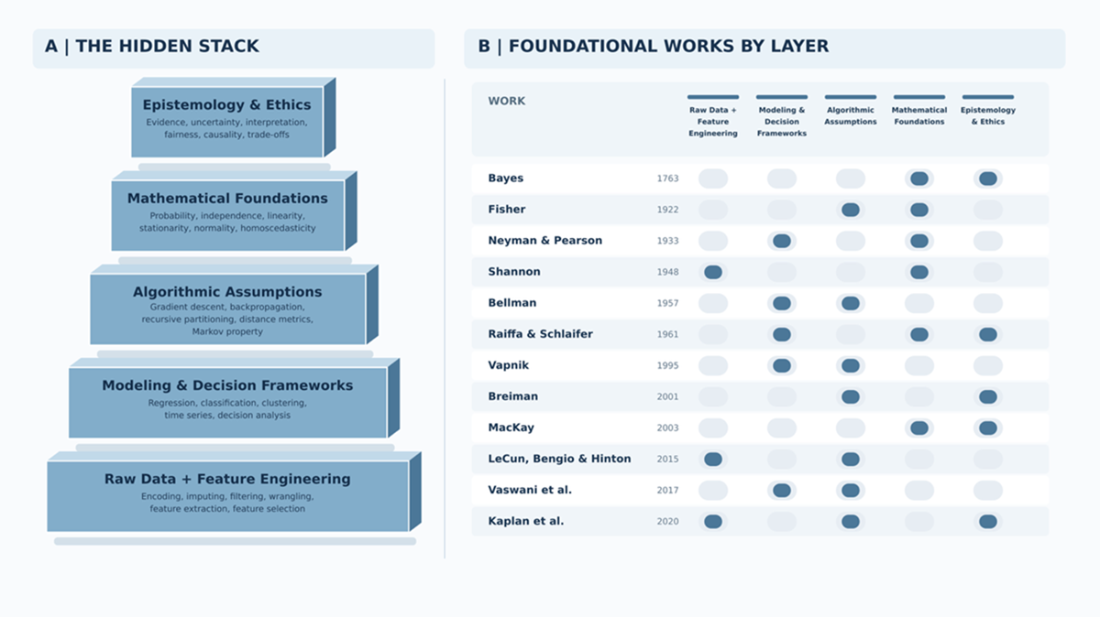
To make that structure visible, the chapter introduces a “hidden stack” of modern intelligence, ranging from raw data and feature engineering up through modeling frameworks, algorithmic assumptions, mathematical foundations, and finally epistemology and ethics. Each layer shapes what the system can learn, how outputs are produced, and how they should be interpreted in practice. The chapter’s message is that reliable use of models depends on understanding these layers and the assumptions they encode, so that outputs can be evaluated critically rather than accepted at face value.

The hidden stack of modern intelligence. This figure presents a layered view of the ideas and assumptions that give structure to data-driven reasoning. From bottom to top, the stack moves from raw data and feature engineering to modeling frameworks, algorithmic assumptions, mathematical foundations, and finally epistemology and ethics. Each layer shapes what can be observed, how problems are framed, how relationships are learned, what conditions must hold for results to be reliable, and how outputs should ultimately be interpreted and used. The foundational works explored in this book do not correspond one-to-one with these layers; instead, each contributes to one or more layers of the stack, thereby helping explain how modern systems reason from data and why their outputs take the forms they do.

Summary

  • Modern data science has lowered the barrier to building systems, but not to understanding them. Tools can generate results quickly, yet those results depend on assumptions that are often hidden. The central challenge is no longer execution, but interpretation—understanding how results are produced, why they behave as they do, and when they can be trusted.
  • The foundational ideas explored in this book—spanning probability, estimation, information, generalization, and decision-making—form the intellectual basis of modern data-driven reasoning. Developed across different contexts, many of these ideas now operate together within the same systems, shaping how data is structured, how relationships are defined, and how results are interpreted.
  • The hidden stack of modern intelligence provides a framework for making this structure visible. By organizing ideas into layers—from data and representation through mathematical structure to epistemology and ethics—it becomes possible to see where assumptions enter, how results are formed, and how different components interact.
  • Each foundational contribution examined in this book addresses a subset of layers within this stack. These ideas do not function as complete systems on their own; rather, they contribute to specific aspects of a larger structure. Understanding where they operate—and how they connect—bridges the gap between theory and practice.
  • These ideas are powerful, but not universally applicable. They rely on conditions such as stable patterns, representative data, and well-defined objectives. When those conditions fail, results can degrade—sometimes immediately, and sometimes gradually over time. Using these ideas effectively requires not just applying them, but recognizing when their assumptions hold and when they do not.

FAQ

What is the main problem this chapter says modern data science faces?The chapter argues that the main problem is no longer building models, but understanding them. Models can be created and deployed quickly, yet when they fail, practitioners often cannot easily trace the cause, question assumptions, or explain the results.
Why does the chapter compare model use to an autopilot failing in fog?The autopilot metaphor shows how systems can seem reliable and easy to trust until something goes wrong. When failure happens, the critical question is whether the human operator understands the system well enough to take control and respond correctly.
What does the chapter mean by the gap between execution and understanding?It means that tools can now generate code, select algorithms, and produce results with little effort, but that does not guarantee real understanding. A practitioner may be able to run a model without knowing why it works, when it fails, or how to interpret its output.
Why are foundational ideas like Bayes, Fisher, and Shannon important for modern AI?These ideas provide the intellectual basis for how modern models learn, represent uncertainty, estimate relationships, and generalize. They are not outdated historical concepts; they continue to shape regressions, random forests, neural networks, and large language models.
What does the chapter mean by “wisdom” in data science?Wisdom is the ability to interpret results, question assumptions, recognize failure modes, and decide when to trust a model. It goes beyond knowledge of tools and code by focusing on judgment and interpretation.
What is the “hidden stack of modern intelligence”?It is a layered framework for understanding what is happening inside data-driven systems. The stack moves from raw data and feature engineering, to modeling frameworks, algorithmic assumptions, mathematical foundations, and finally epistemology and ethics.
Why does the chapter say performance is not the same as reliability?A model can score well on training or test data while relying on fragile, biased, or context-specific patterns. Reliability depends on whether those patterns still hold under real-world conditions, not just whether the model produced good metrics in a limited evaluation setting.
How do data drift and bias affect model trust?Data drift happens when real-world conditions change, causing a model’s learned relationships to weaken over time. Bias occurs when a model reproduces historical patterns or performs unevenly across groups, which can create unfair or misleading outcomes even if overall accuracy looks strong.
What is the purpose of the book according to this chapter?The book aims to make modern data science and AI intelligible by explaining the foundational ideas behind them. It is not mainly about programming or implementation, but about understanding how models behave, why they succeed, and where they fail.
When does the chapter say foundational ideas work well, and when do they fail?They work well when their assumptions hold, such as stable data patterns, appropriate problem framing, and alignment between the objective and the real-world goal. They fail or become unreliable when conditions change, important cases are rare, or the method’s assumptions no longer match the problem.

pro $24.99 per month

  • access to all Manning books, MEAPs, liveVideos, liveProjects, and audiobooks!
  • choose one free eBook per month to keep
  • exclusive 50% discount on all purchases
  • renews monthly, pause or cancel renewal anytime

lite $19.99 per month

  • access to all Manning books, including MEAPs!

team

5, 10 or 20 seats+ for your team - learn more


choose your plan

team

monthly
annual
$49.99
$499.99
only $41.67 per month
  • five seats for your team
  • access to all Manning books, MEAPs, liveVideos, liveProjects, and audiobooks!
  • choose another free product every time you renew
  • choose twelve free products per year
  • exclusive 50% discount on all purchases
  • renews monthly, pause or cancel renewal anytime
  • renews annually, pause or cancel renewal anytime
  • Timeless Algorithms, The Foundational Ideas ebook for free

choose your plan

team

monthly
annual
$49.99
$499.99
only $41.67 per month
  • five seats for your team
  • access to all Manning books, MEAPs, liveVideos, liveProjects, and audiobooks!
  • choose another free product every time you renew
  • choose twelve free products per year
  • exclusive 50% discount on all purchases
  • renews monthly, pause or cancel renewal anytime
  • renews annually, pause or cancel renewal anytime
  • Timeless Algorithms, The Foundational Ideas ebook for free