6 Embracing purity with functional programming
This chapter introduces functional programming as a way to add purity to beautiful code. Purity means keeping behavior predictable, isolated, and free from hidden state or side effects. Compared with imperative programming, which describes step-by-step instructions and often mutates state, functional programming favors declarative transformations: data flows through small functions that express what should happen rather than how every control step is performed. Pure functions always return the same output for the same input, are easier to test, safer to compose, and simpler to reason about.
The chapter explains how functions become practical building blocks through functional interfaces, lambda expressions, first-class functions, and composition. Lambdas reduce boilerplate by letting developers express behavior directly and concisely, while first-class functions can be assigned, passed, returned, stored, and combined. Composition encourages splitting behavior into small, reusable transformations that can be chained into larger operations. Pipelines then bring these ideas together by letting data move through creation, intermediate operations such as filtering and mapping, and a terminal operation that produces the final result. When well designed, pipelines read like a clear story and keep data at the center.
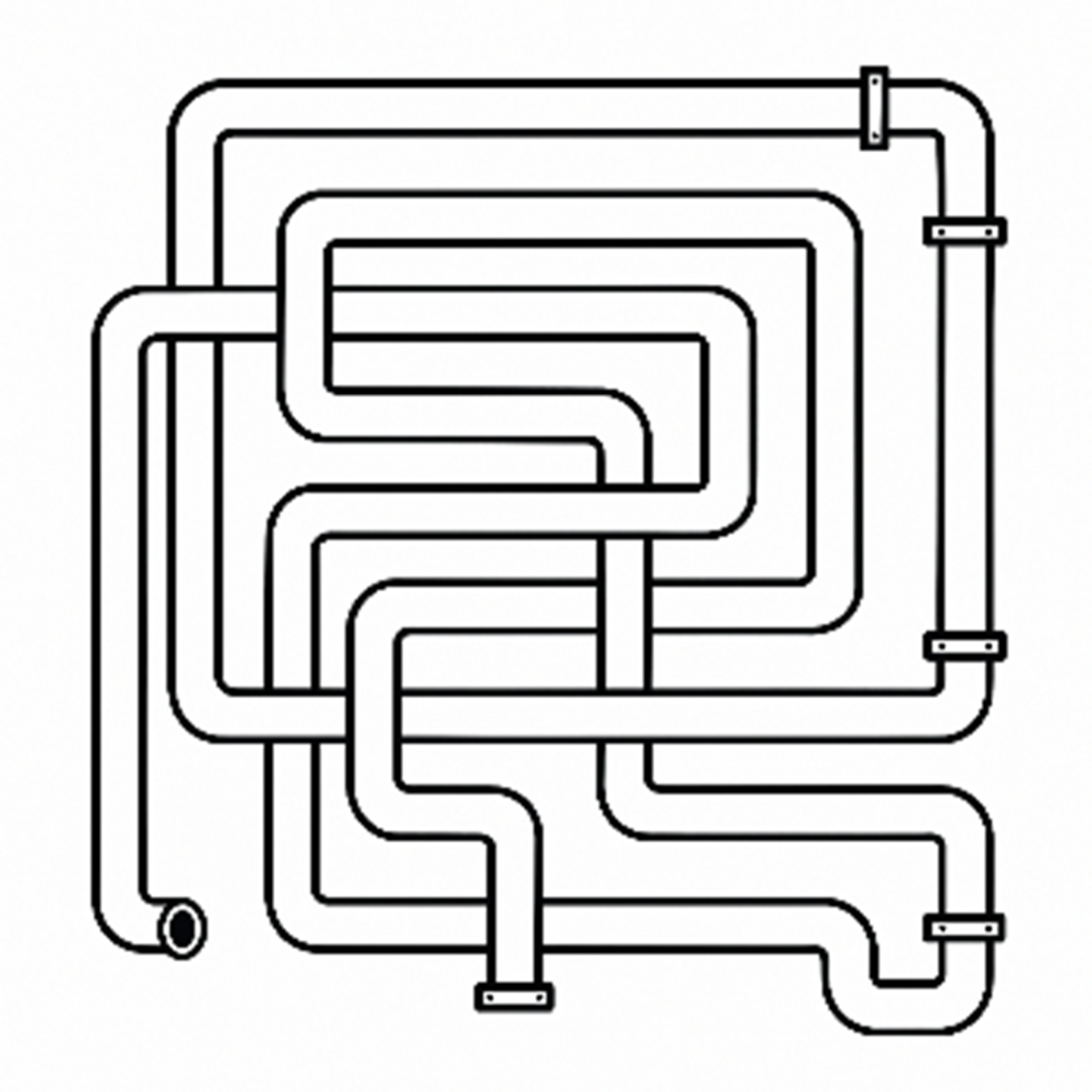
The chapter also warns that functional programming is not automatically beautiful. Exceptions, hidden side effects, mutable objects, and overly long pipelines can make code harder to understand. In some cases, especially when failure handling, external interactions, or heavy mutation dominate the logic, imperative code may be clearer and more honest. The key is judgment: prefer small pure functions, immutable data, readable transformations, and short pipelines, but choose the paradigm that best expresses intent. AI tools can help identify opportunities for purity and functional refactoring, but developers must still review the trade-offs and decide whether the result is truly simpler, clearer, and more maintainable.
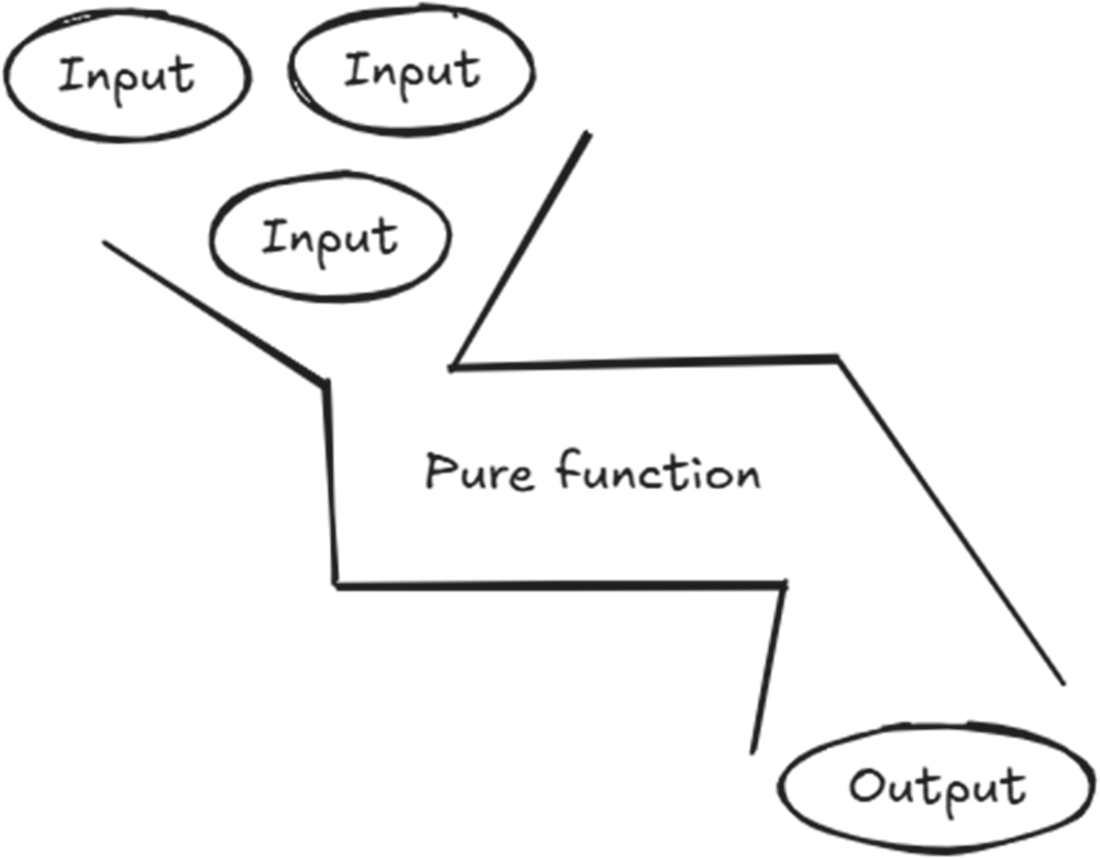
This representation illustrates a pure function as an isolated transformation: inputs enter the function and a single output is produced. The function depends only on its inputs and does not interact with external state. As a result, the same inputs always produce the same output.
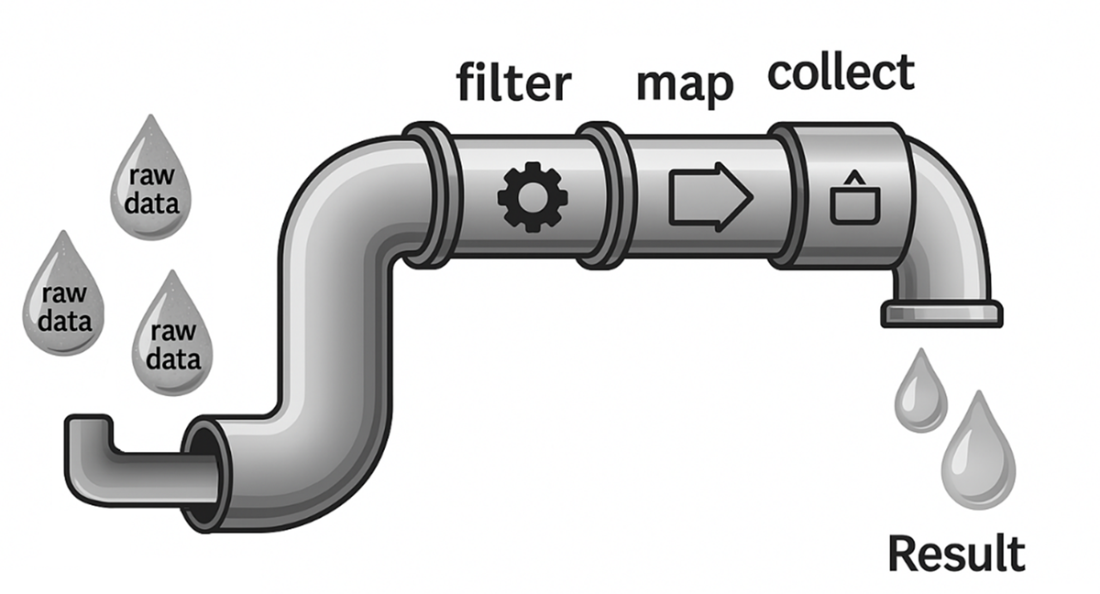
A functional pipeline: transforming raw data.
Summary
- Imperative programming describes how to execute each step; functional programming emphasizes what transformation should happen.
- A pure function always produces the same output for the same input and avoids side effects.
- Lambdas allow behavior to be expressed concisely and passed as data.
- Functional interfaces make lambdas possible in Java by defining a single abstract method.
- Pipelines separate data from behavior and describe transformations step by step.
- Intermediate operations such as filter, map, and flatMap remain lazy until a terminal operation is applied.
- Terminal operations, such as toList, collect, or count, trigger execution and materialize the result.
- Short inline lambdas improve readability when the transformation remains visually simple.
- Long pipelines reduce readability and should be simplified by grouping logic, extracting methods, or storing intermediate results.
- Exception handling inside a pipeline often reduces clarity and may justify returning to imperative code.
- Mutable state inside a pipeline breaks purity, even when the compiler allows it. Functional style improves readability only when balanced with clarity, simplicity, and sound data modeling.
FAQ
What does “purity” mean in functional programming?
Purity means that behavior is isolated, predictable, and free from hidden side effects or hidden state. A pure function depends only on its inputs, does not modify external state, and always returns the same output for the same input. This makes the code easier to reason about, test, and compose.How is functional programming different from imperative programming?
Imperative programming describes how to do something step by step, often using loops, conditionals, mutable variables, and side effects. Functional programming focuses on what transformation should happen, expressing behavior as a composition of functions. In functional code, control-flow mechanics fade into the background while the data transformation remains visible.Why are pure functions easier to test and maintain?
Pure functions are easier to test because they do not depend on external systems, mutable shared state, or hidden conditions. Given the same input, they always produce the same output, so tests can simply assert the result. They are also easier to maintain because each function has a clear responsibility and can be understood without knowing the rest of the system.What is referential transparency?
Referential transparency means that a function call can be replaced by its result without changing the behavior of the program. For example, if a function always returns3 when given 1, then calling the function with 1 is equivalent to writing 3 directly. This property depends on the function being pure and free from side effects.What are lambda expressions used for?
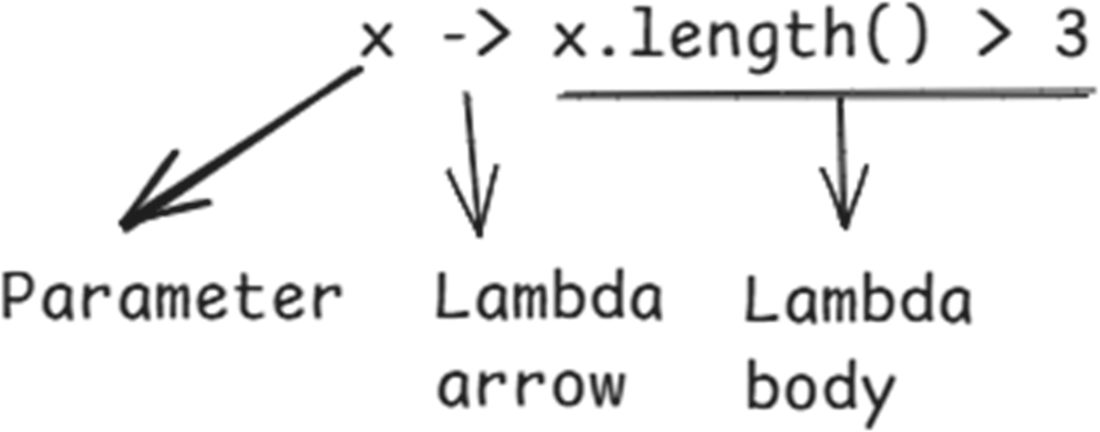
Lambda expressions provide a concise way to define anonymous functions. Instead of creating a full class just to implement a small piece of behavior, a lambda keeps only the essential logic. In Java, for example,x -> x.length() > 3 defines a function that checks whether a string has more than three characters.What is a functional interface in Java?
A functional interface is an interface with exactly one unimplemented abstract method. It represents a function signature and can be implemented using a lambda expression. Java provides many built-in functional interfaces, such asPredicate, Function, Consumer, and Supplier. The optional @FunctionalInterface annotation asks the compiler to enforce the single-method rule.What does it mean for functions to be first-class citizens?
When functions are first-class citizens, they can be treated like ordinary values. They can be assigned to variables, passed as arguments, returned from methods, and stored in data structures. This allows behavior to be composed dynamically and makes it possible to build flexible pipelines and reusable transformations.What is function composition?
Function composition means building larger behavior by combining smaller functions, where the output of one function becomes the input of the next. For example, instead of writing one function that both normalizes spaces and removes special characters, you can write two smaller functions and combine them with something like Java’sandThen. This keeps each function focused, reusable, and easier to understand.What are the main stages of a functional pipeline?
A functional pipeline has three main stages: creation, intermediate operations, and a terminal operation. Creation starts the pipeline from a data source, such as a Java stream. Intermediate operations, such asfilter and map, define transformations but usually remain lazy. The terminal operation, such as toList(), triggers execution and materializes the result.
 The Art of Code ebook for free
