4 Clarity of intent through elegant data modeling
This chapter explains that clarity of intent begins with clear data modeling. Since most software “plots” revolve around moving, cleaning, protecting, storing, or transforming data, the structure of that data should make the code’s purpose obvious. Poor models—such as generic objects with ambiguous numeric parameters—force readers to infer meaning and invite mistakes. Better models use meaningful names, explicit units, and domain-specific types where they reduce ambiguity, while avoiding unnecessary over-modeling.
The chapter then examines why traditional object-oriented approaches can make data difficult to work with. Mutable data can create subtle bugs when shared references are modified unexpectedly, so immutability should be preferred when change is not needed. Encapsulation protects state, but in many languages it also produces large amounts of boilerplate: constructors, getters, setters, equality methods, string representations, and builders. Modern constructs such as Java records, Kotlin data classes, C# records, and frozen Python dataclasses address this by providing concise immutable data carriers with generated supporting behavior.
The chapter advocates a data-oriented approach as a mindset rather than a full paradigm shift: model the data first, make invariants local to the data, use explicit categories for closed sets, flatten confusing nested structures, and let behavior organize around clear data shapes. Through a BMI statistics example, it shows how records, enums, composite keys, pattern matching, and narrative refactoring transform unclear code into code whose purpose is visible from its types and method names. The main lesson is that elegant data modeling reduces risk, removes noise, and lets the intent of the program emerge naturally.
Summary
- Mutable data increases risk by enabling unintended side effects and forcing defensive code.
- Encapsulation, although intended to protect consistency, often introduces significant boilerplate around simple data.
- Traditional data classes can obscure intent when supporting code outweighs the meaning of the data itself.
- Modern language constructs such as Java records, Kotlin data classes, C# records, and Python dataclasses make small immutable data carriers concise and practical.
- In records, compact constructors allow for lightweight validation and transformation at initialization time.
- Record pattern matching improves data routing and logic clarity.
- Clear data modeling improves readability by replacing generic structures with meaningful domain types and small explicit carriers.
- Flattening structures, naming data precisely, and avoiding over-modeling help preserve clarity without adding unnecessary complexity.
- The data-oriented approach models the problem through data first, then lets behavior organize itself around that model.
FAQ
What does “clarity of intent” mean in data modeling?
Clarity of intent means making the purpose of code unmistakable: not only what the code does, but why it does it and how each part contributes to the problem being solved. In this chapter, clarity begins with the data itself, because most software plots revolve around moving, cleaning, protecting, storing, retrieving, or transforming data.
Why is data considered central to software design in this chapter?
The chapter argues that data is not merely something code manipulates; data is often the plot of the program. Delivering moves data, cleaning removes invalid data, defense protects data, archiving stores and retrieves data, and transformation turns raw data into meaningful information. When the data model is clear, the behavior around it becomes easier to understand.
What is the risk of using primitive values such as int or double for domain concepts?
Primitive values can hide meaning. For example, new User("John", 180, 70) does not reveal whether 180 and 70 represent age, height, weight, or units such as pounds, inches, or centimeters. Replacing ambiguous primitives with explicit types such as WeightInPounds and HeightInInches makes the call site self-explanatory and allows the compiler to catch swapped arguments.
Why is mutable data dangerous?
Mutable data can be changed after it is created, which makes bugs easier to introduce and harder to detect. If two references point to the same mutable list, one part of the code may accidentally modify data that another part still expects to remain unchanged. The chapter demonstrates this with a product-counting method that removes items from what appears to be a clone but is actually the original list.
Why doesn’t declaring a collection as final make it immutable?
Declaring a collection reference as final only prevents the variable from being reassigned to another collection. It does not prevent the contents of the collection from being modified. To truly prevent changes, you need an immutable collection, such as one created with Java’s List.of(...), or equivalent immutable structures in other languages.
What is the hidden cost of encapsulation in traditional object-oriented languages?
Encapsulation protects internal state and helps enforce consistency, but it often creates large amounts of boilerplate: constructors, getters, setters, equals, hashCode, toString, and sometimes builders. The chapter estimates that a fully boilerplate-heavy Java data class can grow according to the formula 16n + 25 lines, where n is the number of fields. This verbosity can bury the actual data model and become a source of bugs.
What are records, and why are they useful?
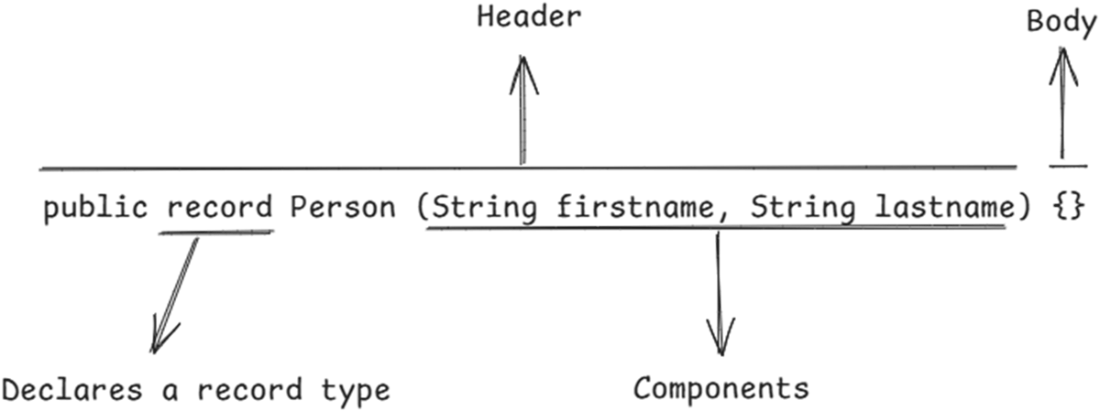
In Java, records are concise immutable data carriers introduced in Java 16. A record declares its components in a header, and the compiler automatically generates immutable fields, accessors, equals, hashCode, and toString. Records reduce boilerplate and put focus back on the data itself.
What is a compact constructor in a Java record?
A compact constructor is a special constructor in a Java record whose signature is implicit. It lets you validate, sanitize, or normalize data before it is stored without manually assigning every component. For example, a Person record can use a compact constructor to convert names to lowercase or replace nulls with empty strings.
When are small immutable data carriers especially useful?
Small immutable data carriers are useful for DTOs, configuration settings, simple value types, composite keys, multiple method return values, parameter objects, and functional programming patterns. They help make data explicit without requiring verbose one-off classes.
What are the main principles of elegant data modeling?
Elegant data modeling means modeling the data first, naming data meaningfully, keeping invariants close to the data, preferring immutability when possible, using small explicit data carriers, avoiding over-modeling, making object creation self-explanatory, using enums or equivalent constructs for closed sets, flattening deeply nested structures, routing behavior through explicit data decisions, and letting clearly modeled data shape simpler behavior.

 The Art of Code ebook for free
