10 Creativity in code and problem-solving
Creativity is presented as a practical engineering skill that brings the qualities of beautiful code to life. Rather than being a sudden flash of inspiration, it grows from knowledge, experience, curiosity, perseverance, and an open mind. In software development, creativity appears when developers move beyond routine work: translating essential complexity into readable code, designing adaptable APIs, debugging difficult failures, improving team workflows, anticipating future needs, and making thoughtful trade-offs under real-world constraints.
The chapter shows that constraints can stimulate creative coding when they are balanced and meaningful. A simple task, such as extracting information from a list of people, can lead to very different implementations depending on whether the priority is readability, performance, memory usage, functional style, or a single-pass pipeline. The exercise demonstrates that no single solution is universally best: highly optimized code may become harder to read, while a clear functional version may be preferable for ordinary datasets. The broader lesson is that developers make creative choices whenever they decide which constraints matter most for the problem at hand.
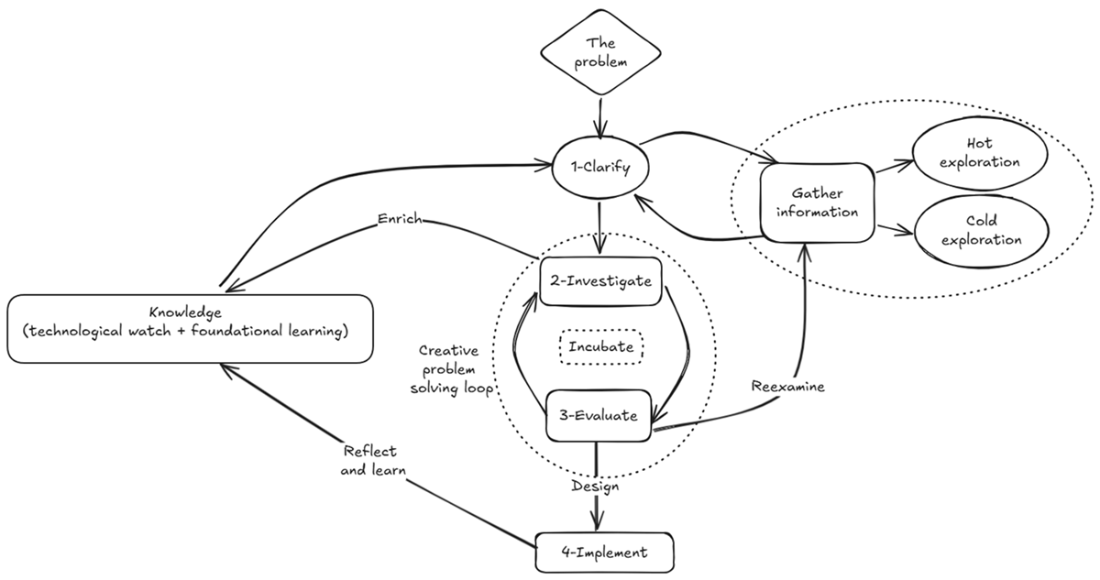
The chapter then frames problem-solving as a creative methodology rooted in knowledge and continuous learning. Developers begin by clarifying the issue, gathering context, reproducing it when possible, and exploring evidence through logs, metrics, traces, dumps, recent changes, and system behavior. They then investigate root causes, test hypotheses, use techniques such as the Five Whys, sketchstorming, and mind mapping, and allow time for incubation when stuck. Once a solution is found, they implement it carefully, validate it, add tests, and reflect on the lessons learned. The closing message is that, even in an AI-assisted era, human judgment and creativity remain central to building durable, maintainable, and meaningful software.
The creative problem-solving methodology.
Summary
- Creativity in software engineering is necessary in coding, problem-solving, and foresight.
- Applying constraints such as performance, readability, or memory limitations can spark new solutions.
- The creative problem-solving process follows four steps: clarify, investigate, evaluate, and implement.
- Clarity is about building a precise understanding of the problem by asking the right questions to understand the context and gathering data through hot or cold exploration.
- Hot exploration techniques help trace problems when they can be reproduced. It starts at the point where the error first appears, then gradually follows the trail until you get as close as possible to the root cause.
- Cold exploration is performed when you cannot reproduce the issue. It requires building a timeline around when the error was first reported.
- Investigate by searching for the root cause with creative insight and outside input, then evaluate your hypotheses to confirm the real cause.
- Incubation allows the subconscious to continue working on problems during rest.
- Design and implement the solution, then reflect to turn every solved issue into reusable knowledge and potential innovation.
- Viewing creativity as a practical engineering skill transforms limitations into opportunities for producing beautiful, purposeful code.
FAQ
What does creativity mean in software development?
Creativity in software development is the ability to generate new and useful ideas by combining knowledge, skill, intuition, imagination, perseverance, and an open mind. It is not only about artistic “creative coding”; it also appears when developers design APIs, solve bugs, optimize performance, refactor legacy code, write expressive code, or anticipate future needs.
Is creativity in programming a sudden stroke of genius?
No. The chapter presents creativity as a structured process rather than a mysterious flash of brilliance. It begins with knowledge and grows through practice, experimentation, problem-solving, and the ability to recognize patterns. New ideas often emerge after gathering information, trying different approaches, and sometimes letting the mind incubate the problem in the background.
Where does creativity usually appear in a developer’s daily work?
The chapter identifies three main areas: coding, problem-solving, and creative foresight. Creativity appears in coding when dealing with complex algorithms, essential complexity, unfamiliar frameworks, difficult tests, legacy refactoring, or making ordinary code clearer and more durable. It appears in problem-solving when investigating bugs or failures. Creative foresight appears when anticipating future product, architecture, security, scalability, or team-process needs.
How do constraints affect creativity in coding?
Constraints can foster creativity by narrowing the range of possibilities and forcing developers to focus on what matters. Performance goals, memory limits, language restrictions, deadlines, or maintainability requirements can lead to more original and practical solutions. However, too many constraints can create stress and poor results, so the most productive creativity comes from a balanced level of limitation.
What is the purpose of the chapter’s coding exercise with Person objects?
The exercise demonstrates how the same simple task can produce very different implementations depending on the constraints. Developers must extract the youngest person’s name, the oldest person’s name, and an alphabetical list of names. They first solve it naturally, then repeat it under performance, memory, and one-stream functional programming constraints. The goal is to observe how constraints change trade-offs between readability, performance, and memory usage.
Why is the most readable solution often better than the most optimized one?
Optimization is valuable only when it serves a real need. For moderate datasets, a concise and clear functional solution may be preferable to a complex one-stream or highly optimized version. The chapter emphasizes that readability, simplicity, and maintainability often outweigh minor performance gains unless the context truly demands optimization.
What are examples of self-imposed constraints developers can use to practice creativity?
Developers can challenge themselves by reducing lines of code without hurting readability, lowering cognitive complexity, minimizing memory usage, improving performance, avoiding external libraries, time-boxing a task, writing the clearest possible code, using functional-style programming, rewriting an imperative solution functionally, or solving a problem without copy-paste, AI assistance, or internet search.
What are the main steps of the creative problem-solving methodology?
The methodology is built on knowledge and unfolds through five main actions: clarify, investigate, evaluate, implement, and reflect. First, understand the problem and gather context. Then search for the root cause. Next, test hypotheses and discard false leads. Once the cause is known, implement a solution and validate it. Finally, reflect on what was learned and how similar issues can be prevented.
What is the difference between hot exploration and cold exploration?
Hot exploration happens when the problem can be reproduced. The developer observes the failure as it occurs, starting from where the error appears and following the trail toward the root cause. Cold exploration happens when the issue cannot be reproduced or lacks enough information. The developer reconstructs events after the fact using logs, metrics, traces, timelines, monitoring data, and experience.
Why are reflection and learning important after fixing a problem?
Fixing a bug is also a learning opportunity. Reflection helps identify hidden design flaws, gaps in testing, incorrect assumptions, or missing team practices. Even investigation paths that did not lead to the final answer still expand knowledge. Over time, these lessons strengthen future problem-solving and help teams improve their code, processes, and long-term product durability.

 The Art of Code ebook for free
