8 Fine-tuning language models
Fine-tuning language models is presented as the step beyond prompt engineering and retrieval-augmented generation when products demand expert-level accuracy, consistent tone, and reduced post-editing. By embedding domain knowledge and task behavior directly into a model, fine-tuning enables outputs that feel like they come from a subject-matter expert and supports targeted capabilities such as classification and instruction following. The chapter emphasizes the product manager’s role in setting clear objectives, aligning training data with user needs, and running rigorous evaluation and iteration. Because fine-tuning is resource-intensive, it should be pursued when it yields measurable ROI—especially in specialized domains, recurring user pain points, or for strategic differentiation—and avoided for broad, fast-changing, or short-lived use cases or where prompts and RAG already suffice.
Domain-specific fine-tuning focuses on selecting and testing open-source base models, balancing model size with compute costs, and ensuring compatibility with parameter-efficient techniques. Success hinges on curating high-quality, representative corpora from credible sources and partner content, then running disciplined training with tuned hyperparameters. Evaluation relies on custom, domain-aware benchmarks and qualitative reviews with real users, while monitoring for issues like catastrophic forgetting. The chapter also highlights practical optimizations—iteratively strengthening datasets where the model is weak, adopting PEFT to control costs, leveraging memory-style methods to anchor factual knowledge, and using preference alignment to better match human expectations.
Supervised fine-tuning is used to teach task-specific behavior such as topic classification, improving relevance by mapping content to client taxonomies. Small language models are favored for efficiency, with balanced, well-labeled datasets, accuracy targets, real-world trials, and feedback loops guiding continuous improvement and scalable per-client adaptation via PEFT. Instruction fine-tuning powers interactive “AI editing,” trained on pairs of instructions and revised outputs that range from simple edits to complex restructurings. Its performance is assessed through manual audits, automated judging, and in-product feedback. Guardrails—such as focused system prompts and decline responses for off-topic or unsafe requests—keep the feature on-mission. Together, these approaches turn a generic LM into a differentiated, domain-accurate, and adaptable product that consistently meets user standards.
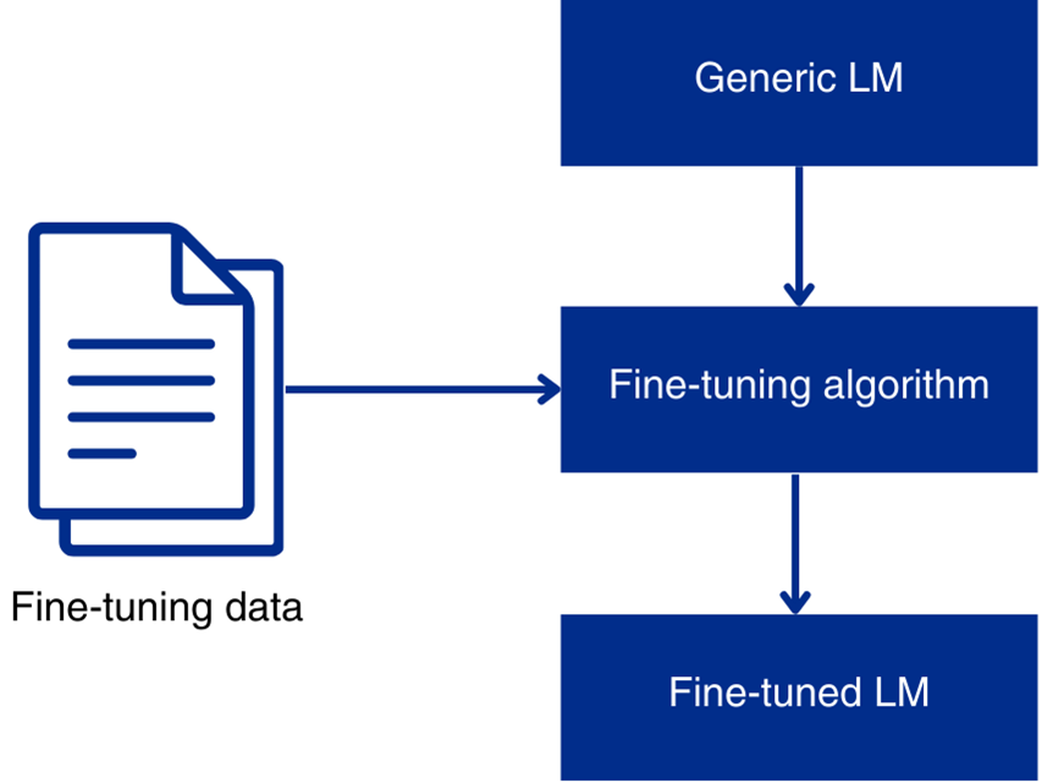
Fine-tuning algorithms take a “base” LM and specific fine-tuning data as input; the output is a new language model that has internalized the knowledge from the fine-tuning data.
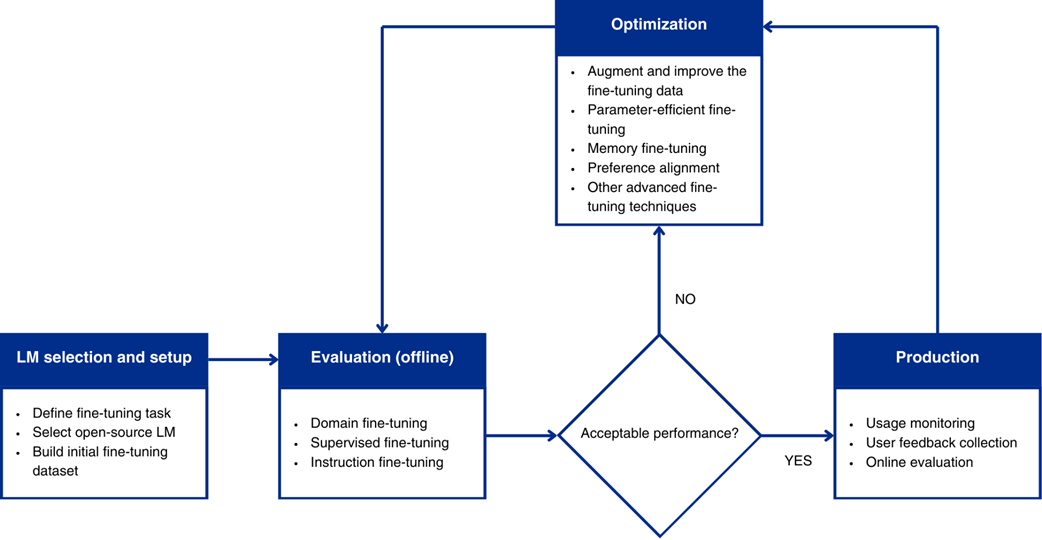
The fine-tuning lifecycle; here, PM tasks are mostly related to task definition, LM selection, the creation of fine-tuning data, and evaluation.
Summary
- Use fine-tuning to enhance language models with domain-specific knowledge, specialized tasks, or instruction-following capabilities beyond prompt engineering or RAG.
- In most cases, fine-tuning is done based on open-source models.
- Evaluate multiple options for task relevance, fine-tuning compatibility, and compute efficiency.
- Build high-quality, task-specific datasets that reflect real-world use cases, focusing on precision and diversity of the data over volume.
- Begin with a small dataset that you can construct manually and iteratively enrich using real-world performance data, user feedback, and edge cases.
- Develop custom evaluation metrics and benchmarks tailored to specific use cases, such as domain expertise, task accuracy, or instruction-following.
- Validate models by testing them in real-world applications and collecting actionable feedback from users and stakeholders.
- Train models to handle off-topic or malicious requests with polite rejection responses and adjusted system prompts.
- Implement in-app feedback mechanisms, like thumbs up/down and comments, to continuously gather insights for model improvement.
- Optimize performance and scalability using advanced techniques like memory fine-tuning, parameter-efficient fine-tuning (PEFT), and preference alignment.
FAQ
When is fine-tuning a better choice than prompts or RAG?
Choose fine-tuning when you need expert-level depth, consistent tone, or task reliability that generic models can’t deliver. It shines for highly specialized domains, recurring user rewrites, task-specific needs (e.g., classification), scalable improvements across many users, and competitive differentiation—especially if you have an engineering team comfortable with open-source LMs. If prompts or RAG already meet quality needs, your domain changes frequently, or you lack budget/expertise, skip fine-tuning.How does fine-tuning differ from prompt engineering and RAG?
Prompts and RAG add context at inference time but don’t change the model’s internal knowledge. Fine-tuning updates the model’s weights to internalize domain facts, terminology, tone, and task behavior. The result is fewer edits, more consistent outputs, and better handling of nuanced, specialized requests.What are the main fine-tuning types and what problems do they solve?
- Domain-specific fine-tuning: Teaches industry terminology, tone, and concepts to reduce generic outputs and rewrites.- Supervised fine-tuning: Optimizes for labeled tasks (e.g., topic classification) to improve relevance and consistency.
- Instruction fine-tuning: Trains the model to follow iterative user directions for in-app editing and refinement.

 The Art of AI Product Development ebook for free
