Overview

2 Discovering and prioritizing AI opportunities

This chapter explains how to find, evaluate, and shape AI opportunities that solve real problems and fit a company’s strategy, capabilities, and risk tolerance. It frames discovery in an “opportunity space,” urging teams to resist building “AI for AI’s sake” and to focus on measurable customer and business value. The text maps common AI value themes—automation and productivity, human-AI improvement and augmentation, personalization, inspiration and innovation, convenience, and emotional engagement—while highlighting pitfalls such as automating rare, one-off decisions or pursuing use cases that require full explainability better served by simpler methods. Throughout, it emphasizes balancing quick wins with longer-term, defensible investments.

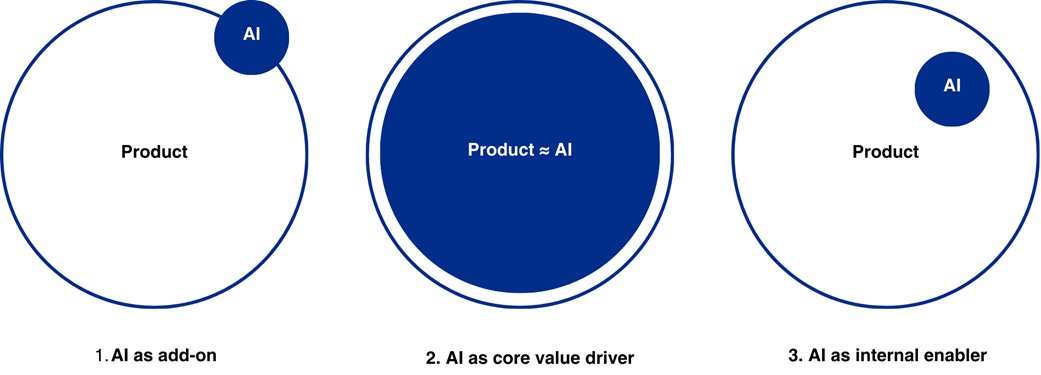
To source strong ideas, the chapter recommends combining existing knowledge and intuition with internal crowdsourcing, dogfooding, and customer listening validated against real behavior, while also scanning broader signals like technological shifts, competitor moves, regulation, and positioning. It distinguishes horizontal opportunities (broad, cross-industry) from vertical ones (domain-specific) and notes the different demands each places on data, domain expertise, and model adaptation. Three integration scenarios are outlined: AI as an add-on to an existing product (fast path but data/UX integration challenges), AI as the core value driver in greenfield products (requires solving cold-start and continuous model improvement while avoiding “solution in search of a problem”), and AI as an internal enabler that improves the product behind the scenes (guided by clear KPIs, governance, and strong internal UX).

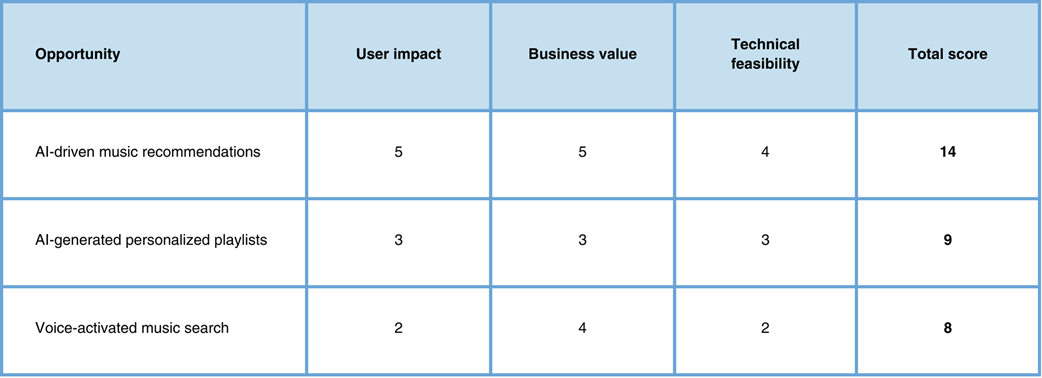
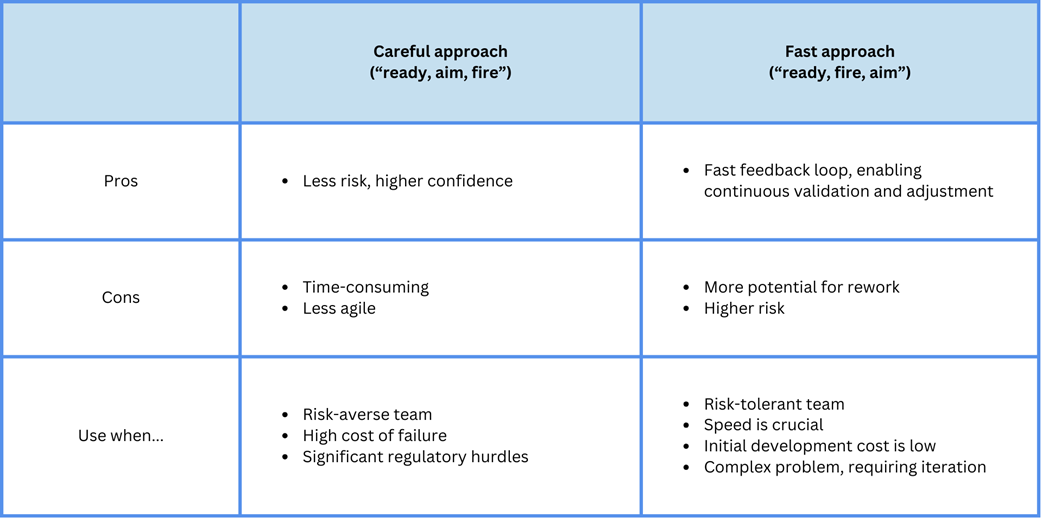
For prioritization, the chapter proposes criteria such as user and business impact, technical feasibility, data availability, regulatory ease, scalability, and customer fit, illustrated via a music app where better discovery drives retention and is feasible with existing behavioral data and standard recommendation techniques. It cautions against overreliance on scoring matrices; instead, teams should surface uncertainties, make transparent trade-offs, and be ready to pivot. Finally, it contrasts two ways to shape opportunities: a careful “ready, aim, fire” approach suited to high-stakes or regulated contexts, and a fast “ready, fire, aim” approach that leans on rapid prototyping, real-world feedback, and iterative model improvement. Choosing the right mix helps teams deliver near-term wins while building a durable AI advantage.

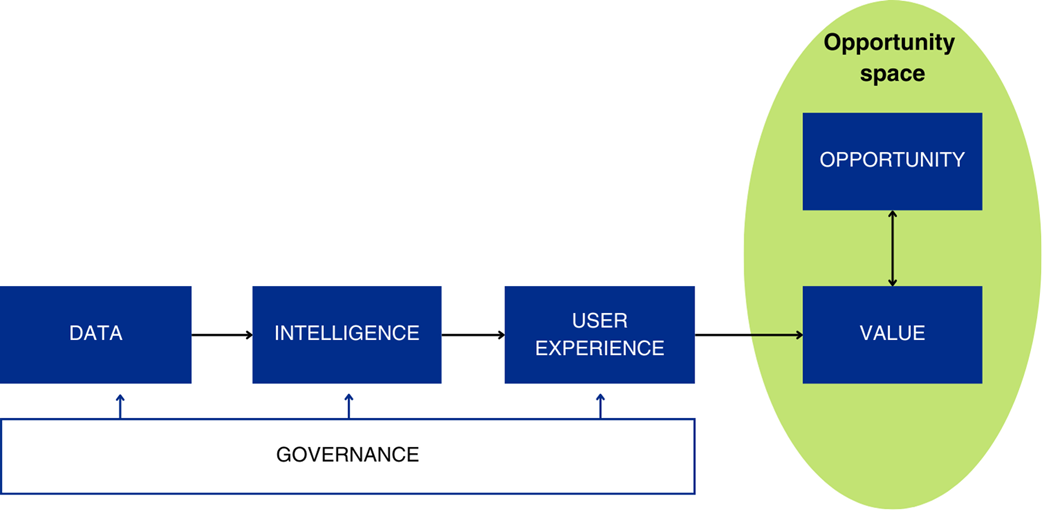
This chapter addresses discovery in the “opportunity space” in the mental model of an AI system
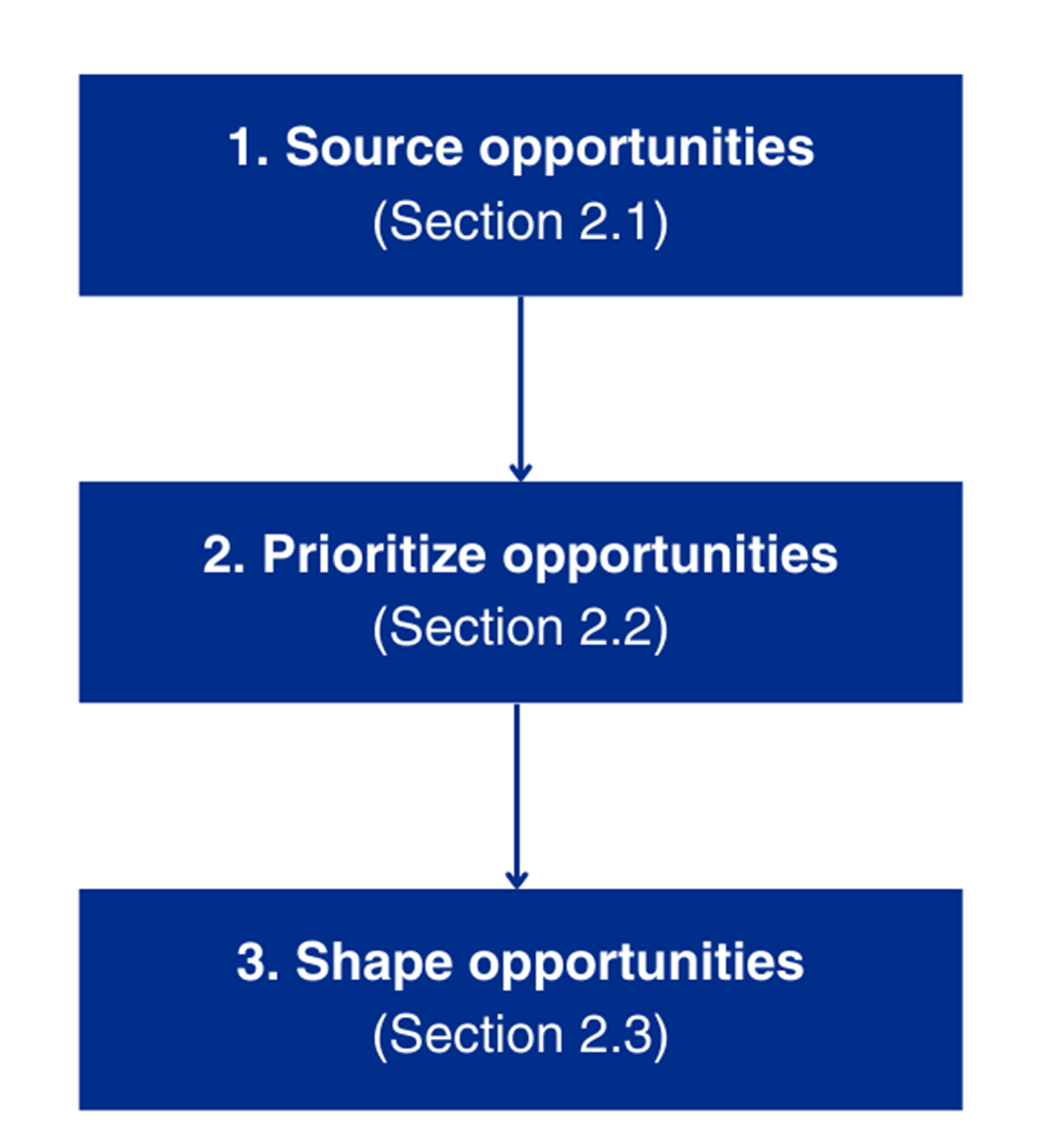
The process for discovering AI opportunities
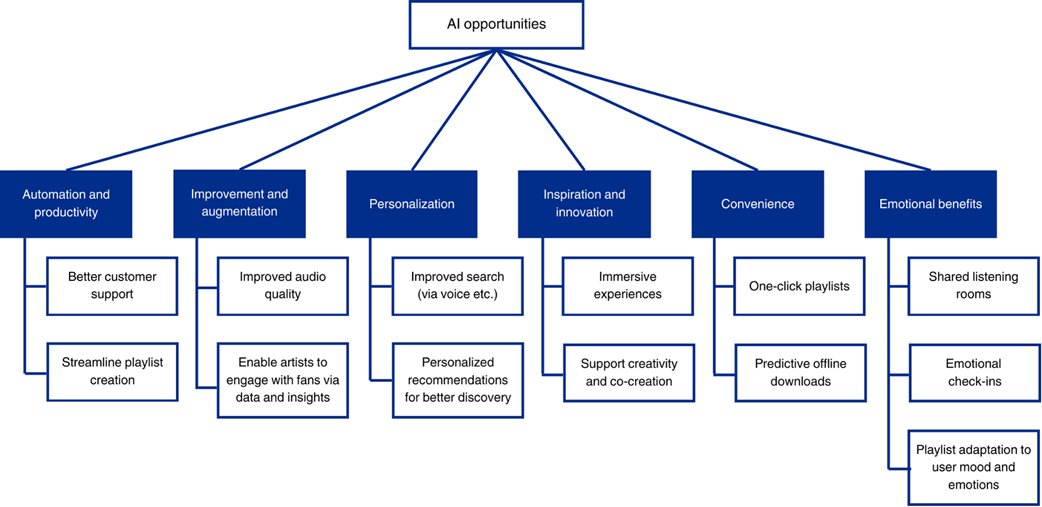
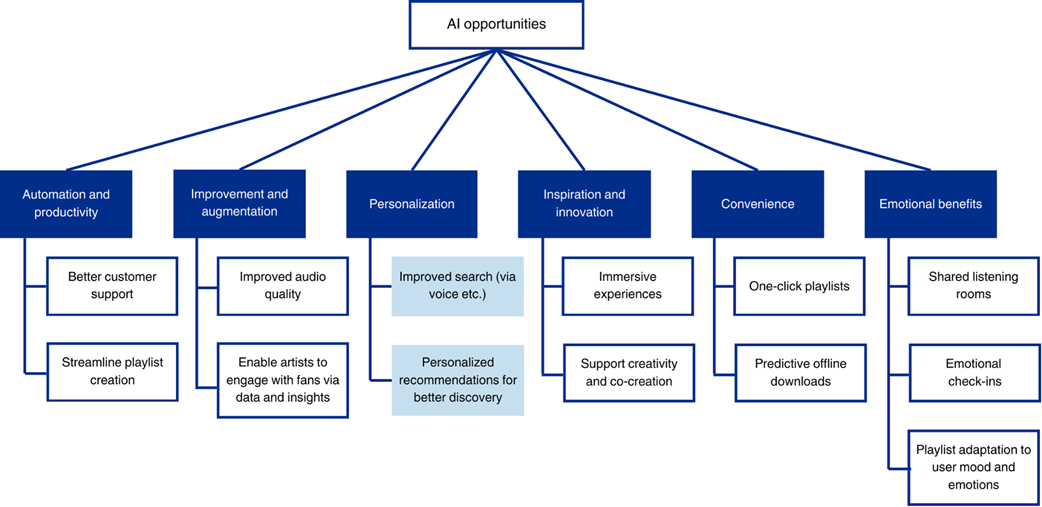
AI opportunity tree for a music streaming app
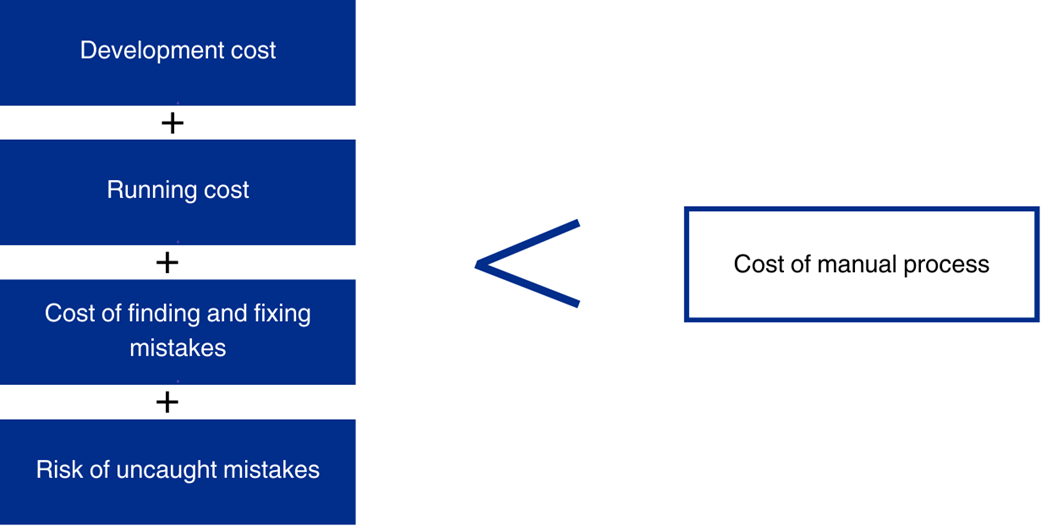
The AI cost equation for automation opportunities; beyond the development and operation cost, you should also estimate the cost of finding and fixing mistakes and the risk of uncaught mistakes.
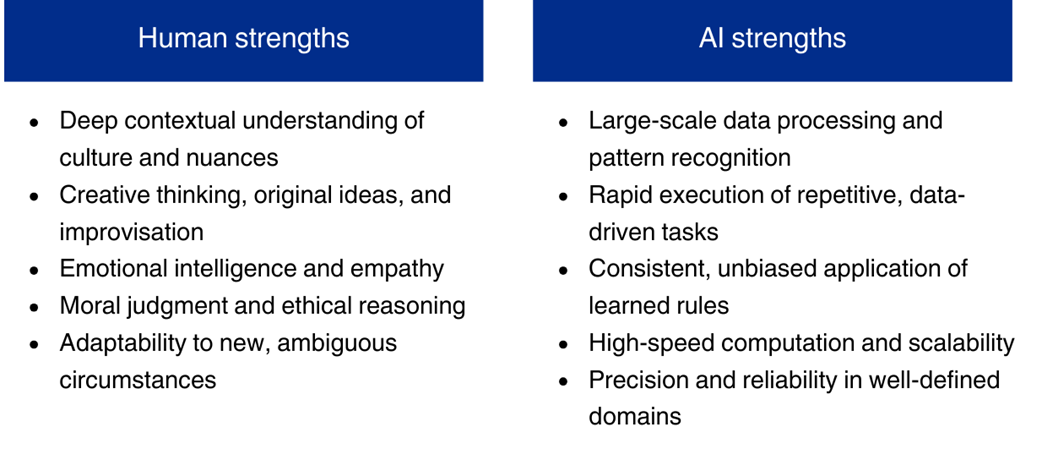
Humans and AI each have different strengths which should be leveraged when building AI-driven products.
Three scenarios for AI integration
You decide to explore the personalization branch in your opportunity tree
This simple prioritization matrix evaluates AI opportunities according to user impact, business value, and technical feasibility. It is clear but potentially oversimplifies the decision.
When to be careful vs. fast: comparing “ready, aim, fire” and “ready, fire, aim”
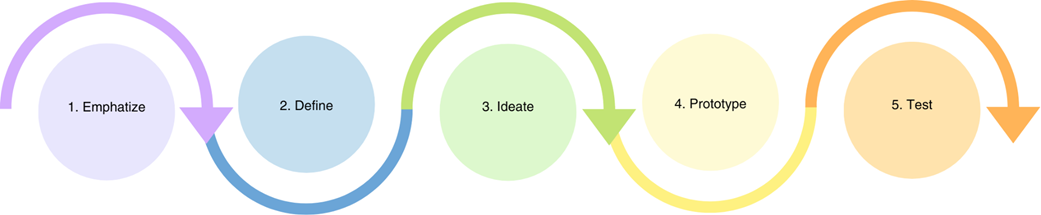
The traditional design thinking process
Summary

  • Cultivate idea flow: Create and maintain a constant flow of AI ideas by sourcing from multiple channels—user feedback, competitors, team insights, and technological developments. The more ideas you evaluate, the more likely you are to discover valuable opportunities.
  • Involve your team: Engage the entire team in the idea generation and prioritization process. Use their intuition, creativity, and domain expertise for faster ideation and more robust decision-making.
  • Quickly discern the “AI advantage”: Prioritize AI opportunities that solve specific user problems such as automating routine tasks, improving outcomes, innovating, or personalizing user experiences. Avoid "one-off" decisions and situations requiring full explainability or perfect accuracy.
  • Use diverse sources: Go beyond customer feedback to identify AI opportunities. Draw inspiration from competitors, emerging technology, regulations, and market positioning to stay innovative and competitive.
  • Distinguish horizontal vs. vertical use cases: Understand whether your AI opportunity applies to industries (horizontal) or a specific domain (vertical). Horizontal opportunities need broad market understanding, while vertical ones require deep domain expertise.
  • Apply a prioritization framework: Use a structured framework to score AI opportunities based on user impact, business value, and technical feasibility. This approach ensures an objective evaluation process and helps align the team.
  • Balance quick wins vs. long-term investments: Prioritize quick wins for immediate user impact while investing in long-term AI opportunities to create a competitive edge with AI.
  • Choose the right development approach: Select between a careful, research-first approach ("ready, aim, fire" / design thinking) for high-stakes projects and a fast, iterative approach ("ready, fire, aim" / lean startup) to speed up time-to-value. Also consider your team's culture and risk attitude when making this choice.
  • Validate and iterate: Continuously test your AI ideas through experimentation. Whether you're following a fast or careful approach, gathering user feedback early and iterating ensures better alignment with real-world needs.

FAQ

How do I tell if a problem is a good fit for AI?Look for problems where AI’s strengths create clear value: - Automation and productivity: repetitive, routine, high-volume tasks - Improvement and augmentation: humans and AI combine strengths for better outcomes - Personalization: tailored content or experiences at scale (with sufficient data) - Inspiration and innovation: idea generation, pattern finding, faster iteration - Convenience and emotional engagement: reduce friction, add human-like interactions Avoid poor candidates like rare “one big decisions” and domains needing full explainability where simple rules work better.
What is an AI opportunity tree and how do I build one?An AI opportunity tree maps AI benefits to concrete opportunities: - Start from AI benefit categories (e.g., automation, augmentation, personalization) - For each, list user problems and potential AI-enabled outcomes - Add early solution hints if helpful, then later size and compare opportunities This keeps ideation focused on where AI actually shines while staying user-centric.
How can I estimate ROI for AI automation?Compare the end-to-end cost of the AI process vs. the manual process: - AI side: development + operations + cost to find/fix AI mistakes + risk/cost of undetected errors - Manual side: current labor, overhead, and error costs Proceed if the AI side is significantly lower and risks are acceptable. Gather rough estimates during discovery, then refine with pilots.
Where should I source AI opportunities besides customer requests?Use multiple inputs: - Existing knowledge and team intuition; run quick experiments - Internal crowdsourcing to surface diverse ideas - Dogfooding to solve your own pains, then broaden beyond your biases - Customer interviews and behavior data to validate real needs - Market signals: new tech capabilities, competitor moves, regulation, and positioning Always bring ideas back to validated user value.
What’s the difference between horizontal and vertical AI opportunities?- Horizontal: broad needs across industries (e.g., coding assistants, customer ops). Requires understanding common user needs and scaling to varied contexts. - Vertical: domain-specific (e.g., financial analytics copilots). Requires deep domain expertise, specialized data, and often model fine-tuning. Both can be viable; choose based on your team’s strengths and strategy.
What are the main scenarios for integrating AI into products?Three common scenarios: - AI add-on to an existing product (“brownfield”): leverage existing users/data; mind data integration and UX fit; avoid AI-for-AI’s-sake - AI as core value driver (“greenfield”): AI is the product; solve cold-start data, iterate models continuously; avoid premature scaling - AI as an internal enabler: behind-the-scenes optimization; set clear KPIs, ensure security/compliance, and invest in internal UX and training
How should I prioritize AI opportunities?Use simple, stable criteria: - User and business impact (engagement, retention, revenue, strategic fit) - Technical feasibility (data availability, team expertise, model maturity) - Custom factors (regulatory ease, scalability, customization effort) Scoring can help, but don’t hide uncertainty—document assumptions, risks, and open questions to enable fast pivots.
How do I balance quick wins with long-term AI bets?Create a portfolio: - Quick wins: feasible in months, prove value, build momentum; often easy to copy unless backed by unique assets (e.g., proprietary data) - Long-term bets: riskier, slower, but more defensible (e.g., novel modalities, deeper personalization, voice/agentic UX) Adjust the mix to your AI strategy—table stakes vs. differentiated moat.
When should I use “ready, aim, fire” vs. “ready, fire, aim”?- Ready, aim, fire (careful): use when failure cost is high (healthcare, finance), regulations are strict, or research meaningfully reduces risk. Pros: confidence and compliance; cons: slower, risk of analysis paralysis. - Ready, fire, aim (fast): use when speed is crucial, build costs are low, and iteration with real data drives learning (e.g., consumer recommendations). Pros: rapid insight and agility; cons: may need frequent course-correction.
How do I avoid building “AI for the sake of AI”?- Anchor on a real user problem and measurable outcomes - Prefer the simplest solution that works (rules/UX changes before AI) - Set explicit scope and communicate AI limitations and failure modes - Test with real users early; monitor satisfaction and accuracy thresholds - Design human-AI collaboration thoughtfully; don’t over-automate where trust or explainability is key

pro $24.99 per month

  • access to all Manning books, MEAPs, liveVideos, liveProjects, and audiobooks!
  • choose one free eBook per month to keep
  • exclusive 50% discount on all purchases
  • renews monthly, pause or cancel renewal anytime

lite $19.99 per month

  • access to all Manning books, including MEAPs!

team

5, 10 or 20 seats+ for your team - learn more


choose your plan

team

monthly
annual
$49.99
$499.99
only $41.67 per month
  • five seats for your team
  • access to all Manning books, MEAPs, liveVideos, liveProjects, and audiobooks!
  • choose another free product every time you renew
  • choose twelve free products per year
  • exclusive 50% discount on all purchases
  • renews monthly, pause or cancel renewal anytime
  • renews annually, pause or cancel renewal anytime
  • The Art of AI Product Development ebook for free

choose your plan

team

monthly
annual
$49.99
$499.99
only $41.67 per month
  • five seats for your team
  • access to all Manning books, MEAPs, liveVideos, liveProjects, and audiobooks!
  • choose another free product every time you renew
  • choose twelve free products per year
  • exclusive 50% discount on all purchases
  • renews monthly, pause or cancel renewal anytime
  • renews annually, pause or cancel renewal anytime
  • The Art of AI Product Development ebook for free