Overview

12 Working with your stakeholders

AI products magnify the complexity of stakeholder communication, demanding that product leaders act as educators, translators, and advocates who align diverse perspectives around business outcomes and user value. Framed through Mark’s development of a predictive analytics platform for supply chain management, the chapter shows how uncertainty, interdisciplinary work, and human–AI interaction raise the bar for clarity, trust-building, and expectation management. It lays out a practical roadmap for navigating three arenas—collaboration within the AI team, communication with internal business stakeholders, and engagement with customers and users—while emphasizing user-centered goals, iterative learning, and transparency as the foundation for adoption and impact.

Inside the product team, effective collaboration hinges on deeply understanding roles (data science, engineering, UX, and domain expertise), converging on user-focused metrics, and embracing experimentation. Tactics include adopting tightly knit working models (e.g., a product trio), making problem framing and trade-offs explicit, and translating across different “languages” of success (accuracy, latency, usability, domain fidelity). The chapter then extends to business stakeholders: for executives, lead with outcomes and a simple case for ROI and next steps; for sales and marketing, equip clear narratives and differentiation without overpromising; for customer success, combine scenario-based guidance with transparency about limitations; and for legal/compliance, proactively address privacy, bias, data handling, and auditability. Across all groups, precise, jargon-free communication that anticipates concerns sustains momentum and trust.

Externally, the chapter focuses on communicating value in concrete terms—efficiency and productivity gains, improved decisions, personalization, innovation potential, convenience, and even emotional benefits—while being explicit about AI’s failure modes, error frequency, and safeguards. It recommends giving users tools to spot, override, and report errors; building channels for proactive updates; addressing core anxieties (trust, job replacement, privacy) with empathy and control; and educating users to interpret probabilistic outputs and collaborate with the system. Finally, it advocates turning users into co-creators through continuous feedback loops and recognition, and tailoring strategies to B2B versus B2C realities—different decision-makers, onboarding depth, channels, and adoption paths. The common thread is disciplined transparency, evidence-backed value, and two-way learning that compounds product quality and stakeholder confidence over time.

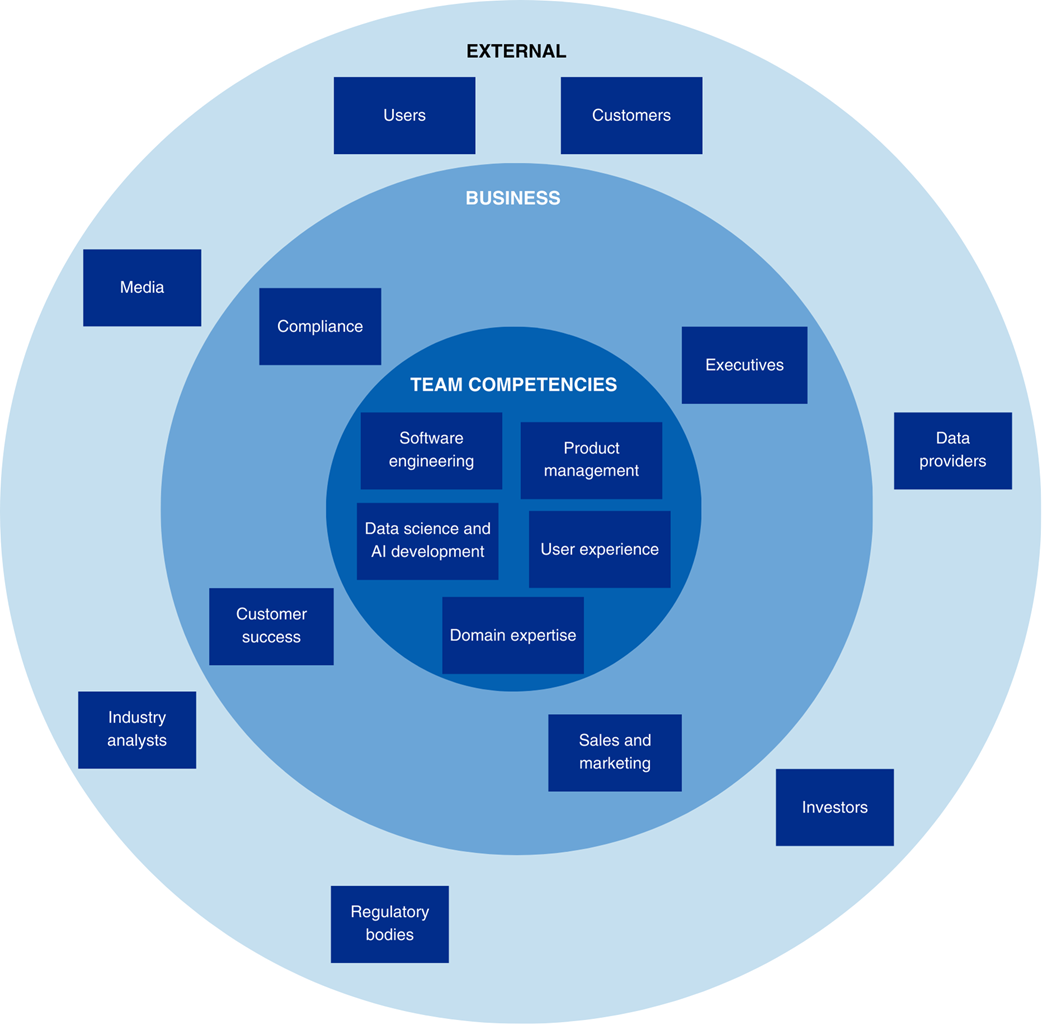
The major stakeholders of an AI-driven product
Summary

  • Learn the responsibilities and priorities of your team members—whether they are engineers, data scientists, or UX designers—to reduce friction and enable effective collaboration.
  • Shift focus from individual role-specific metrics (e.g., model accuracy or latency) to shared outcomes like user satisfaction and adoption rates to ensure the product delivers meaningful value.
  • Acknowledge that AI involves experimentation and learning. Iterate collaboratively, treating insights and methods developed during the process as valuable intellectual property.
  • Tailor messaging to business stakeholders by focusing on outcomes like ROI, operational efficiency, and market positioning rather than technical details.
  • For B2B, highlight strategic benefits (e.g., cost reduction, productivity gains) to decision-makers, and practical improvements (e.g., simplifying daily workflows) for end users. In B2C, focus on personalized, intuitive, and emotionally engaging experiences.
  • Tackle fears of job displacement by positioning AI as a tool that enhances rather than replaces human expertise, and offer a forward-looking perspective on how roles can evolve.
  • Build trust by openly explaining how the AI works, its limitations, and what users can expect. Use confidence intervals, explainable models, and real-world examples to make the system more approachable.
  • Be upfront about the types and frequency of errors, their potential impact, and how users can identify and manage them. Position failure as an opportunity for collaborative learning and improvement.
  • Recognize the nuanced differences—B2B often involves high-touch communication with tailored onboarding, while B2C relies on scalable, low-touch tools and emotional engagement.
  • Establish efficient mechanisms to gather user feedback, integrate it into model updates, and communicate how their input shapes the system. This cultivates co-creation and trust.

FAQ

What are the core principles for effective cross-functional collaboration in AI teams?Align around three practices: (1) Understand each role’s goals, language, and constraints to reduce friction. (2) Anchor decisions in end-user outcomes and shared, user-centered metrics (e.g., adoption, satisfaction), not siloed technical KPIs. (3) Embrace iterative learning—experiment, test, and refine together to navigate AI’s inherent uncertainty.
Which roles are essential in an AI team, and how do AI engineers differ from ML engineers?Five competence areas typically show up: product management, software engineering, data science/AI development, user experience, and domain expertise. ML engineers primarily build, train, and operationalize models; AI engineers integrate models into products—connecting APIs, building workflows, and optimizing inference and UX.
How can I structure my AI team to avoid silos and keep delivery efficient?Adopt a “product trio” (PM, design, engineering) collaborating end-to-end, and add AI/data and domain expertise as needed by phase. Keep the team lean, beware the “mythical man-month,” and plan role evolution across the lifecycle (e.g., early prototyping vs. later scalability and MLOps).
What conversation patterns help align data science, engineering, and UX?Frame discussions around outcomes and constraints. Examples: with data science, balance accuracy vs. runtime against a business tolerance; with engineering, test real-world latency and plan for bottlenecks; with UX, design for trust (e.g., confidence intervals). Use open-ended questions to surface trade-offs and options.
How do I pitch an AI initiative to executives?Use a five-step, outcome-first narrative: (1) Problem statement, (2) Impact on key KPIs, (3) Proposed solution (high level), (4) Estimated ROI with realistic adoption assumptions, (5) Next steps with timeline and resources. Avoid technical depth; emphasize business value and clear execution.
How should I enable sales, marketing, and customer success to drive adoption?For sales/marketing: provide clear value stories, competitive differentiation, and transparent expectation-setting (limitations, confidence ranges, overrides). For customer success: equip them with scenarios, explainability aids, and guidance for reconciling AI outputs with real-world context to build trust and usage.
How do I work with compliance and legal on AI products?Be transparent on data handling (minimize/secure/anonymize), model risk (bias detection/mitigation), and governance (audits, flags, oversight). Proactively explain safeguards, monitoring, and escalation paths so stakeholders can assess regulatory fit and ethical risks with confidence.
What’s the best way to communicate AI’s value to customers and users?Tie benefits to concrete outcomes: efficiency (quantify time/cost savings), improvement (accuracy/quality gains), personalization (relevance with privacy controls), innovation (new capabilities), convenience (simpler workflows), and emotional benefits (confidence, reduced stress). Use numbers, examples, and case stories.
How should I communicate and manage AI failures with users?Be explicit about failure modes (false positives/negatives, ambiguity, bias, hallucinations), expected frequency, and impact. Give users tools to spot, correct, and report errors (confidence indicators, overrides, “flag for review”) and set up channels (status pages, proactive alerts, product updates) focused on improvements.
What differs in B2B vs. B2C stakeholder communication for AI?B2B: two audiences—buyers (ROI, risk) and users (workflow fit). Use high-touch channels (demos, workshops), phased rollouts/pilots, tailored enablement, and everboarding. B2C: a single user audience, low-touch scalable channels (in-app tips, FAQs), fast onboarding, and community-driven feedback before broader release.

pro $24.99 per month

  • access to all Manning books, MEAPs, liveVideos, liveProjects, and audiobooks!
  • choose one free eBook per month to keep
  • exclusive 50% discount on all purchases
  • renews monthly, pause or cancel renewal anytime

lite $19.99 per month

  • access to all Manning books, including MEAPs!

team

5, 10 or 20 seats+ for your team - learn more


choose your plan

team

monthly
annual
$49.99
$499.99
only $41.67 per month
  • five seats for your team
  • access to all Manning books, MEAPs, liveVideos, liveProjects, and audiobooks!
  • choose another free product every time you renew
  • choose twelve free products per year
  • exclusive 50% discount on all purchases
  • renews monthly, pause or cancel renewal anytime
  • renews annually, pause or cancel renewal anytime
  • The Art of AI Product Development ebook for free

choose your plan

team

monthly
annual
$49.99
$499.99
only $41.67 per month
  • five seats for your team
  • access to all Manning books, MEAPs, liveVideos, liveProjects, and audiobooks!
  • choose another free product every time you renew
  • choose twelve free products per year
  • exclusive 50% discount on all purchases
  • renews monthly, pause or cancel renewal anytime
  • renews annually, pause or cancel renewal anytime
  • The Art of AI Product Development ebook for free