11 AI governance
As AI capabilities accelerate, the risk surface for digital products expands across security, privacy, fairness, and transparency, making governance a core product responsibility rather than a compliance checkbox. The chapter uses Sam’s journey at DataMax to illustrate how reactive firefighting—after issues like data leakage, biased outputs, or opaque decisions emerge—erodes user trust and slows adoption. It argues for a proactive, product-led governance approach that bridges technical development, business goals, ethics, and evolving regulations to build trustworthy AI that performs reliably at scale.
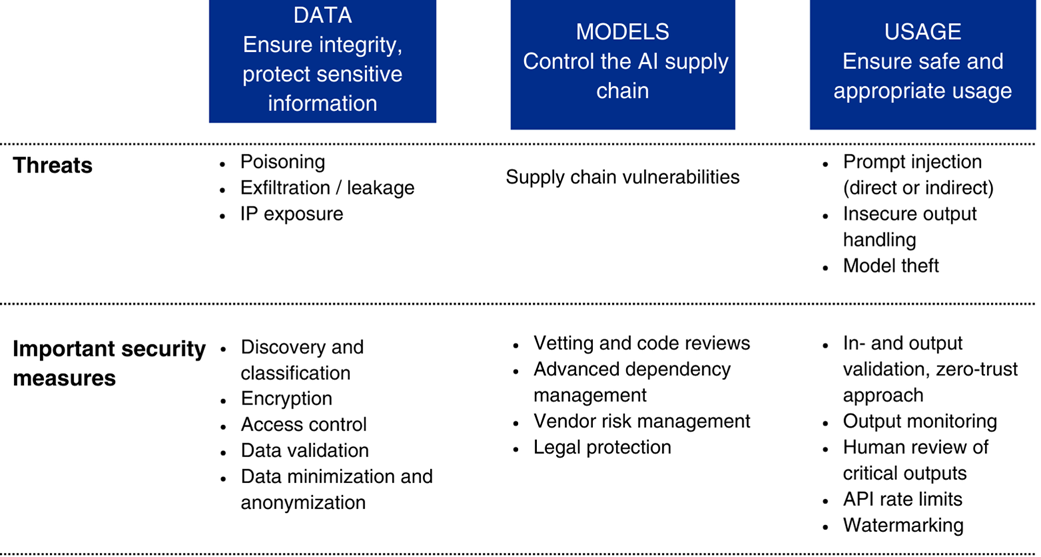
The chapter organizes security into data, model, and usage layers, showing how threats such as data poisoning, exfiltration, IP exposure, supply chain vulnerabilities, prompt injection, insecure output handling, and model theft demand end-to-end controls. Mitigations include rigorous data validation, classification and minimization, encryption and role-based access, monitoring and audits, vendor and third‑party vetting with SBOMs, sandboxing, rate limiting, and red teaming. It then zooms in on privacy, highlighting the added risks of generative AI and the loss of control when using external LLMs. Adopting privacy-by-design—proactive risk assessment, privacy-by-default settings, data minimization, end‑to‑end security, transparency to users, and user control—helps teams meet expectations in both B2C (personal data) and B2B (IP and data sovereignty) contexts while staying aligned with jurisdictional requirements.
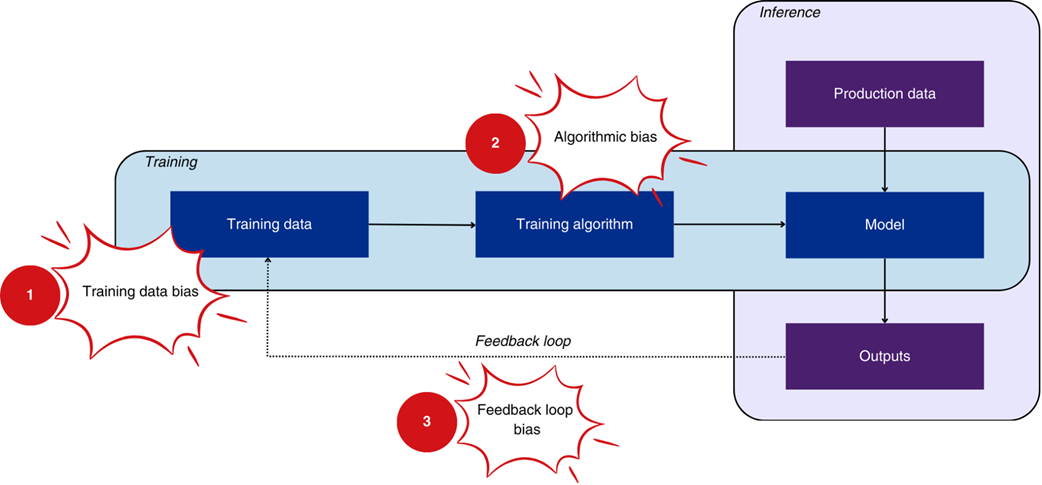
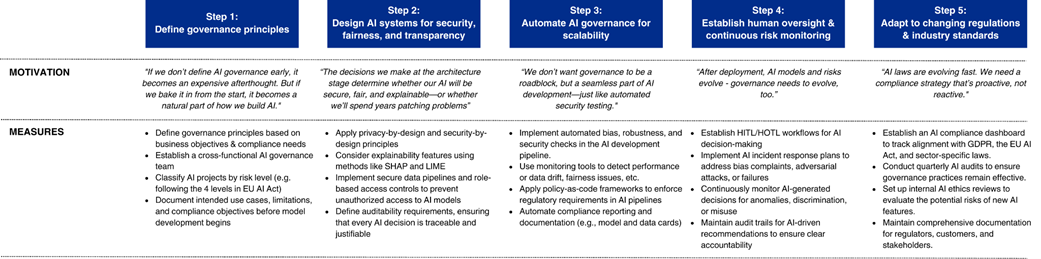
To reduce harm and increase adoption, the chapter emphasizes fairness, transparency, and accountability. It traces bias to training data, algorithms, and feedback loops, and prescribes audits, dataset rebalancing, continuous drift monitoring, explainability methods, fairness testing, and periodic reviews. Transparency is advanced through clear explanations, interpretable and actionable outputs, and robust audit trails. Accountability is operationalized via appropriate levels of human oversight (human-in/on/out-of-the-loop) based on risk and impact. Throughout, the chapter maps practices to regulatory expectations (such as requirements for explainability, privacy, and oversight) and culminates in a shift-left roadmap that bakes governance into every phase of the AI lifecycle—turning governance-by-design into a strategic advantage rather than a bottleneck.
Security needs to be managed at the levels of data, intelligence, and user experience.
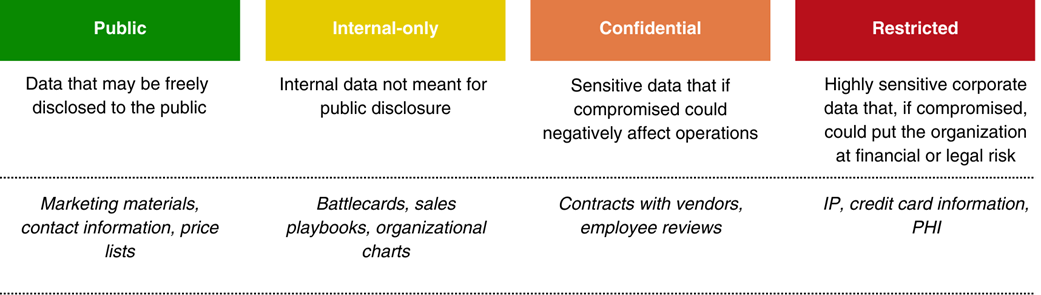
Data classification classifies data into multiple confidentiality levels for a differentiated security strategy.
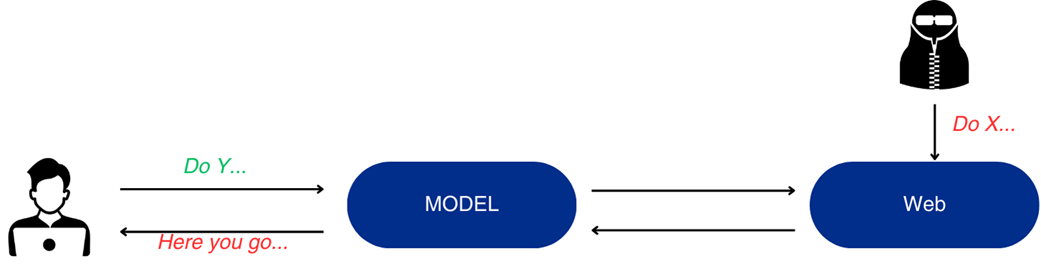
In direct prompt injection, harmful instructions are provided directly as part of the prompt.

In indirect prompt injection, harmful instructions are provided directly as part of the prompt.
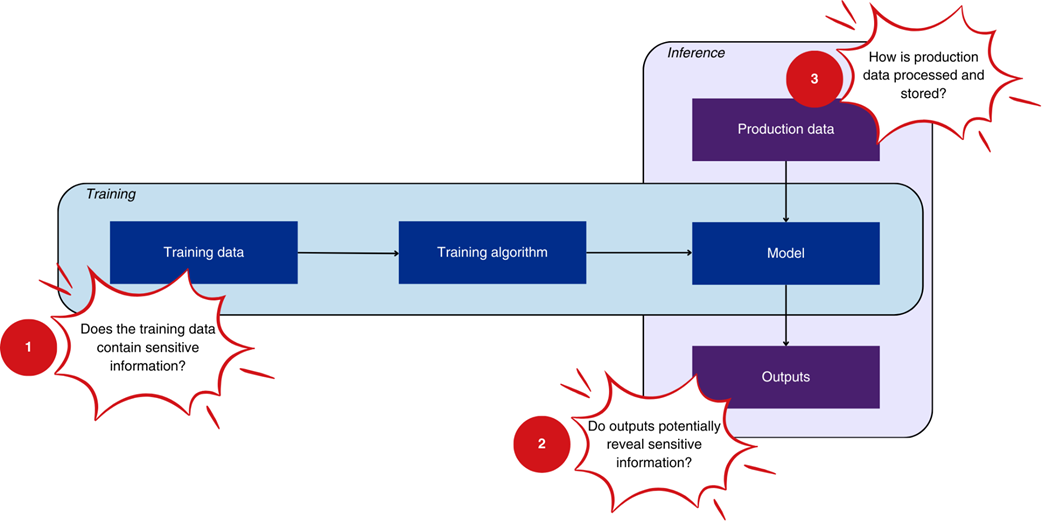
Major privacy concerns in an AI system
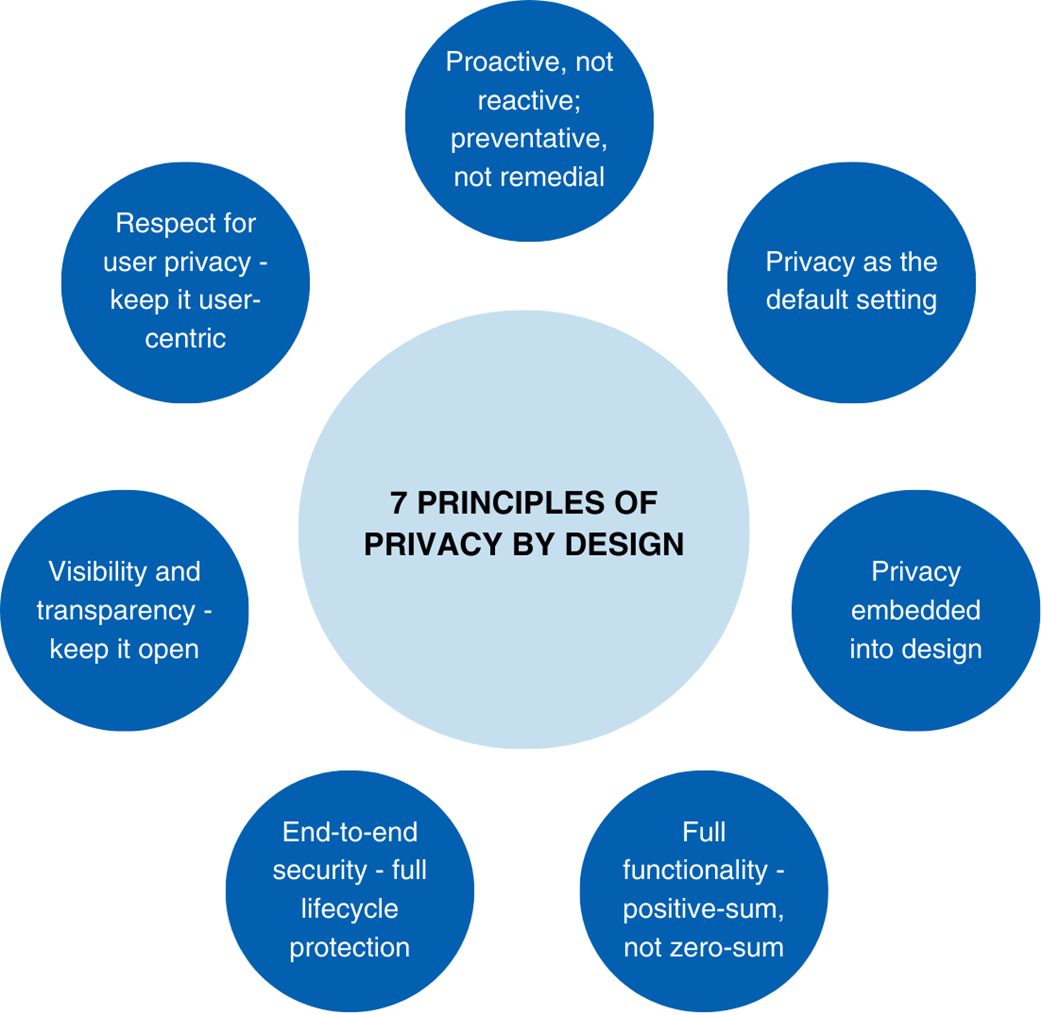
The seven principles of privacy-by-design
Bias can originate from the training data, the AI algorithm, and the feedback loops with users
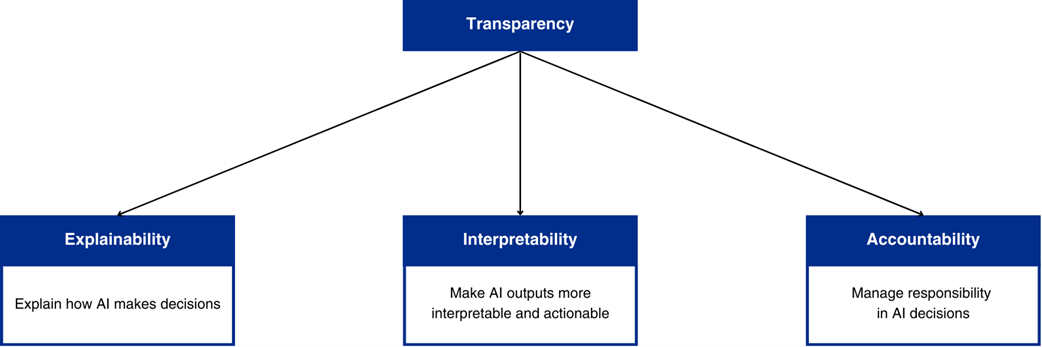
The three components of transparency are explainability, interpretability, and accountability
A roadmap for proactive governance implementation (shift-left approach)
Summary
- AI governance is essential for balancing innovation with responsibility, helping companies build trust with clients while avoiding potential risks such as data breaches and biased decision-making.
- Security must be prioritized across data, models, and production usage in AI systems, ensuring that confidential information remains protected from threats like data poisoning, exfiltration, and model theft.
- Proactive data security practices, such as validating training data and implementing encryption, are critical for preventing incidents like data poisoning, exfiltration, or leakage that can compromise system integrity and client trust.
- Rigorous vetting and monitoring of third-party libraries and software should be integrated into AI development processes to guard against supply chain vulnerabilities that could expose sensitive data or intellectual property.
- Clear accountability measures must be established in AI systems, ensuring that human oversight can intervene when AI-generated recommendations are incorrect or dangerous, and providing a traceable audit trail for all decisions.
- Transparency is key to AI adoption and trust, and companies should ensure that AI outputs are both explainable and interpretable, providing users with clear insights into how decisions are made.
- Explainability empowers users to understand how AI makes decisions, enabling them to make informed adjustments and feel more confident using AI-driven systems in critical workflows.
- Regular bias testing and model retraining on diverse datasets are necessary to prevent AI systems from reinforcing existing biases, particularly in applications like hiring, credit scoring, or healthcare recommendations.
- Adhering to global AI regulations, such as GDPR and the EU AI Act, is essential for companies operating in different regions, and they should conduct regulatory risk assessments and implement privacy-by-design principles to stay compliant.
- AI systems should be continuously audited and monitored for compliance with evolving regulatory requirements, ensuring that they operate ethically and legally while maintaining trust with customers and stakeholders.
- A proactive, shift-left approach to AI governance mitigates risks upfront and builds customer trust, eliminating ad-hoc incidents and fire-fighting.
FAQ
What is AI governance and why does it matter for product managers?
AI governance is the set of practices that align AI development and operations with security, privacy, fairness, transparency, and regulatory requirements. For product managers, it bridges technical work, business goals, compliance, and ethics to reduce risks like breaches, data leakage, bias, and black-box decisions—building user trust and long-term adoption. A proactive “shift-left” approach embeds governance from ideation through deployment to avoid costly firefighting later.How should we secure AI systems across data, model, and usage layers?
- Data: Guard against poisoning and leakage with strict data validation, trusted sources, classification and minimization, anonymization, encryption, and RBAC; continuously monitor performance for anomalies.- Models: Vet open-source/commercial dependencies, maintain an SBOM, use automated updates (e.g., Dependabot/Renovate), scan for vulns (OWASP Dependency-Check, Snyk), sandbox code (containers, SELinux), and run vendor risk management and pen tests.
- Usage: Defend against prompt injection, validate and constrain outputs (zero-trust), require human approval for high-risk actions, sandbox executions, rate-limit APIs, and perform red teaming and ongoing monitoring.
How can we prevent data poisoning and detect it in production?
- Validate and filter incoming data; use trusted sources.- Automate anomaly/outlier detection before data enters training and eval sets.
- Continuously monitor model metrics; investigate sudden accuracy drops or odd outputs.
- Maintain lineage and reproducibility for rapid rollback and forensics.
- Use checklists and automated gates in your ML pipeline to block tainted data before training.
How do we prevent data leakage/exfiltration and protect IP and models?
- Classify data and apply minimization/anonymization where possible.- Enforce end-to-end encryption (in transit/at rest) and strict RBAC with least privilege; log and audit access.
- Isolate sensitive inputs from broad access (e.g., separate prompts/logs, scoped token permissions).
- Conduct regular security audits and third-party assessments.
- For IP: ensure datasets are licensed, run IP audits, remove infringing materials, and honor provider licenses.
- For model protection: rate-limit APIs, watermark outputs, apply differential privacy, consider homomorphic encryption for sensitive computation, and enforce EULAs to deter cloning and misuse.
How should we vet and manage third‑party AI components and vendors?
- Pre-integration scanning: use Snyk, OWASP Dependency-Check; verify maintainers and update cadence.- Ongoing dependency hygiene: Dependabot/Renovate; maintain an SBOM (e.g., CycloneDX).
- Isolation: sandbox third-party code (containers, SELinux/AppArmor), restrict network/filesystem access.
- Vendor risk management: require security attestations, pen tests, and clear contractual liability/security obligations; review data retention and residency policies.
What is prompt injection and how do we defend against it?
Prompt injection manipulates an LLM via crafted inputs or contaminated external data (direct or indirect) to bypass guardrails. Defenses include:- Input validation and pattern blocking (e.g., “ignore previous instructions”); strip/control special tokens.
- Separate user content from system instructions; avoid mixing control text with untrusted data.
- Hard-coded refusals for risky intents; confidence and policy checks.
- Session/context resets to prevent accumulation of malicious state.
- Continuous monitoring, adversarial testing, and red teaming to catch evolving attacks.
How do we make AI agent/tool integrations safe (insecure output handling)?
- Adopt zero-trust output validation; strictly parse and whitelist allowed actions/SQL/commands.- Block or review dangerous operations (e.g., DROP/DELETE); require human approval for high-risk steps.
- Execute in sandbox/staging first; use capability-constrained tool APIs rather than free-form execution.
- Log, alert, and roll back automatically on policy violations.
What does privacy‑by‑design look like in practice, especially with LLMs?
Apply the seven principles: proactive risk assessment (PIAs), privacy by default, privacy embedded in architecture (anonymization, minimization, federated learning where feasible), full functionality (seek positive-sum designs), end-to-end security, visibility/transparency (data usage reports), and user control over data. For commercial LLMs: encrypt data, restrict and audit access, review training data provenance and retention policies, and ensure jurisdictional compliance for cross-border flows.How do we detect and mitigate AI bias across data, algorithms, and feedback loops?
- Data: Audit representation (Fairlearn, AI Fairness 360), rebalance/augment (e.g., SMOTE), and monitor drift (WhyLabs).- Algorithms: Use explainability (SHAP/LIME), run fairness tests pre-release, and schedule periodic bias audits.
- Feedback loops: Keep humans in the loop for high-stakes decisions, diversify data sources beyond historical AI outputs, and set automated bias alerts (e.g., Evidently AI).
What transparency, interpretability, and oversight should we provide—and what regulations apply?
- Transparency: Communicate capabilities/limits, typical failure modes, data sources, and high-level model logic; provide actionable, context-rich explanations in the UI.- Interpretability: Present outputs as clear, business-aligned rationales with confidence and caveats.
- Accountability: Choose appropriate oversight mode (HITL/HOTL/HOOTL), log decisions and interventions, and maintain audit trails.
- Regulations to consider: EU AI Act (risk, transparency, oversight), GDPR/CCPA (privacy, explainability, automated decisions), HIPAA/PCI DSS (sector data controls), EEOC AI hiring guidance (fairness), ISO 27001/27701/42001 (security/privacy/governance). Adopt a shift-left compliance approach and keep updating controls as laws evolve.

 The Art of AI Product Development ebook for free
