Overview

7 Choosing the right model: designing the reasoning stack

Reasoning breaks down in groups when people silently operate in different thinking structures at the same time. One person may want a quick decision, another may be surfacing assumptions, a third may be exploring alternatives, and a fourth may be testing the idea against evidence. These moves are all valid, but without a shared architecture they produce friction, delay, and frustration that look like disagreement while actually reflecting model mismatch.

The chapter argues that the better approach is not to pick a single “best” method, but to diagnose the shape of the problem and apply the smallest sufficient reasoning structure. The models form a stack of increasing complexity: direct question-and-answer for bounded problems, visible reasoning for assumption-heavy ones, branching for ambiguous problems with multiple paths, perspective rotation when different lenses are colliding, and evidence-based iteration when uncertainty must be tested. Leaders are encouraged to notice signals in conversation, match the structure to the problem, and avoid both under-structuring simple issues and over-structuring easy ones.

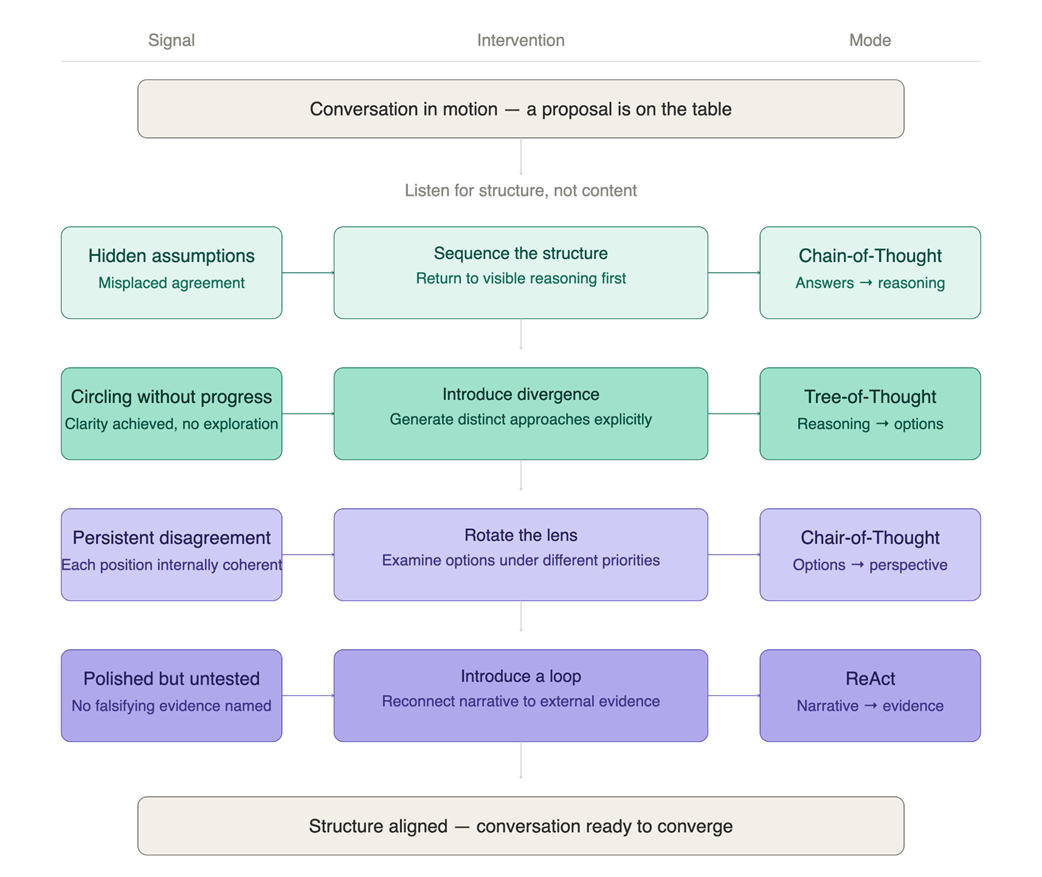
In live discussion, this becomes a practical skill of coordination: short phrases can shift the room from answers to reasoning, from reasoning to options, from options to perspective, or from narrative to evidence. The chapter also warns that even the right architecture can fail if the environment is hostile, such as when status pressure, time pressure, cognitive load, or attachment to ideas causes people to hide reasoning or resist change. So the deeper lesson is that effective leadership means not only choosing the right model, but using it lightly, timing interventions well, and recognizing when the surrounding conditions are undermining the structure itself.

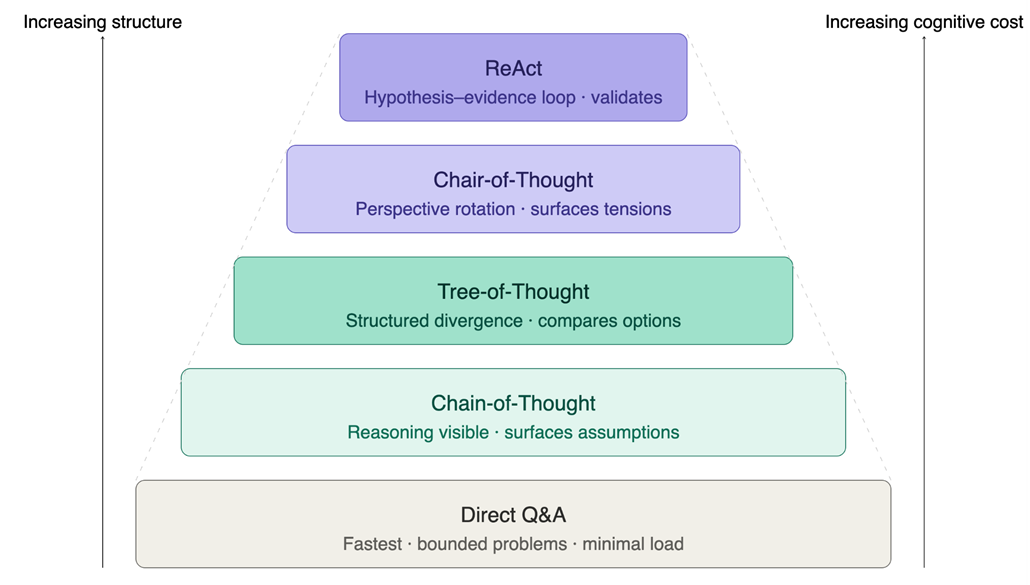
The reasoning models form a stack of increasing structure. Each layer adds a distinct capability, allowing teams to calibrate the depth of reasoning to the complexity and uncertainty of the problem being solved. Use only the layers required by the problem.
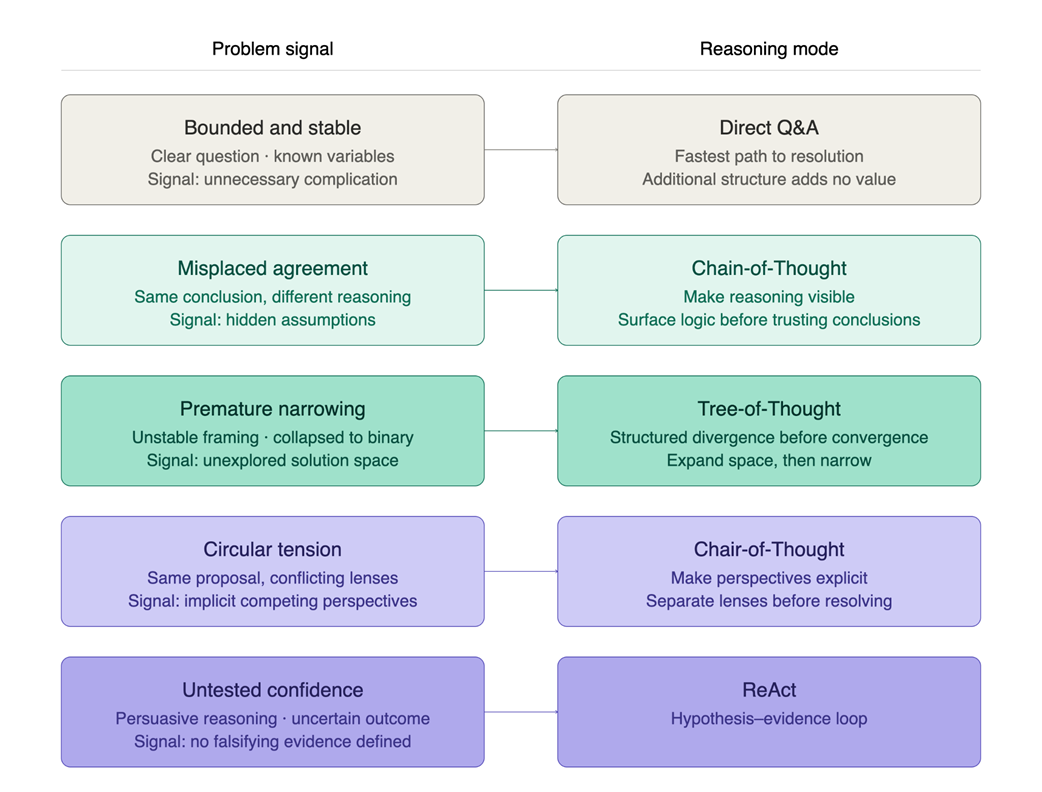
Diagnosing the shape of the problem allows you to commit to the appropriate reasoning mode.
Interventions require no formal declaration. A single sentence is sufficient to shift the reasoning mode to an appropriate layer.
Summary

  • Organizational friction often reflects mismatched reasoning architectures rather than disagreement about content.
  • The reasoning models form a stack that can be selected and layered according to problem shape.
  • Problem shape provides the diagnostic signal for selecting a reasoning mode: hidden assumptions, premature narrowing, perspective conflict, and untested confidence each require different structures.
  • Effective reasoning depends on applying the smallest sufficient architecture: enough structure to restore clarity, but not so much that the structure becomes overhead.
  • The stack is dynamic rather than sequential. Teams may move between modes as the problem unfolds, returning to simpler structures once clarity has been restored.
  • Leadership involves coordinating reasoning modes in real time through small structural interventions, framing phrases, and clear boundaries.
  • Common decision failures can be diagnosed as structural mismatches and corrected by shifting the reasoning architecture, rather than treating every problem as interpersonal conflict or poor execution.
  • Even the right architecture depends on environmental conditions that allow reasoning to function effectively.

FAQ

What is a model mismatch in team reasoning?Model mismatch happens when people in the same conversation are using different reasoning structures at once—such as one person pushing for a decision while another is unpacking assumptions, someone else is branching alternatives, and another is asking for evidence. Each mode can be valid, but together they create friction and stall progress.
Why do meetings often feel confusing even when everyone is being reasonable?Because the problem is often architectural rather than interpersonal. People may be reasoning coherently inside different models, but without a shared structure the conversation becomes circular, delayed, or frustrating. The issue is usually misalignment in reasoning mode, not lack of intelligence or effort.
What are the main reasoning modes in the stack described in this chapter?The chapter presents a stack of increasing structure: Direct Q&A, Chain-of-Thought, Tree-of-Thought, Chair-of-Thought, and ReAct. Each adds a distinct capability, from fast decision-making to visible reasoning, structured branching, perspective rotation, and evidence testing.
How do you know which reasoning model to use?Start by diagnosing the shape of the problem. Ask whether it is bounded, assumption-heavy, structurally ambiguous, perspective-contested, or hypothesis-driven with uncertain outcomes. The right model is the smallest sufficient architecture that fits that shape.
What does “the smallest sufficient architecture” mean?It means using only as much reasoning structure as the problem requires—no more and no less. If a problem is simple and stable, Direct Q&A may be enough. If hidden assumptions, multiple paths, conflicting lenses, or evidence uncertainty appear, add structure only to the extent needed to restore clarity.
What are common signals that a conversation needs a different reasoning mode?Common signals include fast agreement, binary debates, persistent conflict, growing certainty without testing, and repeated confusion. These can indicate compressed reasoning, premature narrowing, perspective mismatch, or insufficient validation.
How can a leader coordinate reasoning modes in live conversation?A leader can listen for the current structure, name the transition, and shift the discussion with a brief prompt. For example, they might say, “Let’s pause at the assumptions level,” or “What evidence would change our view?” Small interventions can move the room from answers to reasoning, or from reasoning to evidence.
Why is branching into multiple options not always the right next step?Because branching too early can create drift, overload, or endless exploration. If the group hasn’t yet surfaced assumptions, the better move is to make reasoning visible first. Branching is useful only when the problem truly has multiple viable paths.
What risks come from overusing reasoning structures?Overusing structure can create over-analysis, performative explanation, artificial role-play, delayed decisions, or excessive iteration. The chapter warns that structure can become theater if it is applied for status or rigor-signaling rather than problem-solving.
Why can the right reasoning model still fail?Because reasoning happens under real human conditions: pressure, time limits, status concerns, cognitive load, and emotional attachment. Even a well-chosen structure can collapse if the environment does not support it. So model selection is necessary, but not sufficient.

pro $24.99 per month

  • access to all Manning books, MEAPs, liveVideos, liveProjects, and audiobooks!
  • choose one free eBook per month to keep
  • exclusive 50% discount on all purchases
  • renews monthly, pause or cancel renewal anytime

lite $19.99 per month

  • access to all Manning books, including MEAPs!

team

5, 10 or 20 seats+ for your team - learn more


choose your plan

team

monthly
annual
$49.99
$499.99
only $41.67 per month
  • five seats for your team
  • access to all Manning books, MEAPs, liveVideos, liveProjects, and audiobooks!
  • choose another free product every time you renew
  • choose twelve free products per year
  • exclusive 50% discount on all purchases
  • renews monthly, pause or cancel renewal anytime
  • renews annually, pause or cancel renewal anytime
  • The Architecture of Reasoning ebook for free

choose your plan

team

monthly
annual
$49.99
$499.99
only $41.67 per month
  • five seats for your team
  • access to all Manning books, MEAPs, liveVideos, liveProjects, and audiobooks!
  • choose another free product every time you renew
  • choose twelve free products per year
  • exclusive 50% discount on all purchases
  • renews monthly, pause or cancel renewal anytime
  • renews annually, pause or cancel renewal anytime
  • The Architecture of Reasoning ebook for free