The chapter argues that decisions often feel reliable simply because they are narratively coherent, not because they have been tested against reality. In organizations, fluent explanations, social momentum, and early supporting metrics can all make an idea seem stronger than it is, while hidden assumptions remain unexamined. This creates a dangerous gap between a convincing story and a dependable outcome.
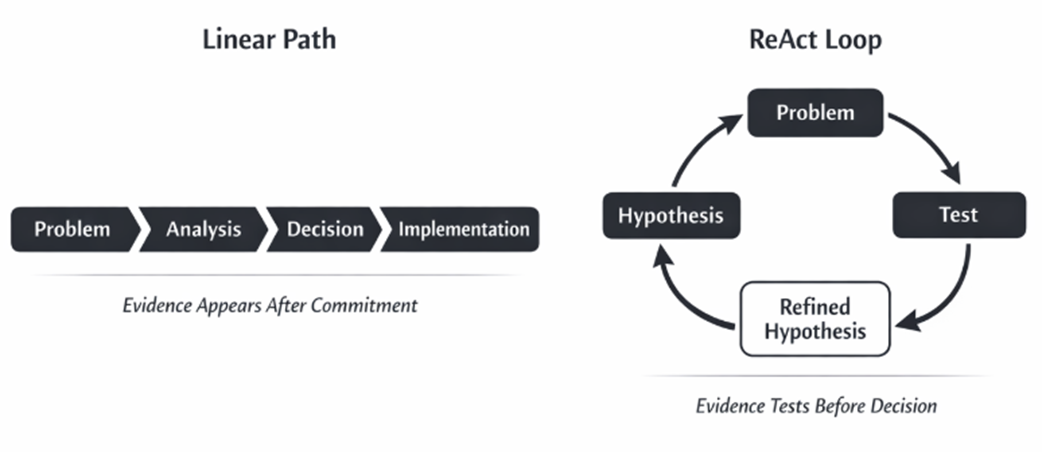
To address that gap, the chapter introduces ReAct as a loop of reasoning, acting, observing, and updating. Rather than treating conclusions as final, ReAct treats them as provisional hypotheses that must encounter evidence before commitment hardens. Deliberative reasoning adds the pause needed for this process by interrupting narrative momentum long enough to surface assumptions, define what would count as disconfirmation, and make adjustment part of the decision itself.
The chapter shows that ReAct is especially important when feedback is delayed, causality is ambiguous, decisions scale quickly, or social pressure makes reversal costly. Without evidence loops, organizations fall into predictable failures such as assumption drift, confirmation selection, performance theatre, and delayed recognition. The practical remedy is simple but disciplined: define the hypothesis, identify the key assumption, specify disconfirming signals, run a small test, set an observation window, and agree in advance how to respond if reality contradicts the story.
Linear vs looped reasoning. Coherence without testing becomes commitment. Testing before commitment becomes durability.
Summary
Coherent reasoning can still be wrong when it isn't required to encounter disconfirming evidence before commitment.
ReAct introduces a structural loop that treats conclusions as hypotheses, requiring interaction with reality before they stabilize.
Deliberation creates the conditions for this loop by interrupting narrative momentum and making assumptions explicit and testable.
Without evidence loops, reasoning drifts into predictable distortions such as assumption drift, confirmation selection, and performance theatre.
The model becomes necessary when feedback is delayed, causality is ambiguous, scale amplifies risk, or narrative and social pressure suppress challenge.
The goal is to shift when errors are discovered, reducing the cost of correction by testing before commitment deepens.
FAQ
What is ReAct in the context of deliberate reasoning?ReAct stands for reasoning and acting. It is a loop where a system or team reasons, takes an action to gather evidence, observes the result, and then updates the reasoning before moving forward. Its purpose is to prevent conclusions from hardening before they have been tested against reality.Why is ReAct useful for organizational decisions?ReAct is useful because organizations often face delayed feedback, complex dependencies, and strong social momentum that make coherent explanations feel true before they are verified. ReAct shortens the distance between explanation and evidence so decisions can be corrected earlier and at lower cost.How does ReAct differ from simply reasoning more carefully?Reasoning more carefully improves the quality of the explanation, but ReAct adds an evidence loop. It does not stop at coherence; it requires the reasoning to encounter reality before commitment. That makes it a correction mechanism, not just a thinking method.What is deliberative reasoning?Deliberative reasoning is the discipline of pausing before committing to a conclusion. It interrupts narrative momentum long enough to examine assumptions, alternatives, and causal links so that a plausible explanation does not become an untested certainty.Why do coherent narratives dominate human decisions?Humans naturally prefer explanations that connect events into a clear story. Coherence feels trustworthy, fluency makes ideas seem more credible, and group dynamics can reinforce the first plausible explanation. Over time, that narrative can be mistaken for evidence.What goes wrong when evidence loops are absent?Without evidence loops, several failure patterns appear: assumption drift, confirmation selection, performance theatre, and delayed recognition. These make teams keep defending a narrative even when reality is providing signals that it may be incomplete or wrong.When is ReAct most necessary?ReAct becomes especially important when feedback is delayed, causality is ambiguous, decisions operate at scale, or there is strong social pressure to stay the course. In those conditions, coherent reasoning can stabilize before it has been meaningfully tested.What are the core elements of a practical ReAct scaffold?A practical ReAct scaffold includes a hypothesis, a key assumption, a disconfirming signal, a test action, an observation window, and an adjustment rule. Together, these make the reasoning, the test, and the response to results explicit.Why is defining a disconfirming signal important?Defining a disconfirming signal in advance changes evidence from something interpreted after the fact into something that can interrupt the plan. It answers the question: what result would tell us this reasoning is wrong or incomplete?How did the AI support rollout example illustrate the need for ReAct?In the example, the rollout improved response times and reduced backlog, but customer satisfaction declined because the team had assumed speed was the main driver of satisfaction. ReAct would have required testing that assumption early, using a limited rollout and pre-defined disconfirming signals before scaling the solution.
pro $24.99 per month
access to all Manning books, MEAPs, liveVideos, liveProjects, and audiobooks!

 The Architecture of Reasoning ebook for free
